
Managing custom welding projects across international borders often feels like flying blind. custom welding projects 1 When our team in Vietnam receives a complex set of drawings, we know the client worries that silence equates to delays. You need visibility into the process without drowning in daily emails or micromanaging the shop floor, yet finding that balance is one of the hardest parts of remote sourcing.
For most custom welding orders, request a weekly status report to balance oversight with efficiency. However, increase this to daily updates for “hot” orders or safety-critical parts, and demand evidence at specific milestones like material receipt, tack welding, and final NDT inspection.
Let’s examine the exact reporting schedule that keeps projects on track and prevents late-stage surprises.
What specific details should I look for in a welding production status report?
We often see generic reports from sub-suppliers that simply say "on schedule" while hiding significant issues. In our Vietnam facility, we have learned that vague updates usually mean trouble is brewing, so we insist on granular data to ensure the aluminum lattice structures meet strict specifications. aluminum lattice structures 2
A comprehensive welding report must go beyond simple percentage completion. You should require specific data including material batch numbers, tack welding progress, current NDT pass/fail rates, and updated consumable inventory levels. This granular data reveals true production health.
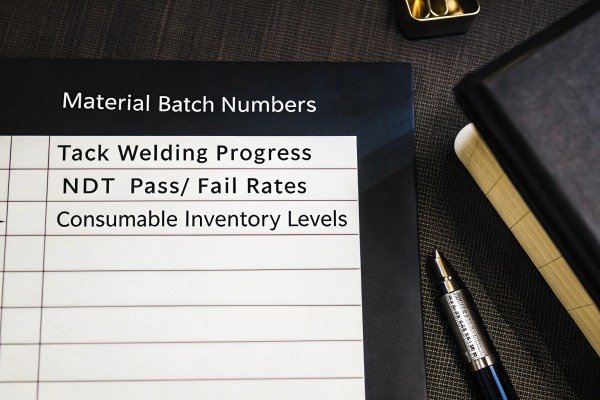
When you review a status report, you are not just checking a box; you are auditing the health of the manufacturing process remotely. A percentage complete figure is subjective and often optimistic. Instead, we train our quality engineers to demand hard data that correlates with physical progress and quality adherence.
Traceability and Material Validation
The first section of any robust report must cover traceability. For the aluminum extrusions used in your silver-colored frames, this means listing the specific heat numbers or batch lots currently on the cutting floor. If a supplier cannot link the current work-in-progress to a specific material test report (MTR), you have a traceability gap. In our internal audits, we look for confirmation that the Welding Procedure Specification (WPS) is being followed. Welding Procedure Specification (WPS) 3 Welding Procedure Specification 4 The report should explicitly state which WPS is active for the current batch.
Quality Metrics and Yield Rates
The most critical detail missing from standard reports is the First-Pass Yield (FPY). First-Pass Yield (FPY) 5 This metric tells you what percentage of welds passed inspection the first time they were tested. If a supplier reports 50% completion but fails to mention a 30% rejection rate on the lattice joints, your delivery date is in jeopardy. High rework rates consume unplanned labor hours and material. By asking for the FPY rate weekly, you can gauge if the shop floor is struggling with the geometry of your design.
Consumable Status
Finally, look for data on consumables. It sounds minor, but running out of specific welding wire or shielding gas is a common cause of unexpected delays in Asia. A good report will flag if consumable inventory drops below a safety stock level.
| Reporting Element | "Lazy" Report Entry | Actionable Report Entry |
|---|---|---|
| Progress | "Fabrication 40% complete" | "40% welded; 20 frames tack-welded; 10 frames in final NDT." |
| Quality | "Quality looks good" | "First-Pass Yield: 92%. 3 frames required rework due to porosity." |
| Material | "Material in stock" | "Using Aluminum Batch #AL-2044; Certs attached. Gas supply stable." |
| Risks | "No issues" | "Humidity high; increased pre-heating required to prevent porosity." |
Is a weekly update frequency sufficient for my custom welding orders?
Most of our US clients default to asking for weekly emails, but that rhythm does not fit every stage of the manufacturing lifecycle. When we ramp up a new frame design, a week is far too long to wait for feedback, whereas during bulk processing, it might be perfectly adequate.
Weekly updates differ by project phase and complexity. While weekly reporting suffices for standard production runs, you should require bi-weekly or daily updates during the initial setup and "golden sample" fabrication phases to catch dimensional errors immediately.

Determining the right frequency is about matching the information flow to the decision-making speed required. If a mistake happens on Monday and you do not hear about it until Friday, five days of production might need to be scrapped. This is particularly true for complex geometric designs like lattice frames where one dimensional error propagates through the entire structure.
The "Hot" Order Exception
When lead times are compressed—what we call "hot" orders—standard protocols must be abandoned. If the total production window is less than three weeks, a weekly report is useless because it covers 33% of the project's timeline. project's timeline 6 In these scenarios, we implement a daily "stand-up" email. This is a bulleted list sent at the end of the supplier’s shift (morning in the US) confirming exactly what moved that day. It keeps pressure on the production team and allows for instant course correction.
Phase-Dependent Scheduling
We advocate for a dynamic reporting schedule. During the Pre-Production Phase, updates should be event-based (e.g., "Material Arrived," "Tooling Finished"). During the First Article (Golden Sample) Phase, communication must be daily. You need to see photos of the first fit-up, the first root pass, and the final dimension check immediately. Once the sample is approved and Mass Production begins, you can throttle back to weekly reports. However, if the defect rate spikes, the frequency must automatically revert to daily until the process is stabilized.
Long-Lead Projects
For projects stretching over three months, weekly reports can actually become "noise." Purchasing managers often stop reading them carefully if nothing changes week to week. For these long-haul projects, we recommend a bi-weekly deep dive combined with a "management by exception" rule: report immediately if a milestone is missed, otherwise report every two weeks.
| Production Phase | Recommended Frequency | Key Focus Area |
|---|---|---|
| Material Procurement | Event-based | Confirmation of receipt and material grade verification. |
| First Article (PPAP) | Daily | Dimensional accuracy, weld aesthetics, fit-up gaps. |
| Ramp-Up | 2-3 times/week | Stabilizing the process, monitoring welder consistency. |
| Steady Production | Weekly | Output volume, yield rates, shipping schedule. |
| Final Finishing | Weekly | Surface treatment quality, packaging, MRB compilation. |
At which critical milestones should I demand photo evidence from the manufacturer?
We always tell our floor managers that a clear photo saves a thousand emails and prevents weeks of arguments. Sending a client a photo of a poor fit-up before the welder strikes an arc saves expensive rework, especially on aluminum frames where heat distortion is a constant risk.
You must demand high-resolution photo evidence at three critical junctures: material arrival to verify grades, post-tack welding to confirm dimensional fit-up, and after surface treatment. These visual checkpoints prevent covering up structural defects with paint or powder coating.

Requesting photos is not about distrust; it is about remote verification. In our experience, photos serve as a timestamped reality check that cuts through language barriers and cultural hesitation to report bad news.
The Fit-Up Stage (The Most Critical Check)
For a lattice-like design with multiple horizontal and vertical supports, the "tack weld" or fit-up stage is your point of no return. Once fully welded, correcting a twisted frame is nearly impossible without compromising the metal's integrity. We require our suppliers to send photos of the frame in the jig before final welding begins. We look for tight joint fit-up. If we see large gaps filled with weld wire, we know that joint will be weak and prone to failure. Seeing the frame clamped in the fixture provides assurance that the geometry is being controlled mechanically, not just by the welder’s hand.
Visualizing the Root Pass vs. Cap
For structural aluminum parts, the surface appearance can be deceiving. A beautiful "stack of dimes" cap weld can hide a lack of fusion at the root. While you cannot X-ray a part via email, you can ask for photos of the root pass on the first few units. Additionally, we ask for macro photos of the "stop and start" points of the welds. These are the most common locations for crater cracks.
The Hidden Danger of Surface Treatment
The final milestone for photo evidence is immediately after surface treatment (anodizing anodizing or painting 7 anodizing 8 or painting) but before packaging. This is to verify that the silver color matches the control sample and, more importantly, that no one is using paint to fill in undercut or porosity. undercut or porosity 9 We have seen suppliers try to use heavy powder coating to smooth out rough welds. High-resolution photos at this stage help you spot surface irregularities that suggest underlying quality issues.
Photo Evidence Checklist
- Raw Material: Close-up of the stencil/stamp on the aluminum extrusion.
- Fixture Setup: Wide shot showing the frame clamped in the welding jig.
- Tack Weld: Close-up of critical joints showing gap tolerance.
- Finished Weld (Raw): Macro shot of the weld bead before grinding or painting.
- Packaging: Photo of the parts inside the crate to verify dunnage and protection.
How can I use production updates to spot potential delays before they happen?
In our years managing supply chains across Vietnam and China managing supply chains 10, we have learned that silence or repetitive data is the loudest warning signal. When a sub-supplier stops reporting specific metrics or when the data looks "too consistent," our purchasing team knows a delay is likely imminent.
Analyze your reports for missing data or repetitive status descriptions, which often signal stalled progress. Specifically, watch for declining First-Pass Yield (FPY) rates or silence regarding consumable inventory, as these are leading indicators of upcoming production stoppages.

To the untrained eye, a report might look normal, but specific patterns predict disaster. You need to shift from reading reports passively to analyzing them for "negative space"—what is not being said.
Analyzing Yield Rates as a Leading Indicator
The most accurate predictor of a schedule slip is the rework rate. If a supplier plans to weld 100 frames a day but is rejecting 20% of them, they are effectively only producing 80. Over a month, this deficit accumulates massively. If the report shows "Production Quantity: 100" but "Passed QC: 80," do not look at the 100; look at the 80. A declining FPY rate usually means tool wear, welder fatigue, or a bad batch of material. If you spot this trend early, you can force the supplier to pause and fix the root cause before they miss the shipping deadline.
Inventory Red Flags
We mentioned consumables earlier, but here is how to use them to spot delays. If a report stops updating the "Material On Hand" field, or if the value remains static for three weeks while production is supposedly moving, the data is fake, or they are about to run out. Welding gas and specific filler metals often have lead times of their own. If a supplier runs out of Argon gas, the line stops instantly. We always ask, "Do you have enough consumables to finish the current PO?" If the answer becomes vague, we send someone to the factory floor.
Workforce Consistency
Another subtle indicator is the number of welders active on your line. If previous reports listed "5 Welders" and suddenly it lists "3 Welders" without explanation, your capacity just dropped by 40%. In Asia, labor turnover can be high, especially around holidays like Tet or Chinese New Year. A drop in headcount is a guaranteed delay unless they add overtime.
| Warning Sign in Report | Likely Operational Reality | Recommended Action |
|---|---|---|
| Static Completion % | Production has halted; waiting for parts or repair. | Call immediately; demand a photo of today's production. |
| Rising Rework Rate | Tooling is drifting or welders are fatigued. | Request a "Quality Stand-down" meeting. |
| Missing Material Data | They may have used wrong material or lost traceability. | Demand MTRs for the current batch immediately. |
| Reduced Headcount | Workers moved to a "more urgent" client's project. | Reiterate delivery penalties; demand full staffing. |
Conclusion
Determining the right reporting frequency is not about filling your inbox; it is about establishing a rhythm that ensures transparency and accountability. By shifting from passive weekly updates to active, data-driven monitoring—especially during critical phases like tack welding and first-article inspection—you gain control over the outcome. Remember to look for the subtle warning signs in the data, such as yield drops or labor shortages, to prevent delays before they impact your supply chain.
Footnotes
1. The American Welding Society sets global standards for welding project management and certification. ↩︎
2. Wikipedia provides a general overview of lattice structures in engineering and design. ↩︎
3. ASME Section IX is the authoritative standard defining Welding Procedure Specifications. ↩︎
4. AWS is the leading authority for welding procedure specifications and standards. ↩︎
5. ASQ provides the standard industry definition and calculation methods for First-Pass Yield. ↩︎
6. PMI establishes global standards for project scheduling and timeline management. ↩︎
7. Wikipedia provides background on the electrochemical process used for finishing aluminum parts. ↩︎
8. The Aluminum Anodizers Council is the leading industry authority on anodizing standards. ↩︎
9. TWI is a premier research organization explaining common weld defects like porosity. ↩︎
10. CSCMP is the premier professional association for supply chain management best practices. ↩︎


 English
  Español de México
  Deutsch
  Français
  Русский
  العربية