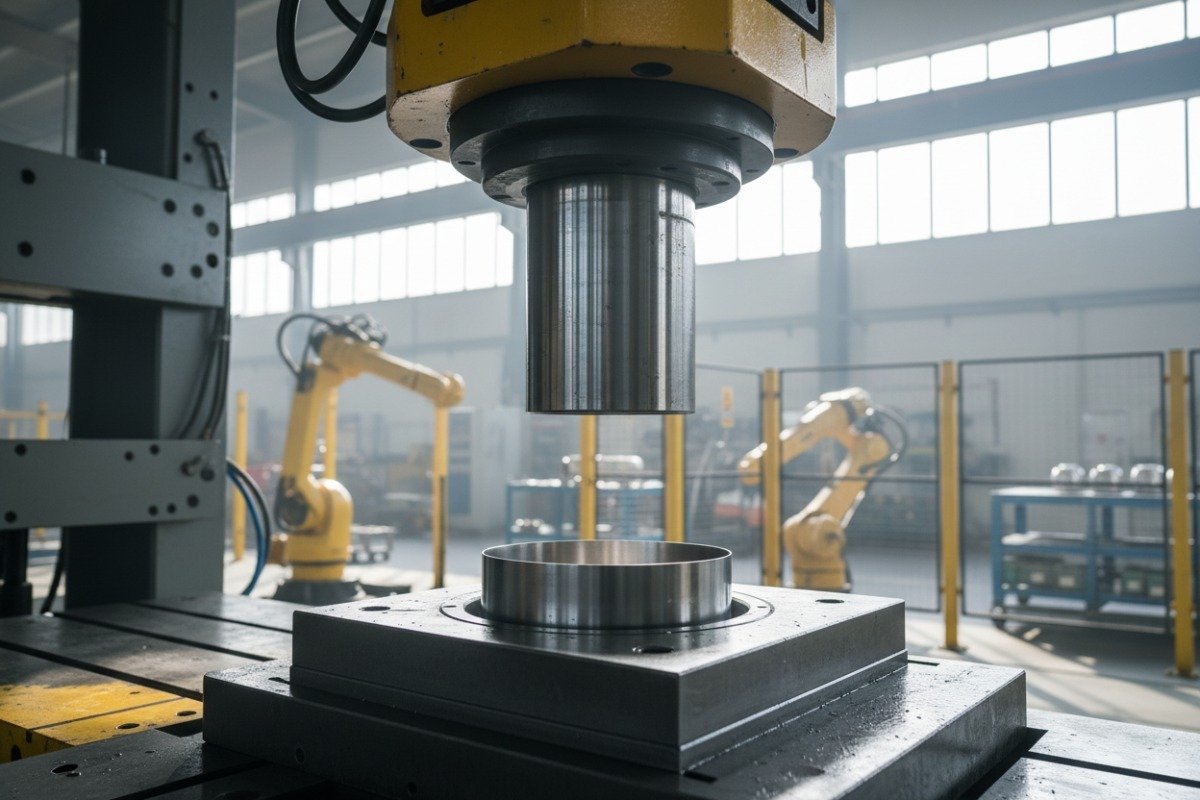
Every week, our project team reviews RFQs from U.S. buyers who need seamless hollow metal parts but aren't sure which forming process fits best cold-forming process 1. The confusion is real. Choosing the wrong method means wasted tooling budgets, missed deadlines, and parts that fail inspection.
Deep draw stamping is a cold-forming process that uses a punch and die to transform flat sheet metal blanks into seamless, hollow three-dimensional components whose depth exceeds their diameter. Sourcing quality deep drawn parts requires evaluating supplier certifications, tooling expertise, quality control rigor, and supply chain resilience.
This guide walks you through the core mechanics of deep draw stamping, how to judge if it's right for your project, what certifications matter, how to cut per-unit costs through smarter design, and what quality control you should demand from any supplier flat sheet metal blanks 2. Let's dig in.
How Do I Determine If Deep Draw Stamping Is the Most Cost-Effective Method for My Metal Parts?
Our engineers field this question almost daily. A client sends over a drawing for a cylindrical housing or a cup-shaped enclosure, and the first thing we do is run a cost comparison across forming methods. Picking the wrong process up front can lock you into high per-unit costs for the entire production life of that part.
Deep draw stamping is most cost-effective when your part is hollow, seamless, and produced in medium-to-high volumes. It reduces material waste compared to CNC machining, eliminates welding seams, and amortizes tooling costs across large runs, making it ideal for cylindrical or cup-shaped components.

When Deep Drawing Beats Other Methods
The decision starts with geometry. If your part has a depth greater than its radius and needs to be seamless, deep drawing is almost always the answer. Turned parts made on a CNC lathe require a solid bar or rod of raw material. The machine cuts away most of that material to create the hollow shape. That means you pay for metal you throw away. Deep drawing starts with a flat blank and forms it into shape. Very little material is wasted.
Welded assemblies 3 are another alternative. You can cut flat pieces, bend them, and weld them together. But every weld is a potential failure point. Welds can crack under stress or fatigue. They also require secondary finishing to look clean. Deep drawn parts have no seams at all. They are stronger and look better out of the press.
Cost Drivers to Evaluate
Here are the main factors that determine whether deep drawing saves you money:
| Cost Factor | Deep Draw Stamping | CNC Machining 4 | Welded Assembly |
|---|---|---|---|
| Tooling cost | High upfront | Low upfront | Low upfront |
| Material waste | Very low (5–15%) | High (40–70%) | Moderate (15–30%) |
| Per-unit cost at 10,000+ pcs | Low | High | Moderate |
| Seam/weld finishing | Not needed | Not needed | Required |
| Cycle time per part | Fast (seconds) | Slow (minutes) | Moderate |
| Structural integrity | Excellent (seamless) | Excellent | Weaker at joints |
The table makes it clear. If your annual volume is above a few thousand pieces, deep drawing wins on per-unit cost. The tooling investment is real—custom dies and punches can cost thousands of dollars—but that cost spreads thin across large batches.
Volume Thresholds Matter
For very low volumes—say, 50 to 200 pieces—CNC machining or even hydroforming might be cheaper because you avoid the tooling expense. But once you cross into the thousands, deep drawing becomes hard to beat. We've seen clients save 30–40% on per-unit costs by switching from machined parts to deep drawn parts at volumes above 5,000 units per year.
Material Compatibility Check
Not every metal is suitable for deep drawing. The material needs to be ductile enough to stretch without tearing. Common choices include stainless steel (304, 316), low carbon steel, aluminum (1100, 3003, 5052), brass, and copper. If your design calls for a very hard or brittle alloy, deep drawing may not work, and you'll need to explore alternatives.
The Break-Even Calculation
Ask your supplier to provide a break-even analysis. This shows the exact volume at which deep drawing becomes cheaper than machining or fabrication. A good supplier will run this calculation for you during the quoting stage. If they can't or won't, that's a red flag about their engineering capability.
The bottom line: deep draw stamping is your best bet when you need seamless hollow parts in medium-to-high volumes, made from ductile metals 5, with consistent quality across every single piece.
What Key Certifications Should I Look for When Choosing a Deep Draw Stamping Partner for My Business?
When we onboard a new supplier in Vietnam or elsewhere in Asia for a deep draw project, the first documents we request are certifications. Certifications aren't just wall decorations. They tell you whether a factory has real systems in place—or whether they're winging it and hoping for the best.
Look for ISO 9001 as a baseline quality management certification. For automotive parts, require IATF 16949. For medical components, demand ISO 13485. Additional certifications like ISO 14001 (environmental) and NADCAP (aerospace) signal advanced capability and commitment to process control.

Why Certifications Matter More Than You Think
A certification like ISO 9001 6 means the factory has documented procedures for every step—from incoming material inspection to final packaging. It means they conduct internal audits. It means there's a corrective action process when something goes wrong. Without this foundation, you're relying on individual people to remember the right steps every time. People forget. Systems don't.
We've audited factories that claimed "ISO equivalent" processes but had no actual certification. In almost every case, we found gaps: no incoming material test reports, no in-process inspection records, no traceability from raw material to finished part. "Equivalent" is not the same as "certified."
Certification Guide by Industry
| Industry | Required Certification | Why It Matters |
|---|---|---|
| General industrial | ISO 9001:2015 | Baseline quality management system |
| Automotive | IATF 16949 7:2016 | Covers PPAP, APQP, FMEA, SPC requirements |
| Medical devices | ISO 13485 8:2016 | Ensures traceability and biocompatibility controls |
| Aerospace | AS9100D / NADCAP | Addresses special process controls and flight safety |
| Environmental compliance | ISO 14001:2015 | Demonstrates responsible waste and energy management |
| Export to EU | CE marking / REACH / RoHS | Material and safety compliance for European markets |
Beyond the Certificate: What to Verify
A certificate on the wall is step one. Step two is verifying that the factory actually follows its own procedures. Here's what we check during supplier audits:
- Scope of certification. Make sure the certificate covers deep draw stamping specifically, not just "metal fabrication" in general. A factory certified for laser cutting may not have controls in place for forming operations.
- Certification body. Is the auditing body accredited? Look for accreditation from IAF (International Accreditation Forum) member bodies. Certificates from unknown or unaccredited auditors carry less weight.
- Expiration date. Certifications expire. An expired ISO 9001 certificate means the factory hasn't been audited recently. That's a concern.
- Surveillance audit records. ISO standards require annual surveillance audits between full recertification cycles. Ask to see the latest surveillance audit report.
PPAP and APQP: The Automotive Gold Standard
If your parts go into automotive applications—or if you simply want the highest level of process discipline—look for suppliers who follow PPAP (Production Part Approval Process) 9 and APQP (Advanced Product Quality Planning). These frameworks require the supplier to prove, with documented evidence, that their process can consistently produce parts within specification before mass production begins.
Even outside the automotive world, we apply PPAP principles to our deep draw projects. It catches problems before they become expensive. A supplier who understands PPAP is a supplier who takes quality seriously.
How Can I Optimize My Component Design to Reduce Material Waste and Lower My Per-Unit Costs?
Our design engineering team spends a lot of time reviewing client drawings before we even quote a project. Small changes in geometry—a slightly larger corner radius, a different wall angle—can mean the difference between a smooth single-draw operation and a costly multi-stage process with high scrap rates.
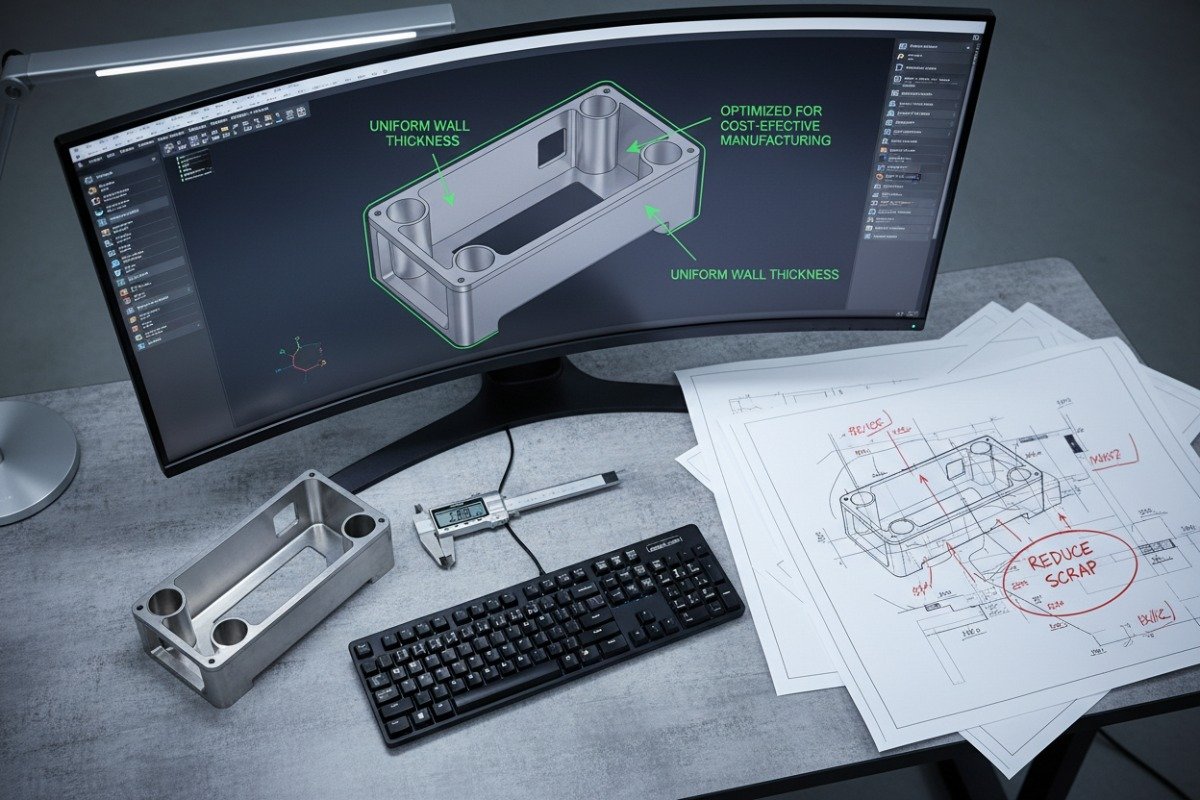
Optimize deep draw designs by using generous corner radii, maintaining uniform wall thickness, keeping the draw ratio below 2:1 for single draws, and selecting standard blank sizes. These adjustments reduce tooling complexity, minimize material waste, and significantly lower per-unit production costs.
The Draw Ratio Rule
The draw ratio is the relationship between the blank diameter and the finished part diameter. A ratio of 2:1 or less can usually be achieved in a single draw. Go beyond that, and you need redraw stages. Each additional stage means another die, more press time, and higher cost.
Here's a practical reference:
| Draw Ratio (Blank Dia ÷ Part Dia) | Number of Draws Needed | Cost Impact |
|---|---|---|
| 1.5:1 or less | 1 draw | Lowest cost |
| 1.5:1 to 2.0:1 | 1–2 draws | Low to moderate cost |
| 2.0:1 to 2.5:1 | 2–3 draws | Moderate cost |
| 2.5:1 to 3.0:1 | 3–4 draws | Higher cost |
| Above 3.0:1 | 4+ draws | Highest cost, risk of defects |
If your part requires a very deep draw, consider whether you can split it into two components that are joined later. Sometimes a two-piece design is cheaper than a five-stage deep draw.
Corner Radii: The Silent Cost Driver
Sharp corners are the enemy of deep drawing. When the punch forces metal into a tight corner, the material has to stretch dramatically. This causes thinning, which can lead to cracks and tears. The result? Higher scrap rates and slower production speeds.
A general rule: the inside corner radius should be at least equal to the material thickness. Larger radii are even better. If your design currently specifies a 0.5mm radius on a 1.0mm thick part, increasing that to 1.0mm or 1.5mm can reduce your reject rate significantly.
Wall Thickness Uniformity
Deep drawing naturally causes some variation in wall thickness. The bottom of the part tends to stay close to the original blank thickness, while the sidewalls thin slightly as the metal stretches. Designing with this in mind helps. Avoid specifying extremely tight wall thickness tolerances on the sidewalls unless your application truly requires it. Tighter tolerances mean more inspection, more rejects, and higher cost.
Blank Size Optimization
Work with your supplier to optimize the blank size relative to standard coil widths. If your blank can be nested efficiently on a standard coil, you minimize edge trim waste. A blank that's just slightly too large for efficient nesting on a 1,000mm coil might fit perfectly on a 1,200mm coil—or vice versa. This is a conversation worth having early in the design phase.
Use FEA Simulation Before Cutting Steel
Finite Element Analysis (FEA) software 10 can simulate the entire deep draw process digitally. It predicts where thinning, wrinkling, or tearing will occur. It shows how the metal flows during each draw stage. Running a simulation before building the die saves enormous time and money. We use simulation on every complex project. It typically costs a fraction of what a failed first tool run would cost.
Practical Design Tips Summary
- Keep draw depth as shallow as your application allows.
- Use radii of at least 1× material thickness on all corners.
- Avoid unnecessary features (holes, slots) in the drawn area—add them as secondary operations.
- Specify realistic tolerances. Tighter than needed just adds cost.
- Consult your supplier's engineering team during the design phase, not after it's finalized.
Good design for manufacturability (DFM) is the single biggest lever you have to control cost. A 10-minute conversation with an experienced tooling engineer can save thousands of dollars over the life of a production program.
What Quality Control Processes Should I Expect from My Supplier to Ensure My Components Meet Tight Tolerances?
When we manage deep draw stamping projects for our U.S. clients, the quality control plan is something we build before production starts—not something we figure out after the first shipment fails incoming inspection. Too many buyers learn this lesson the hard way. They receive a container of parts, find 8% out of spec, and then scramble to negotiate returns or rework.
Expect your supplier to provide incoming material inspection, first article inspection (FAI), in-process SPC monitoring, final dimensional inspection with CMM equipment, and full traceability documentation. A robust QC system catches defects at the source and ensures every part meets your drawing specifications.

Incoming Material Inspection
Quality starts before the press even runs. Your supplier should verify every incoming coil or sheet of metal against the material certificate (mill cert). This means checking chemical composition, mechanical properties (tensile strength, yield strength, elongation), and physical dimensions (thickness, width). If the raw material is out of spec, every part made from it will be out of spec too.
We require our suppliers to perform thickness measurements at multiple points across each coil and to retain samples for traceability. If a quality issue surfaces months later, we can trace it back to the exact coil and heat number.
First Article Inspection (FAI)
Before mass production begins, the supplier should produce a small batch of parts from the production tooling and measure them against every dimension on the drawing. This is the First Article Inspection. It proves that the tooling, the material, and the process settings all work together to produce conforming parts.
A proper FAI report includes:
- Measured values for every dimension on the drawing
- Pass/fail status for each dimension
- Material test report for the specific coil used
- Photos of the part from multiple angles
- Any deviations noted and dispositioned
If your supplier can't produce a thorough FAI report, they probably can't control quality during mass production either.
In-Process Statistical Process Control (SPC)
During production, critical dimensions should be monitored using SPC. This means the operator measures samples at regular intervals—say, every 50 or 100 parts—and plots the results on a control chart. SPC detects drift before it becomes a defect. If a dimension is trending toward the upper specification limit, the operator can adjust the press before parts go out of tolerance.
Key SPC metrics to ask about:
- Cp and Cpk values. A Cpk of 1.33 or higher means the process is capable and centered. Below 1.0 means the process is not capable of consistently meeting your tolerance.
- Control chart frequency. How often are samples measured? Every 30 minutes? Every 100 parts? More frequent is better for tight tolerances.
Final Inspection and CMM Measurement
After production, a final inspection should cover dimensional checks, visual inspection, and any functional requirements. For tight-tolerance deep drawn parts, Coordinate Measuring Machine (CMM) inspection is essential. A CMM can measure complex geometries to micron-level accuracy, far beyond what manual gauges can achieve.
Your supplier should provide an inspection report with every shipment. This report should reference the drawing revision, list all measured dimensions, and include the actual measured values—not just "pass" or "fail."
Traceability and Documentation
Full traceability means you can trace any finished part back to its raw material source, production date, machine, operator, and inspection results. This is critical for industries like automotive and medical, but it's good practice for any application. If a field failure occurs, traceability lets you determine the scope of the problem quickly.
What a Complete QC System Looks Like
Here's a summary of what you should expect at each stage:
| Production Stage | QC Activity | Deliverable |
|---|---|---|
| Raw material receiving | Mill cert verification, thickness check | Material test report |
| Tooling setup | First Article Inspection | FAI report with full dimensional data |
| Mass production | SPC on critical dimensions | Control charts, Cp/Cpk data |
| Post-production | CMM final inspection, visual check | Inspection report per shipment |
| Packaging & shipping | Packaging audit, labeling check | Packing list, traceability records |
Don't Assume—Verify
The most important thing you can do as a buyer is verify. Visit the factory or send an auditor. Review actual inspection records, not just the quality manual. Ask to see control charts from a recent production run. A supplier who welcomes this scrutiny is a supplier who has nothing to hide.
We conduct final inspections on behalf of our clients before any shipment leaves the factory. This extra layer of verification has prevented countless quality escapes over the years. It costs a little more upfront but saves far more in rejected shipments, production line stoppages, and damaged customer relationships.
Conclusion
Deep draw stamping is a powerful process for producing seamless, high-precision hollow metal components. Sourcing success depends on choosing the right process, verifying certifications, optimizing design, and demanding rigorous quality control from your supplier.
Footnotes
1. Provides a general overview of cold forming in metallurgy. ↩︎
2. Explains sheet metal blanking, which produces flat blanks for forming. ↩︎
3. Describes complex welded assemblies in industrial manufacturing. ↩︎
4. Provides a comprehensive overview of the CNC machining process. ↩︎
5. Discusses key properties and best metals for deep drawing, emphasizing ductility. ↩︎
6. Official ISO page for the ISO 9001 quality management system standard. ↩︎
7. Official IATF page providing information about the IATF 16949 standard. ↩︎
8. Wikipedia provides an overview of ISO 13485 for medical devices. ↩︎
9. Found a comprehensive guide to PPAP from Fictiv, which references the Automotive Industry Action Group (AIAG). ↩︎
10. Ansys provides a clear explanation of FEA and its applications. ↩︎

 English
 Español de México
 Deutsch
 Français
 Русский