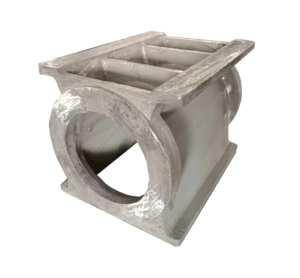
If Iron is the backbone of industry, Steel Casting is the muscle. When a part needs to withstand extreme tension, high pressure, or corrosive chemicals that would shatter iron or melt aluminum, steel is the only answer.
What sets steel apart is its toughness. While iron is great at being squeezed (compression), steel is the king of being pulled (tension). It is the most versatile alloy group in the foundry, capable of being “tuned” through chemistry and heat treatment to be as soft as copper or as hard as a drill bit.
Most steel casting projects fall into two distinct categories based on the environment they will live in:
1. Carbon & Low-Alloy Steel (The Workhorse) Used for structural integrity. These alloys are categorized by their carbon content.
Low Carbon: Great weldability and ductility.
High Carbon: Exceptional hardness and wear resistance, perfect for mining and construction tools.
Key Specs: Tensile strengths ranging from 400 MPa to over 1000 MPa depending on heat treatment.
2. Stainless Steel (The Protector) When rust and corrosion are not an option. By adding Chromium (at least 10.5%) and Nickel, the steel becomes immune to most environmental attacks.
304/316 Grade: The gold standard for food processing, medical tools, and marine hardware.
Duplex Steel: Offers double the strength of standard stainless with even higher corrosion resistance for oil and gas applications.
Steel has a much higher melting point than iron or aluminum (up to 1600°C), which requires specialized refractory materials and processes:
Investment Casting (Lost Wax) When you need “jewelry-level” precision for industrial parts. We create a wax model, coat it in ceramic, melt the wax out, and pour the steel in.
Best for: Small, complex parts (valves, aerospace components, firearms).
Surface Finish: Excellent; often requires no further machining.
Sand Casting For the giants of industry. We use high-strength resin sands to hold the weight of molten steel.
Best for: Heavy equipment frames, pump housings, and railway components.
Capability: Can produce parts weighing from a few kilograms to several tons.
The true magic of steel casting happens after the metal cools. Unlike most other cast metals, steel’s internal grain structure can be completely rearranged through thermal processing:
Annealing: Softens the metal for easier machining.
Quenching & Tempering: Creates a “hard shell” with a “tough core,” allowing a part to resist surface wear while absorbing massive impacts without snapping.
Pro-Tip for Designers: > Steel shrinks significantly more than iron as it cools (about 2%). To avoid internal “shrinkage cavities,” we use large “risers” (reservoirs of molten metal) during the pour. Always design your steel parts with “directional solidification” in mind—tapering walls from thin to thick toward the feed source.
Is your part headed for a high-pressure subsea environment or a heavy-duty construction site? I can help you select the exact alloy chemistry and heat treatment cycle to ensure your steel casting never fails under load.
Contact us to evaluate manufacturability, tolerances, and cost for your specific application.
 English English
 Español de México
 Deutsch
 Français
 Русский
 العربية English English Español de México Deutsch Français Русский العربية
We will contact you within 24 hrs, please pay attention to the email with the suffix “@dewintech.com”. Your privacy is safe, we won’t use your email for any other purposes. Download NDA