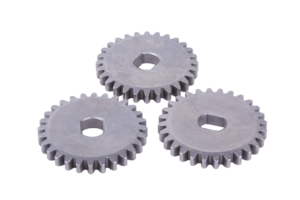
When your project demands the rust-proof performance of stainless steel but the part geometry is too complex for cost-effective machining, Stainless Steel Powder Metallurgy (PM) is the solution. It combines the chemical resilience of high-alloy steel with the “net-shape” efficiency of the sintering process.
Unlike standard steel PM, stainless steel powders are harder and require higher compaction pressures and specialized vacuum sintering furnaces to prevent oxidation during the “baking” process.
| Grade | Series Type | Key Characteristic | Typical Application |
| SS-303 / 316 | Austenitic | Best Corrosion Resistance. Non-magnetic and highly ductile. | Medical tools, marine hardware, food prep |
| SS-410 / 430 | Ferritic | Magnetic. Good balance of strength and corrosion resistance. | Sensor housings, automotive trim |
| SS-440 | Martensitic | Highest Hardness. Can be heat-treated for wear resistance. | Cutlery, surgical instruments, bearings |
In Stainless PM, the final properties are heavily dictated by the Sintering Atmosphere. We typically use pure Hydrogen or Vacuum environments to ensure the chromium in the steel doesn’t react with oxygen, which would ruin its “stainless” properties.
Corrosion Resistance: To match the performance of wrought (solid) stainless steel, we aim for High Density (over 7.0 g/cm³). Low-density PM parts have open pores that can trap moisture and lead to “pitting” corrosion.
Mechanical Strength: Sintered stainless steel provides excellent tensile strength (up to 600 MPa) and impressive elongation, meaning the parts can take a hit without shattering.
Surface Finish: Out of the furnace, stainless PM parts have a clean, matte gray finish. They can be tumbled, polished, or even electropolished to achieve a mirror-like shine.
Eliminate Secondary Ops: Features like hexagonal holes, internal splines, and complex cams that are nightmares to mill in “tough” stainless steel are created in a single press stroke.
High-Volume Savings: If you are making 10,000+ stainless sensors or valves, PM reduces the “cost per part” significantly by eliminating the high cost of stainless steel scrap.
If your stainless steel part is extremely small (under 20g) and has the complexity of a plastic injection molded part, we might suggest Metal Injection Molding (MIM). MIM uses a finer powder and a binder to achieve 98% theoretical density, offering even higher corrosion resistance than traditional press-and-sinter PM.
[Image comparing a traditional PM gear and a high-complexity MIM stainless steel part]
Is your part exposed to salt spray or harsh chemicals? I can help you choose between a 316L for maximum protection or a 400-series for magnetic sensing and higher strength.
Contact us to evaluate manufacturability, tolerances, and cost for your specific application.
 English English
 Español de México
 Deutsch
 Français
 Русский
 العربية English English Español de México Deutsch Français Русский العربية
We will contact you within 24 hrs, please pay attention to the email with the suffix “@dewintech.com”. Your privacy is safe, we won’t use your email for any other purposes. Download NDA