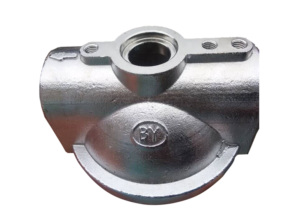
If you strip down a modern electric vehicle or a high-end smartphone, you’ll find Aluminum at its core. It is the “MVP” of the casting world because it offers the ultimate trade-off: the strength of steel at only one-third of the weight.
Aluminum casting thrives in environments where heat is the enemy and weight is the obstacle. Its natural ability to form a protective oxide layer also means it fights off corrosion without needing expensive surface treatments.
In the foundry, we don’t just use “aluminum”—we choose a specific “recipe” (alloy) based on your part’s mission. Here is how the most common players stack up:
| Performance Feature | ADC12 (The All-Rounder) | A380 (The Industry Standard) | A356 (The Strength King) |
| Best For | Complex, thin-walled parts | Most US-based automotive parts | Structural, heavy-duty parts |
| Ease of Casting | Highest (Flows perfectly) | Very High | Moderate (Gravity casting) |
| Heat Dissipation | 96 W/m.K | 96 – 100 W/m.K | 150 W/m.K |
| Tensile Strength | 310 MPa | 320 MPa | 230 – 280 MPa (after T6) |
| Typical Part | 5G Housings, ECU cases | Brackets, Engine covers | Car wheels, Aerospace nodes |
Aluminum isn’t just “poured”; it is engineered. Depending on your part’s complexity and volume, we utilize different “paths” to the final product:
High-Pressure Die Casting (HPDC): Think of this as “injection molding for metal.” We force molten aluminum into a steel die at massive speeds. Result: Incredible precision, thin walls ($1.5\text{mm}$), and high-volume output.
Gravity & Low-Pressure Casting: Perfect for thicker, structural parts that need to be air-tight. It allows for heat treatment (T6), which can double the metal’s strength.
Sand Casting: The “Old School” hero. Best for massive parts (like engine blocks) or low-volume prototypes where you want to avoid expensive steel tooling.
Why Aluminum “Sings” in Electronics:
Aluminum is a thermal sponge. In the 5G and LED industries, we use it to cast massive heat sinks with intricate fins. It pulls heat away from sensitive chips faster than almost any other castable metal, ensuring your tech doesn’t melt under pressure.
Aluminum is a beautiful canvas. Unlike some metals that look dull after casting, aluminum can be:
Anodized: For a hard, sapphire-like colorful surface.
Powder Coated: For heavy-duty outdoor protection.
Sandblasted: For a premium, matte “MacBook-style” texture.
Are you trying to shed weight from a mechanical assembly without losing stiffness? Let’s look at your 3D model—I can suggest where to add “ribs” to the design so we can use a thinner, lighter aluminum wall without sacrificing strength.
Contact us to evaluate manufacturability, tolerances, and cost for your specific application.
 English English
 Español de México
 Deutsch
 Français
 Русский
 العربية English English Español de México Deutsch Français Русский العربية
We will contact you within 24 hrs, please pay attention to the email with the suffix “@dewintech.com”. Your privacy is safe, we won’t use your email for any other purposes. Download NDA