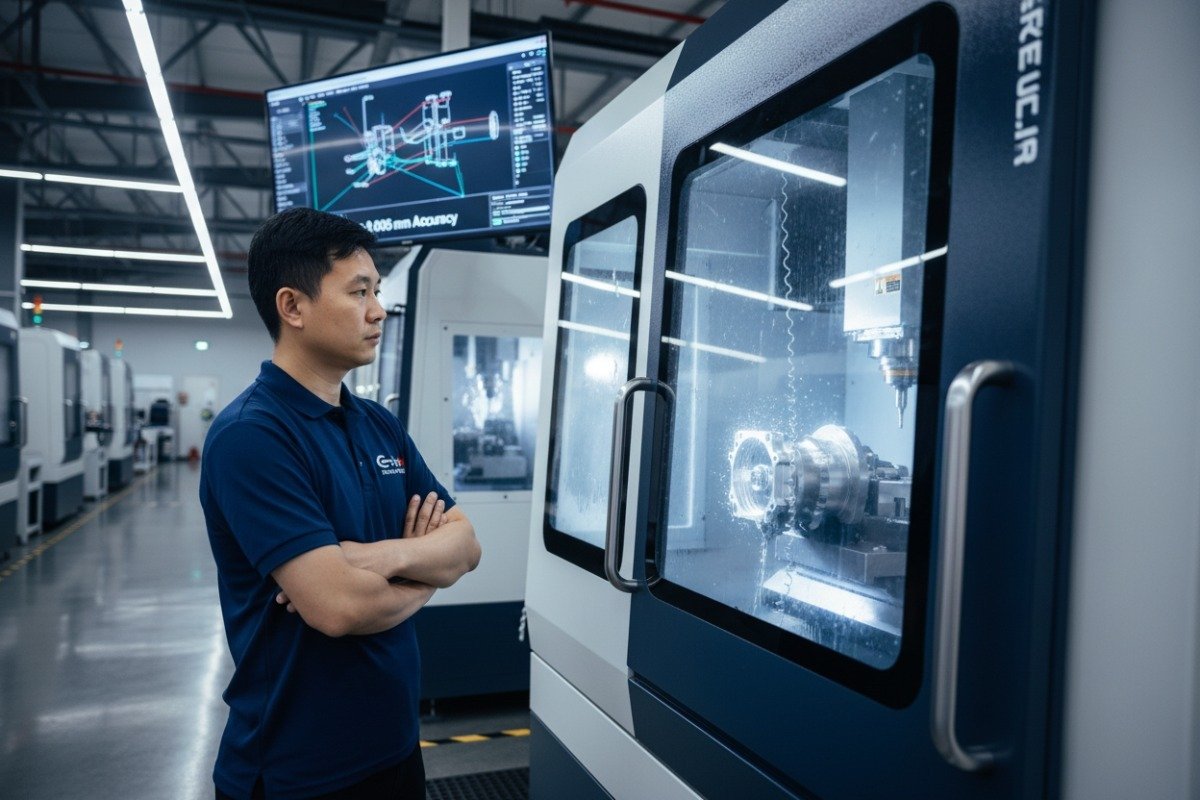
Every week, our engineering team reviews tolerance deviation reports from production runs. The pattern is clear. Most failures trace back to decisions made long before the spindle starts turning — material choice, design intent, and partner selection.
Precision CNC machining achieves tolerances as tight as ±0.005 mm by combining CAD/CAM programming, multi-axis machine capability, proper material selection, and rigorous in-process inspection. Success depends on design optimization, experienced machining partners, and strict quality control at every stage of production.
In this guide, we break down the four critical areas that determine whether your precision CNC machining project hits spec or misses the mark. Each section draws from real production experience and practical data. Let's dig in.
What Factors Should I Consider When Choosing a Precision CNC Machining Partner for My Business?
Our team in Vietnam and China has audited over 200 machining suppliers in the last five years. The gap between a capable partner and an unreliable one often comes down to a handful of measurable factors that many buyers overlook.
When choosing a precision CNC machining partner, evaluate their ISO certifications, multi-axis machine capabilities, material expertise, quality control processes, communication responsiveness, and payment flexibility. A strong partner delivers "right first time" results, meets delivery schedules, and provides transparent project management throughout production.
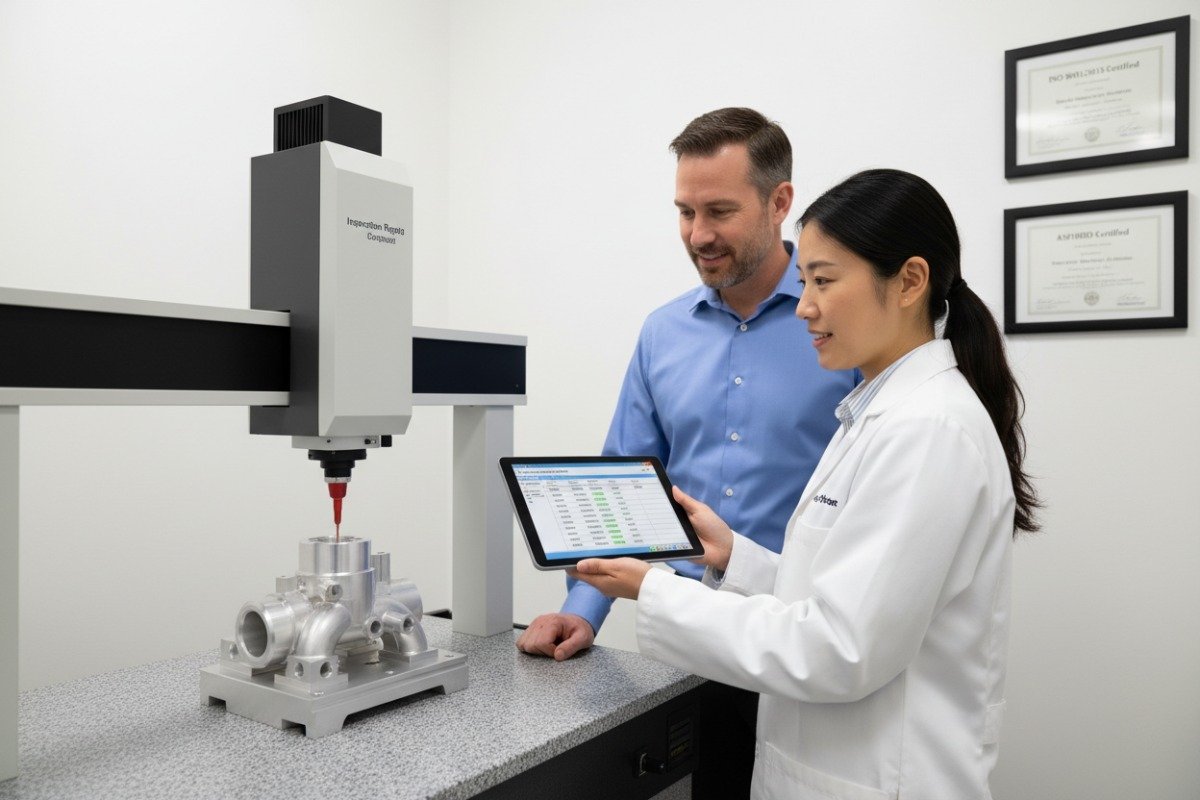
Why Certifications Matter More Than You Think
Certifications are not just wall decorations. An ISO 9001 certification 1 means the supplier follows a documented quality management system. For aerospace parts, AS9100 2 is non-negotiable. For medical components, ISO 13485 is the baseline.
We have seen buyers skip this step. They find a shop with low prices and fast quotes. Then the first shipment arrives with 12% rejection rates. The rework costs more than the savings.
Machine Capability and Capacity
Not all CNC shops are equal. A shop with only 3-axis mills cannot produce the compound angles your turbine housing requires. You need to ask specific questions:
- How many 5-axis machines 3 do they operate?
- What is their spindle speed range?
- Do they have Swiss lathes 4 for small, intricate parts?
- What is their maximum workpiece size?
| Factor | Basic Shop | Mid-Tier Partner | Premium Partner |
|---|---|---|---|
| Machine Axes | 3-axis only | 3-axis and 4-axis | 3, 4, and 5-axis + Swiss lathes |
| Tolerance Capability | ±0.05 mm | ±0.02 mm | ±0.005 mm or tighter |
| Certifications | None or basic | ISO 9001 | ISO 9001 + AS9100 / ISO 13485 5 |
| Inspection Equipment | Calipers, micrometers | CMM (manual) | CMM (automated) + optical scanners |
| Communication | Slow, reactive | Responsive | Proactive with DFM feedback |
| Payment Terms | 100% upfront | 50/50 | Net 60–90 days available |
Communication and Project Management
This is where many sourcing relationships break down. When we manage projects for U.S. clients, we assign a dedicated project engineer who reviews every drawing detail before production starts. Critical dimensions get flagged. GD&T callouts get verified. Questions get asked early — not after 5,000 parts are already cut.
A good partner does not just take your drawing and disappear for six weeks. They come back with questions. They suggest design improvements. They send first article inspection reports (FAIR) before running the full batch.
The Payment Terms Question
Cash flow matters. Many overseas suppliers demand 100% payment before shipping. This puts all the risk on the buyer. Our approach is different. We offer open account terms — Net 60 to Net 90 — for qualified clients. This aligns incentives. We only get paid when you are satisfied with the delivered product.
Ask potential partners about their payment structure. Flexibility here signals confidence in their own quality.
How Can I Optimize My Designs to Lower My Precision CNC Machining Costs?
When our engineers review incoming drawings from new clients, we often spot opportunities to cut 15–30% off production costs without changing the part's function. Small design tweaks make a big difference at the machine.
To lower precision CNC machining costs, simplify geometries, avoid unnecessarily tight tolerances on non-critical features, use standard tool sizes for holes and radii, minimize deep pockets, and design for fewer setups. These changes reduce cycle time, tool wear, and scrap rates while maintaining part performance.
Tolerances: Tight Where It Matters, Relaxed Where It Doesn't
This is the single biggest cost driver we see. A drawing that calls out ±0.01 mm on every dimension forces the machinist to slow down, use finer tools, and run more inspection passes. But most features do not need that level of precision.
Apply tight tolerances only to mating surfaces, bearing fits, and sealing interfaces. Let non-critical dimensions float to standard machining tolerances of ±0.1 mm. This alone can cut cycle time by 20–40%.
| Tolerance Level | Typical Application | Relative Cost Impact | Inspection Method |
|---|---|---|---|
| ±0.1 mm (standard) | Non-critical surfaces, clearance holes | 1x (baseline) | Calipers, go/no-go gauges |
| ±0.025 mm (precision) | Mating surfaces, bearing bores | 2–3x | CMM |
| ±0.005 mm (ultra-precision) | Aerospace fits, medical implants | 5–10x | CMM + optical measurement |
Design for Fewer Setups
Every time the operator repositions the workpiece, it adds time and introduces potential error. A part that requires four setups costs significantly more than one that needs two.
Think about how the part will be held in the vise or chuck. Design flat reference surfaces. Avoid features that require the part to be flipped multiple times. If possible, consolidate features so a 5-axis machine can reach them in a single setup.
Standard Tool Sizes Save Money
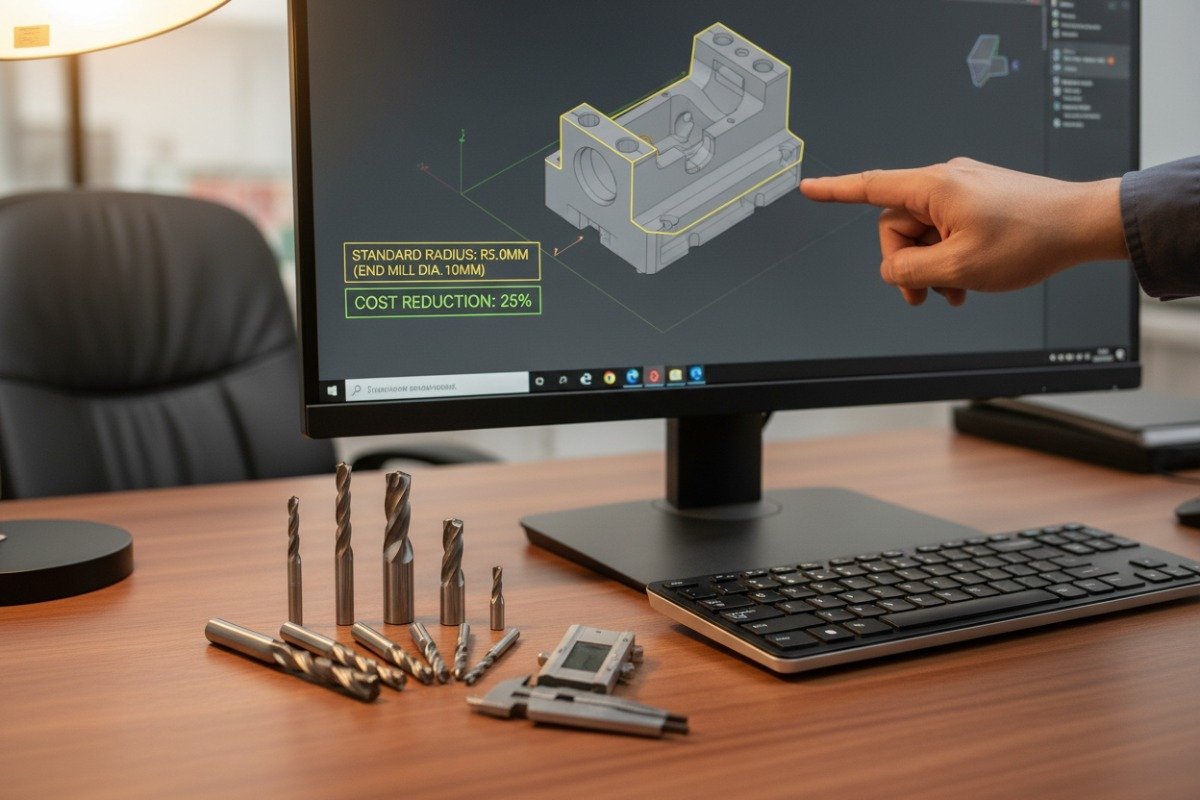
Custom tooling is expensive. If your design calls for a 4.7 mm radius in an internal corner, the shop needs a special end mill. Change that to 5 mm, and they can use a standard tool off the shelf.
The same applies to hole sizes. Standard drill sizes (in metric or imperial increments) are cheaper and faster than custom reamers. Here are common guidelines:
- Internal corner radii: Use standard end mill diameters (3 mm, 4 mm, 5 mm, 6 mm, etc.)
- Hole depths: Keep depth-to-diameter ratio below 4:1 when possible
- Wall thickness: Minimum 0.8 mm for metals, 1.5 mm for plastics
- Thread sizes: Use standard metric or UNC/UNF threads
Avoid Deep Pockets and Thin Walls
Deep pockets require long tools that deflect and chatter. This slows the feed rate and increases scrap risk. If your design has a pocket deeper than 4x the tool diameter, expect higher costs.
Thin walls vibrate during cutting. This causes poor surface finish and dimensional drift. Design walls at least 0.8 mm thick for aluminum and 1.0 mm for steel.
Material Selection Affects Machining Cost Too
Softer materials cut faster. Aluminum 6061 machines roughly 3x faster than stainless steel 316 7. Titanium is even slower and eats through tooling. Choose the easiest-to-machine material that still meets your functional requirements.
We often help clients switch from 304 stainless to 303 stainless for non-corrosion-critical parts. The machinability improvement is dramatic, and the cost drops by 15–25%.
Which Materials Are Best Suited for My High-Precision CNC Machining Requirements?
Our production teams work with dozens of materials every month — from common aluminum alloys to exotic nickel superalloys. The right material choice depends on your part's function, environment, and required tolerances.
The best materials for high-precision CNC machining include aluminum 6061 and 7075 for lightweight parts, stainless steel 303 and 316 for corrosion resistance, titanium Ti-6Al-4V for aerospace strength, brass C360 for electrical components, and engineering plastics like PEEK for chemical resistance. Each material offers distinct machinability, tolerance capability, and cost profiles.
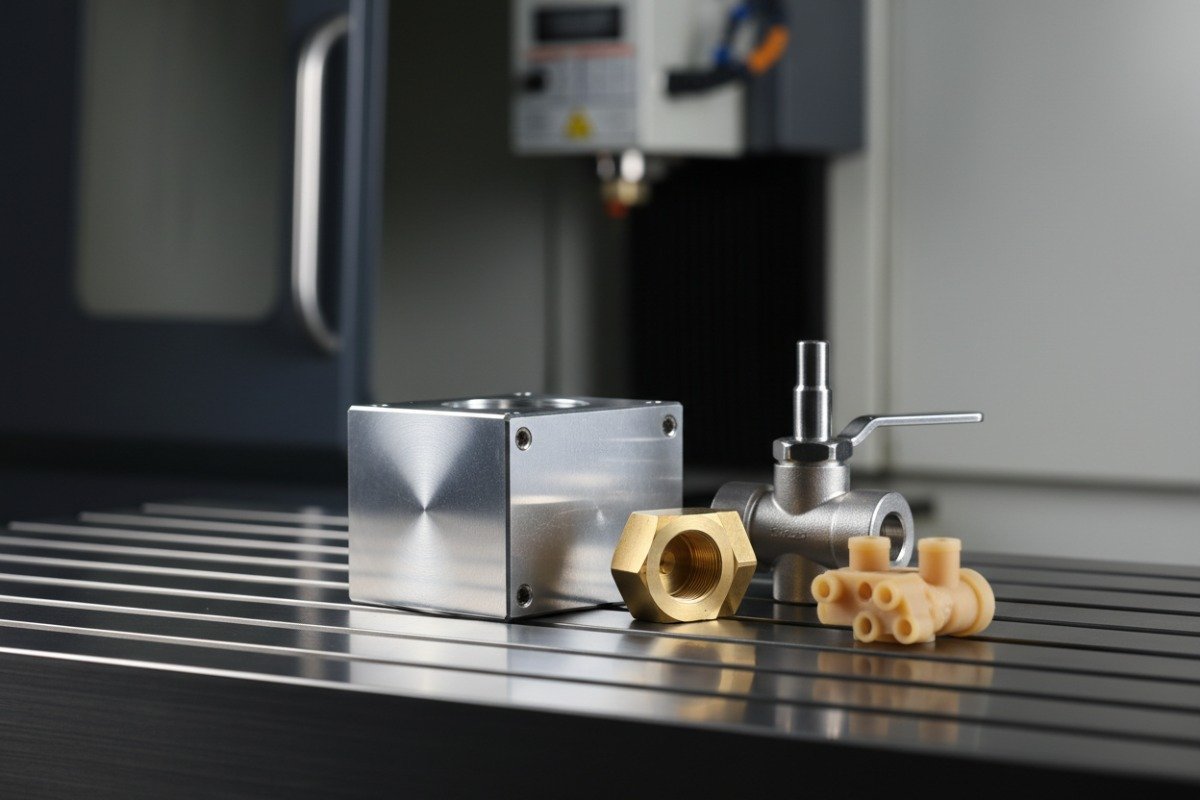
Metals: The Workhorses of Precision Machining
Most precision CNC parts are metal. But "metal" is a broad category. The differences between alloys are significant.
Aluminum alloys are the most popular choice for precision work. They cut fast, produce excellent surface finishes, and hold tight tolerances well. Aluminum 6061-T6 8 is the general-purpose workhorse. Aluminum 7075-T6 offers higher strength for aerospace and structural applications.
Stainless steel is essential when corrosion resistance matters. Grade 303 is the free-machining variant — it contains sulfur that helps chips break cleanly. Grade 316 offers better corrosion resistance but is harder to machine. Grade 17-4 PH provides high strength after heat treatment.
Titanium delivers the best strength-to-weight ratio but is notoriously difficult to machine. It generates extreme heat at the cutting edge, causes rapid tool wear, and tends to gall. Successful titanium machining requires rigid setups, sharp carbide or ceramic tools, and aggressive coolant strategies. Our shops use high-pressure through-spindle coolant systems specifically for titanium work.
Brass and copper alloys machine beautifully. Brass C360 (free-cutting brass) is one of the easiest metals to machine. It produces clean edges, holds tight tolerances, and is ideal for electrical connectors, valve bodies, and fittings.
| Material | Machinability Rating | Achievable Tolerance | Relative Cost | Common Applications |
|---|---|---|---|---|
| Aluminum 6061-T6 | Excellent | ±0.005 mm | Low | Housings, brackets, heat sinks |
| Aluminum 7075-T6 | Very Good | ±0.005 mm | Medium | Aerospace structures, jigs |
| Stainless Steel 303 | Good | ±0.01 mm | Medium | Shafts, fittings, fasteners |
| Stainless Steel 316 | Fair | ±0.015 mm | Medium-High | Marine, medical, food processing |
| Titanium Ti-6Al-4V | Poor | ±0.01 mm | High | Aerospace, medical implants |
| Brass C360 | Excellent | ±0.005 mm | Medium | Connectors, valve bodies |
| PEEK | Good | ±0.02 mm | Very High | Chemical processing, medical |
| Delrin (POM) | Excellent | ±0.01 mm | Low | Gears, bushings, insulators |
Engineering Plastics for Special Applications
Not every precision part needs to be metal. Engineering plastics like PEEK, Delrin (POM), Ultem, and Nylon 66 serve critical roles in medical devices, chemical processing, and electrical insulation.
PEEK stands out for its chemical resistance, high-temperature stability (up to 250°C continuous), and biocompatibility. It machines well but costs 10–20x more than aluminum per kilogram. We recommend it only when metal alternatives cannot meet the functional requirements.
Delrin is a cost-effective choice for gears, bushings, and sliding components. It has low friction, good dimensional stability, and machines cleanly with sharp tools.
Thermal Expansion: The Hidden Challenge
Every material expands when it heats up during machining. This thermal expansion can push dimensions out of tolerance if not managed properly.
Aluminum expands roughly twice as much as steel per degree of temperature change. For ultra-tight tolerance work (±0.005 mm or tighter), our machinists control the shop floor temperature and allow parts to cool to 20°C before final inspection.
Titanium's low thermal conductivity concentrates heat at the cutting zone. This causes localized expansion that distorts thin features. The solution is light cuts, sharp tools, and plenty of coolant.
Material Certification and Traceability
For aerospace and medical applications, material traceability is mandatory. Every bar of metal must come with a mill certificate showing chemical composition, mechanical properties, and heat lot number.
We maintain full material traceability from raw stock to finished part. This is not optional for our clients in defense and medical — it is a regulatory requirement under AS9100 and ISO 13485.
How Do I Ensure My Precision CNC Machining Project Meets Tight Tolerances?
When we calibrate our CNC machines each morning, the process follows a strict protocol — spindle warm-up, probe verification, and test cuts on reference blocks. Tolerances are not achieved by accident. They are the result of disciplined process control from start to finish.
To ensure your precision CNC machining project meets tight tolerances, implement a complete process chain: validate designs with DFM review, select appropriate machine types and tooling, control environmental conditions, use in-process measurement, and perform final CMM inspection with documented first article reports before full production.
Start with Design for Manufacturability (DFM)
Tolerance problems often start in the design phase. A feature that looks fine in CAD may be impossible to hold in tolerance on the shop floor.
Before any metal is cut, our engineers run a DFM review. Design for Manufacturability (DFM) 9 We check every critical dimension against the planned machining process. Can the tool reach that feature? Will the part deflect under cutting forces? Is the datum scheme practical for fixturing?
This review catches problems early. Fixing a tolerance issue in CAD costs nothing. Fixing it after 500 parts are machined costs thousands.
Machine Selection and Setup
Different machines deliver different levels of precision. A general-purpose 3-axis mill can hold ±0.05 mm reliably. A high-end 5-axis machine with linear scales and thermal compensation can hold ±0.005 mm.
For ultra-precision work, Swiss-type lathes are essential. Their guide bushing supports the workpiece close to the cutting point, minimizing deflection and vibration. This is how we achieve tolerances under 0.01 mm on long, slender parts like medical pins and aerospace fasteners.
Setup matters just as much as the machine itself. Proper workholding prevents the part from shifting during cutting. We use custom fixtures, vacuum chucks, and hydraulic clamps depending on the part geometry and material.
In-Process Measurement
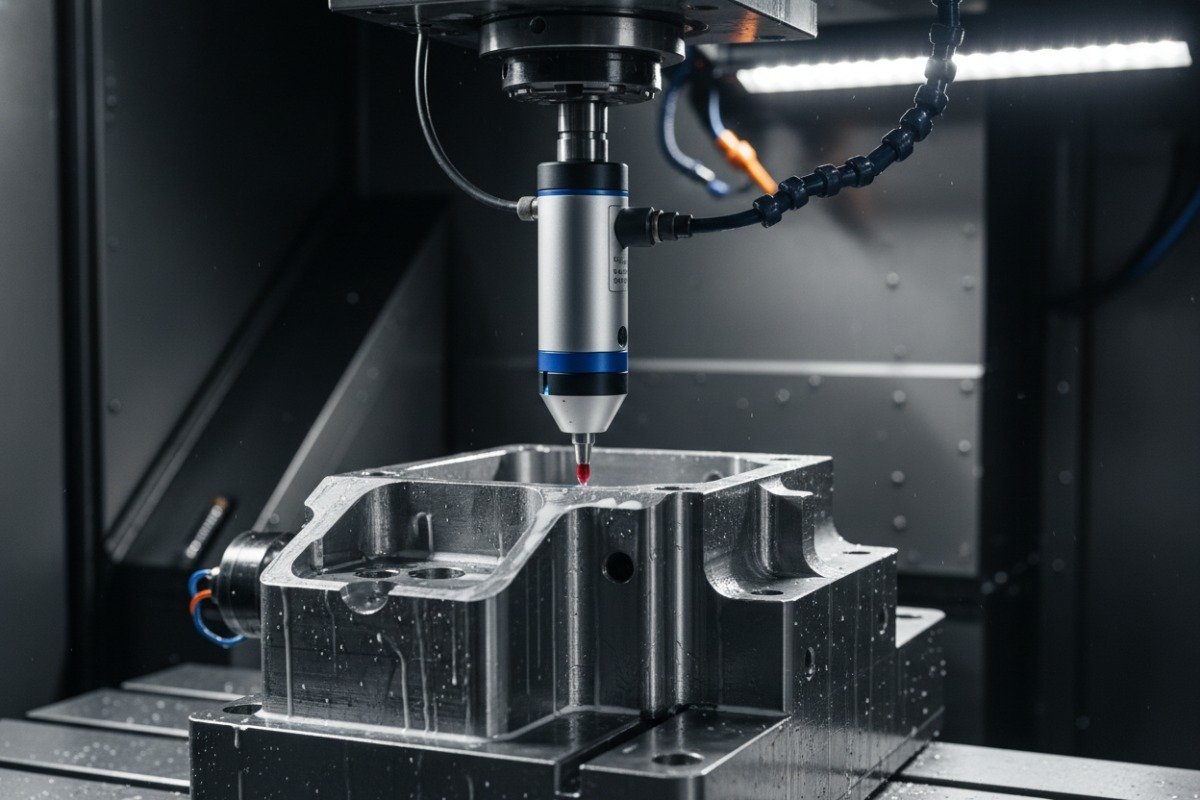
Waiting until the part is finished to check dimensions is too late. Modern precision machining uses in-process probing to verify critical features during the cut.
Touch probes mounted in the spindle measure part dimensions between operations. If a dimension drifts, the machine automatically applies a tool offset correction. This closed-loop feedback keeps tolerances on track throughout the entire run.
For high-volume production, statistical process control (SPC) 10 charts track dimensional trends in real time. If the data shows a drift toward the tolerance limit, the operator intervenes before any parts go out of spec.
Environmental Control
Temperature changes cause parts and machines to expand or contract. A 5°C temperature swing in the shop can shift dimensions by 0.01 mm or more on a steel part.
Precision machining facilities maintain shop floor temperatures at 20°C ±1°C. Some shops go further, using temperature-controlled coolant systems and allowing parts to thermally stabilize before final inspection.
Vibration is another environmental factor. Precision machines are isolated from floor vibrations using anti-vibration pads or dedicated foundations. Heavy truck traffic outside the building, or a stamping press on the next floor, can ruin a precision cut.
Final Inspection and Documentation
The last line of defense is final inspection. Every precision part should be measured on a calibrated CMM (coordinate measuring machine) against the drawing requirements.
For first articles, we generate a full PPAP (Production Part Approval Process) package that includes:
- Dimensional inspection report with actual vs. nominal values
- Material certification with chemical and mechanical test results
- Surface finish measurements
- Visual inspection records
- Process flow diagram and control plan
This documentation gives our clients confidence that the process is capable and repeatable before we run the full production quantity.
Common Causes of Tolerance Failure
Even with good processes, things can go wrong. Here are the most common causes we see:
- Tool wear: Dull tools deflect and produce oversized features. Regular tool life monitoring prevents this.
- Thermal drift: Machine and part temperatures change during long runs. Thermal compensation and mid-run probing address this.
- Fixturing errors: Loose clamps or misaligned fixtures shift the part. Custom fixtures and setup verification eliminate this risk.
- Programming errors: Wrong tool offsets or incorrect G-code cause dimensional errors. Simulation and first-piece verification catch these before production.
- Material inconsistency: Variations in hardness or composition between material batches affect cutting behavior. Mill certificates and incoming material inspection ensure consistency.
Conclusion
Precision CNC machining success comes down to four pillars: choosing the right partner, optimizing your design, selecting the best material, and implementing disciplined process control from drawing to delivery.
Footnotes
1. Official information on the ISO 9001 quality management system standard. ↩︎
2. Provides details on the AS9100 quality management system for the aerospace industry. ↩︎
3. Explains the capabilities and advantages of 5-axis CNC machining technology. ↩︎
4. Describes the function and precision benefits of Swiss-type lathes. ↩︎
5. Official standard for quality management systems in the medical device industry. ↩︎
6. Details the process and importance of Coordinate Measuring Machine (CMM) inspection. ↩︎
7. Provides information on the characteristics and applications of Stainless Steel 316. ↩︎
8. Offers properties and common uses of Aluminum 6061-T6 alloy. ↩︎
9. Explains the principles and importance of Design for Manufacturability in product development. ↩︎
10. Defines Statistical Process Control and its application in quality assurance. ↩︎

 English
 Español de México
 Deutsch
 Français
 Русский
 العربية