
Finding a reliable metal stamping partner is harder than it sounds. We have managed sourcing projects for dozens of U.S. buyers, and the wrong choice leads to scrap, delays, and blown budgets.
To choose the best metal stamping services, evaluate each manufacturer's press capabilities, quality certifications like ISO 9001, in-house tooling, material expertise, and scalability. Compare total cost—including tooling, logistics, and defect risk—not just per-part price. Prioritize suppliers with proven experience in your specific industry.
Below, we break down the four critical areas you need to assess before signing any contract. Each section gives you practical steps, benchmarks, and tables so you can make a confident decision. Let's dig in.
How Do I Evaluate the Technical Capabilities and Equipment of a Potential Metal Stamping Manufacturer?
Our engineering team reviews supplier equipment lists on every new project. We have seen firsthand how a mismatch between press tonnage and part geometry leads to cracked parts and wasted tooling budgets.
Evaluate a metal stamping manufacturer's technical capabilities by reviewing their press tonnage range, die types (progressive, compound, transfer), material versatility, in-house tooling shop, and secondary operations like deburring or welding. Request a facility audit and sample run before committing to production volumes.
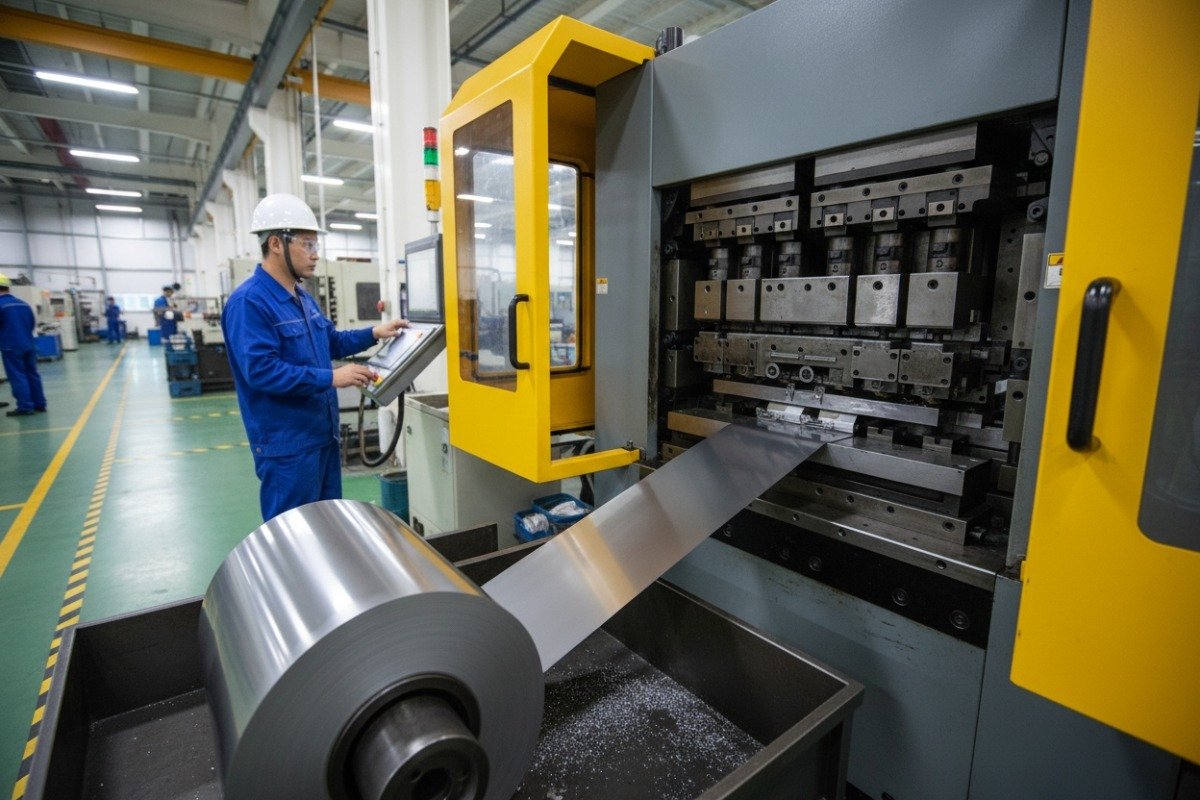
Why Press Tonnage and Speed Matter
Press tonnage determines the maximum force a machine can apply. If your part requires deep drawing, you need higher tonnage—sometimes 200 to 400 tons. If your parts are thin brackets or electrical contacts, a high-speed progressive press running at 600+ strokes per minute is more efficient.
Ask the supplier for a complete equipment list. Look for the following details:
- Number of presses and their tonnage range
- Maximum bed size
- Stroke speed (strokes per minute)
- Feed line automation (coil feeders, servo feeds)
A manufacturer with only a few small presses cannot handle large or complex parts. On the other hand, a shop with only heavy presses may not be cost-effective for small, simple components.
Die Types and Their Applications
Different die types serve different purposes. Here is a quick comparison:
| Die Type | Best For | Volume Suitability | Typical Tolerance |
|---|---|---|---|
| Progressive Die 1 | High-volume, multi-feature parts | Millions of parts per year | ±0.001"–±0.005" |
| Compound Die | Complex geometries, flat parts | Medium to high volume | ±0.002"–±0.005" |
| Transfer Die | Large or deep-drawn parts | Medium volume | ±0.005"–±0.010" |
| Fine Blanking 2 | Ultra-precise edges, no secondary finishing | Medium to high volume | ±0.0005"–±0.002" |
Progressive dies are the workhorse of high-volume stamping. They perform multiple operations—blanking, piercing, bending, forming—in a single pass. Compound dies handle parts that need simultaneous operations on both sides. Transfer dies move the part between stations and work well for larger geometries.
In-House Tooling vs. Outsourced Tooling
This is a critical factor. A manufacturer that designs and builds dies in-house has far more control over quality, lead time, and cost. When tooling is outsourced, costs can inflate by 30% or more, and any modification requires coordination between two companies. That slows everything down.
Ask directly: "Do you have an in-house tool and die shop?" Then ask how many toolmakers they employ and what CAD/CAM software they use.
Secondary Operations and Value-Added Services
Metal stamping rarely produces a finished part on its own. Most parts need secondary work. Common secondary operations include:
- Deburring and tumbling
- Spot welding or projection welding
- Tapping and hardware insertion
- Plating, painting, or powder coating
- Laser cutting and waterjet cutting
A supplier that offers these services under one roof saves you time and shipping costs. It also reduces the risk of damage during transit between vendors.
Material Versatility
Your supplier should have experience stamping the specific material your part requires. Common stamping materials include carbon steel, stainless steel, aluminum, brass, copper, and phosphor bronze. Each material behaves differently under the press. Aluminum tears easily if the die clearance is wrong. Stainless steel work-hardens and wears tooling faster.
Ask for sample parts in your target material. Review their surface finish and dimensional accuracy. That tells you more than any brochure.
What Quality Certifications Should I Look for to Ensure My Metal Stamping Parts Meet Industry Standards?
When we audit suppliers across Vietnam and other Asian countries, the first documents we request are quality certifications. Without them, there is no baseline for accountability.
Look for ISO 9001:2015 as the minimum quality certification for any metal stamping supplier. For automotive parts, require IATF 16949. For aerospace, demand AS9100. Also verify the supplier's use of PPAP, SPC, and FMEA processes to ensure consistent quality and defect rates below 1,000 PPM.

The Core Certifications Explained
Not all certifications carry the same weight. Here is what each one means for you as a buyer:
| Certification | Industry Focus | What It Proves |
|---|---|---|
| ISO 9001:2015 3 | General manufacturing | Documented quality management system with continuous improvement |
| IATF 16949 4 | Automotive | Meets strict automotive quality requirements including defect prevention |
| AS9100 5 | Aerospace | Traceability, risk management, and configuration control for flight-critical parts |
| ISO 14001 | Environmental | Commitment to environmental management and waste reduction |
| ISO 13485 | Medical devices | Quality system designed for medical device manufacturing regulations |
70% of OEMs now prioritize ISO-certified suppliers. The reason is simple. Certification means the supplier has a documented system for catching problems before they reach your dock.
Beyond the Certificate: Process-Level Quality Controls
A certificate on the wall is not enough. You need to verify that the supplier actually uses robust quality tools on the shop floor. Here are the key ones:
PPAP (Production Part Approval Process): This is standard in automotive but valuable in any industry. PPAP 6 requires the supplier to prove—with data—that their process can consistently produce parts to your specifications before mass production begins. It includes dimensional reports, material certifications, process flow diagrams, and control plans.
SPC (Statistical Process Control): SPC 7 uses real-time data from the production line to monitor critical dimensions. If a measurement trends toward the tolerance limit, the operator corrects it before producing bad parts. Ask the supplier if they use SPC charts and how often they sample.
FMEA (Failure Mode and Effects Analysis): FMEA 8 identifies what could go wrong in the process and ranks each risk by severity, occurrence, and detectability. A supplier that performs FMEA before production starts is far less likely to ship defective parts.
How to Verify Certifications Are Real
Unfortunately, some suppliers display expired or fraudulent certificates. Here is how to check:
- Ask for a copy of the certificate with the registrar's name and certificate number.
- Visit the registrar's website and search for the supplier in their certified company database.
- Check the expiration date. ISO audits happen annually, and certificates expire every three years.
- During your facility audit, ask to see internal audit records and management review meeting minutes. These are required by ISO and prove the system is active.
The Cost of Skipping Quality Verification
We once helped a client recover from a situation where their previous supplier had no formal quality system. The supplier shipped 50,000 brackets with a critical hole diameter out of spec by 0.003". The entire lot was rejected. The rework cost exceeded the original order value. That experience reinforced what we already knew: verifying quality systems upfront is not optional. It is the cheapest insurance you will ever buy.
Surveys show that 62% of buyers now also factor sustainability into their supplier selection. Certifications like ISO 14001 signal that a manufacturer manages waste, energy use, and emissions responsibly. This matters more every year as end customers and regulators demand greener supply chains.
How Can I Determine If a Metal Stamping Service Can Scale Production to Meet My Long-Term Volume Needs?
Our project managers deal with scaling challenges regularly. A supplier that performs well on a 10,000-piece trial order may completely fall apart when you need 500,000 pieces per month.
Determine scalability by reviewing the supplier's total press capacity, number of production shifts, tooling redundancy plans, raw material sourcing strategy, and historical on-time delivery rates. Ask for references from customers with similar volume levels and request a capacity analysis before committing to long-term contracts.
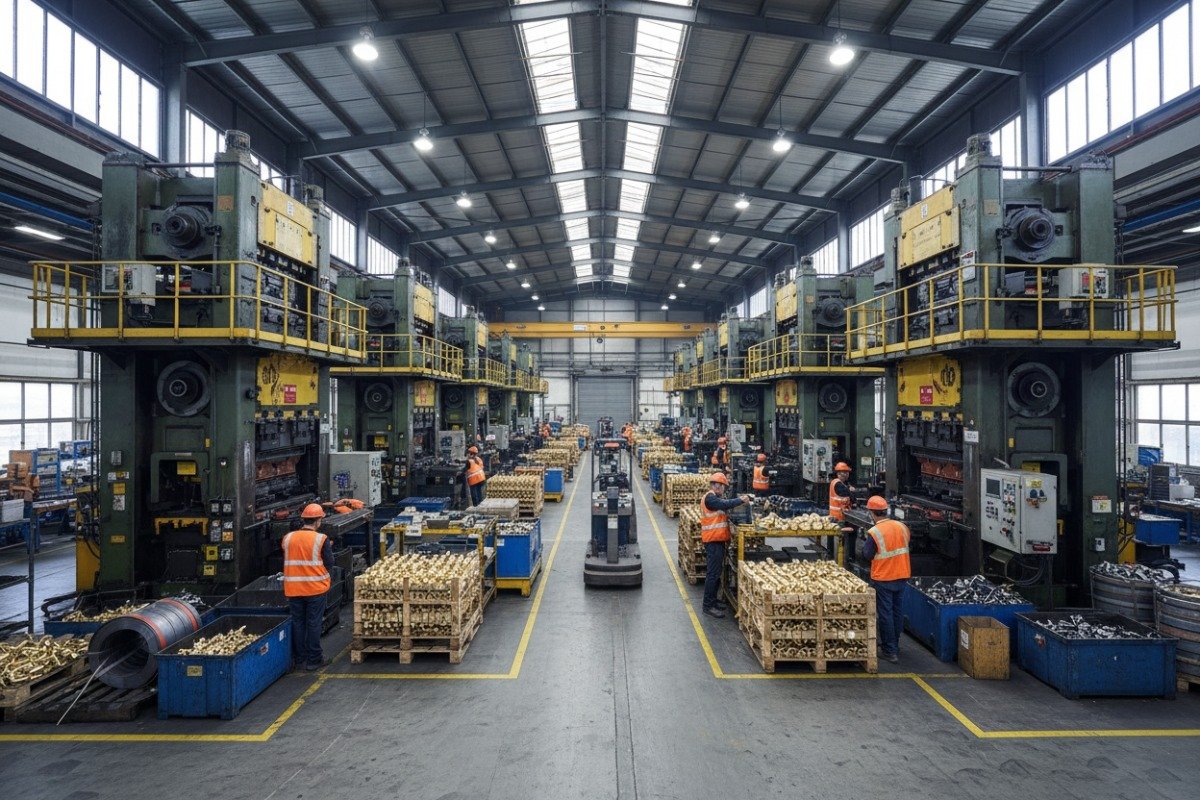
Key Indicators of Production Scalability
Scalability is not just about having big machines. It is about the entire system—people, equipment, materials, and planning—working together at higher volumes without breaking down.
Here are the questions you should ask:
- How many presses do you operate, and what is your current utilization rate?
- How many shifts do you run? Can you add shifts if demand increases?
- Do you maintain backup tooling for high-volume dies?
- What is your raw material procurement lead time?
- Do you have long-term supply agreements with steel or aluminum mills?
A supplier running at 90% capacity with no room to add shifts is a red flag. One equipment breakdown or one rush order from another customer, and your delivery is late.
Tooling Redundancy and Maintenance
Progressive dies wear out. A die producing millions of parts per year needs regular maintenance and eventual replacement. Ask the supplier:
- How often do they perform preventive maintenance on dies?
- Do they keep spare die components (punches, inserts, springs) in stock?
- For critical high-volume programs, do they build a backup die?
Without tooling redundancy, a single die failure can shut down your supply for weeks. We always recommend that our clients negotiate backup tooling into the contract for any program exceeding 1 million parts per year.
Evaluating On-Time Delivery Track Record
Industry benchmarks show that top U.S. stamping suppliers achieve 98% on-time delivery. But you should not take the supplier's word for it. Ask for:
- On-time delivery percentage over the last 12 months
- Names of two or three current customers you can contact as references
- Examples of how they handled a sudden volume increase
A supplier that has successfully ramped from 100,000 to 500,000 parts per month for another customer is far more credible than one that simply says "we can handle it."
Domestic Lead Times vs. Offshore Lead Times
| Factor | Domestic (U.S.) Supplier | Offshore (Asia) Supplier |
|---|---|---|
| Typical lead time | 4–8 weeks | 8–16 weeks (including shipping) |
| On-time delivery rate | ~98% | 80–90% (varies widely) |
| Communication speed | Same-day response | 12–24 hour delay (time zones) |
| Shipping risk | Minimal | Container delays, port congestion |
| Tooling modification turnaround | 1–2 weeks | 3–6 weeks |
This table highlights why many buyers are reshoring or near-shoring their stamping programs. The global metal stamping market is growing at 4.5% CAGR through 2030, driven by automotive and electronics demand. As volumes grow, supply chain reliability becomes even more critical.
However, offshore sourcing still makes sense for certain programs—especially high-volume commodity parts where cost savings outweigh lead time risks. The key is matching your specific requirements to the right regional strength. That is exactly what our team helps clients do every day.
Contingency Planning
Ask the supplier what happens if their main press breaks down. Do they have alternative presses that can run your die? Do they have relationships with partner shops for overflow capacity? A mature supplier has answers to these questions. An immature one will hesitate.
What Factors Should I Consider When Comparing the Total Cost of Sourcing My Metal Stamping Components?
Our quoting team breaks down cost structures for clients every week. The biggest mistake we see is buyers comparing only the per-part price and ignoring everything else.
When comparing total cost, consider tooling amortization, raw material pricing, scrap rates, secondary operations, inspection costs, packaging, freight, import duties, payment terms, and the hidden cost of quality failures. A supplier with a higher per-part price but lower total landed cost often delivers better value over the life of a program.

The True Cost Iceberg
The per-part price is just the tip. Below the surface, there are costs that many buyers overlook until they receive an invoice—or worse, a batch of rejected parts.
Here is a breakdown of cost components you should include in your comparison:
Tooling costs: Progressive dies can cost $20,000 to $150,000 or more depending on complexity. Some suppliers amortize tooling into the part price. Others charge it upfront. Make sure you are comparing apples to apples.
Material costs: Steel and aluminum prices fluctuate. Ask if the quote includes a material price adjustment clause. Some suppliers lock prices for 90 days. Others adjust quarterly. This matters on long-term programs.
Scrap and yield rates: A supplier with a 5% scrap rate is effectively charging you 5% more than a supplier with a 1% scrap rate. Ask for their typical scrap percentage on similar parts.
Secondary operations: If the part needs plating, heat treatment, or assembly, get those costs included in the quote. A supplier that handles everything in-house often costs less than one that subcontracts secondary work.
Domestic vs. Offshore Cost Comparison
The per-part price difference between domestic and offshore suppliers can be significant. But the total cost gap is often much smaller than it appears.
| Cost Element | Domestic Supplier | Offshore Supplier |
|---|---|---|
| Per-part price | $0.05–$0.50 | $0.02–$0.20 |
| Tooling cost | Similar | Often 30–50% lower |
| Shipping (per part) | $0.005–$0.02 | $0.01–$0.05 |
| Import duties/tariffs | None | 5–25% depending on material and country |
| Quality failure cost | Low (shorter feedback loop) | Higher (rework, returns, air freight) |
| Inventory carrying cost | Lower (shorter lead times) | Higher (must hold safety stock) |
| Communication overhead | Minimal | Significant (time zones, language) |
When you add up all these factors, the offshore option that looked 60% cheaper on the quote may only be 10–15% cheaper in total. And if you hit a quality problem, the cost advantage disappears entirely.
Payment Terms and Cash Flow Impact
Payment terms matter more than most buyers realize. A supplier offering Net 60 or Net 90 terms gives you time to receive the parts, inspect them, and even sell them before you pay. That improves your cash flow significantly.
We offer open account payment terms—typically Net 60 to Net 90—specifically because we understand the cash flow pressure that U.S. sourcing companies face. Many offshore suppliers require 30% deposit before production and balance before shipment. That ties up your capital for months.
Design for Manufacturability (DFM) Saves Money Before Production Starts
A good supplier does not just quote your drawing. They review it and suggest changes that reduce cost without sacrificing function. This is called Design for Manufacturability 9, or DFM.
Common DFM recommendations include:
- Adjusting bend radii to reduce cracking risk and eliminate a secondary operation
- Modifying hole positions to allow a simpler die design
- Changing material thickness to reduce weight and material cost
- Combining two parts into one stamping to eliminate an assembly step
Early Supplier Involvement (ESI) takes this further. By involving the stamping supplier during the design phase—not after the drawing is finalized—you can avoid costly tooling changes later. One automotive client we worked with cut long-term costs by 15% through ESI-driven design changes before the first die was even built.
Red Flags in Cost Comparisons
Watch out for these warning signs:
- A quote that is dramatically lower than all others. It usually means something is missing—tooling maintenance, inspection, or packaging.
- No mention of tooling ownership. You should own the tooling you pay for. Confirm this in writing.
- No DFM feedback. A supplier that quotes your drawing without any questions or suggestions is either not reviewing it carefully or lacks the expertise to optimize it.
- Lack of in-house dies. If the supplier outsources tooling, expect 30% higher tooling costs and longer lead times for any modifications.
The smartest buyers do not choose the cheapest quote. They choose the supplier that delivers the lowest total cost of ownership over the life of the program.
Conclusion
Choosing the right metal stamping service comes down to four pillars: technical capability, quality systems, scalability, and total cost. Evaluate all four before you commit, and your program will run smoother from day one.
Footnotes
1. Describes the process and benefits of progressive die stamping. ↩︎
2. Explains the specialized high-precision metal cutting process. ↩︎
3. Explains the international standard for quality management systems. ↩︎
4. Official site for the automotive industry quality management system standard. ↩︎
5. Official standard for quality management systems in the aerospace industry. ↩︎
6. Official standard for production part approval process in automotive. ↩︎
7. Defines Statistical Process Control for monitoring and improving quality. ↩︎
8. Explains Failure Mode and Effects Analysis for identifying and mitigating risks. ↩︎
9. Comprehensive guide to optimizing product design for efficient manufacturing. ↩︎
10. Explains all costs associated with getting a product to its destination. ↩︎

 English
 Español de México
 Deutsch
 Français
 Русский
 العربية