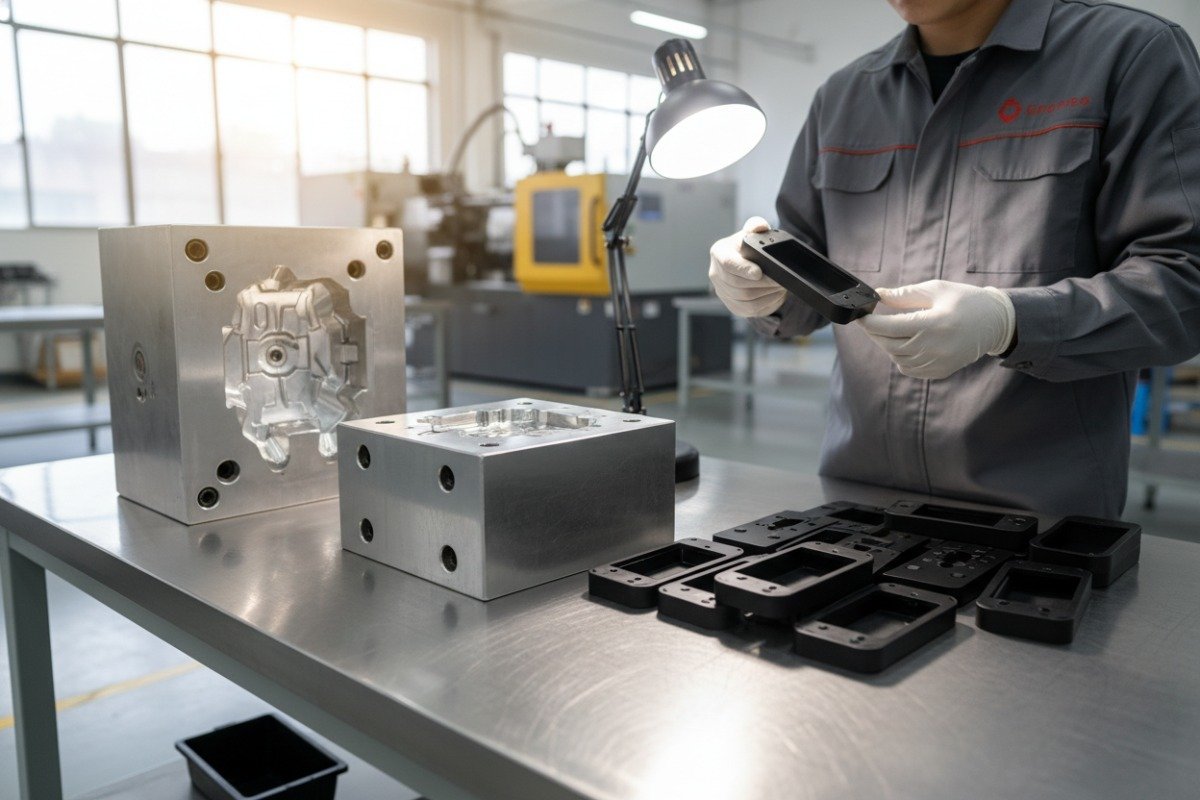
Every year, our team handles dozens of custom molding projects where clients need just a few hundred or a few thousand parts — not millions ISO certifications 1. The challenge is always the same: how do you get production-grade quality without paying production-grade tooling prices?
Low volume injection molding lets you produce 100 to 10,000 high-quality plastic parts using affordable tooling materials like aluminum or soft steel molds. This approach cuts upfront costs by 50–80%, shortens lead times to days or weeks, and gives you the flexibility to refine designs between batches before committing to full-scale production.
Below, we break down how to find the right partner, cut tooling costs, ensure quality, and decide if low volume molding fits your product launch Design for Manufacturability (DFM) 2. Let's get into it.
How Do I Find a Reliable Partner for My Small Batch Injection Molding Project?
When we help U.S. clients source custom plastic parts from Asia, the first question is always the same: "Who can I actually trust with a small run?" It is a fair concern. Many molders focus on high-volume orders and treat small batches as an afterthought aluminum or soft steel molds 3. That means slow responses, sloppy tolerances, and missed deadlines.
To find a reliable low volume injection molding partner, evaluate suppliers based on their experience with soft tooling, ISO certifications, Design for Manufacturability (DFM) review capabilities, transparent quoting processes, and proven track records with small batch runs in your specific industry.
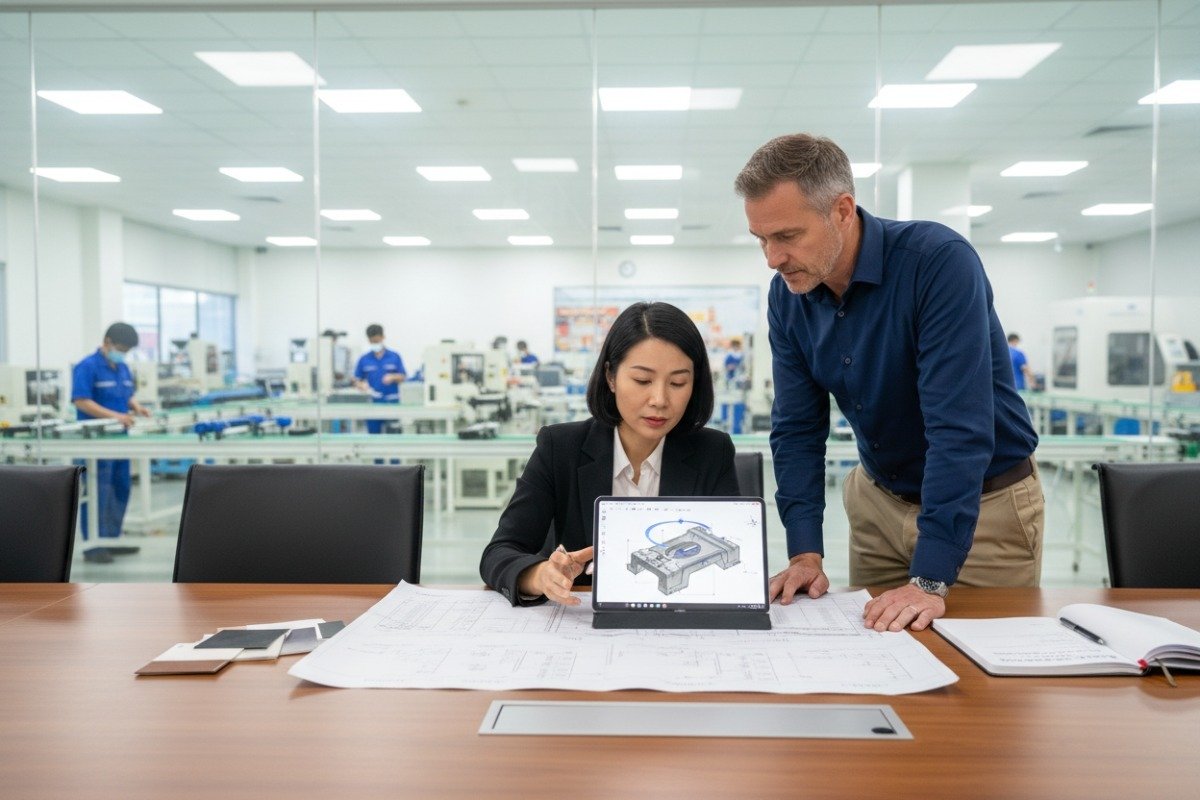
Start With a Clear Project Brief
Before you reach out to any supplier, define your requirements. This sounds obvious, but many sourcing projects go sideways because the buyer's specs are vague. Write down your batch size, target material, critical tolerances, surface finish requirements, and end-use environment. A clear brief saves weeks of back-and-forth.
For example, if you need 500 ABS housings with ±0.005-inch tolerances for a consumer electronics enclosure, say that upfront. A good supplier will respond with a DFM review, not just a price.
Where to Search
You have several channels. Online platforms like ThomasNet, Xometry, Protolabs, and Fictiv offer instant or near-instant quoting. These are great for speed. For more customized sourcing — especially if you want to tap into cost-effective manufacturing in Vietnam, Taiwan, or India — working with a supply chain partner who has local teams on the ground gives you visibility that a platform cannot.
Our office in Vietnam, for instance, conducts in-person supplier audits. We walk the factory floor, check calibration records, and review their process control documentation before a single part is molded.
What to Look for in a Supplier
Here is a quick checklist:
| Evaluation Criteria | What to Check | Red Flag |
|---|---|---|
| Tooling expertise | Aluminum molds, hybrid molds, 3D-printed tooling | Only offers hardened steel molds for small runs |
| Certifications | ISO 9001, ISO 13485 (medical), IATF 16949 (automotive) 4 | No quality management system in place |
| DFM capability | Provides wall thickness, draft angle, and gate location feedback | Accepts your CAD file without any questions |
| Communication | Responds within 24 hours, assigns a dedicated project manager | Slow replies, generic responses |
| Sample policy | Offers T1 samples and first article inspection reports | Refuses to send samples before full production |
| Payment terms | Flexible terms (e.g., 60–90 day open account for qualified buyers) | 100% upfront payment with no negotiation |
Request Competitive RFQs
Send your project brief to at least three suppliers. Compare not just price, but lead time, revision policy, mold ownership terms, and what is included in the quoted price. Some suppliers quote the mold cheap but charge extra for every design change. Others include one or two revisions in the tooling cost. Ask directly.
A typical aluminum mold for a low volume project costs between $2,000 and $8,000, depending on complexity. Steel molds for the same part could run $15,000 to $50,000. The savings are real.
Vet Industry Experience
If your parts go into medical devices, your supplier needs to understand biocompatibility testing and validation protocols. If your parts are for automotive, they need to know PPAP documentation 5 inside and out. We have seen projects fail not because the supplier could not mold the part, but because they did not understand the compliance requirements around it.
How Can I Reduce My Upfront Tooling Costs for Low Volume Production?
Tooling is the biggest line item in any injection molding project. When we quote custom molding jobs for our clients, the mold itself often accounts for 60–80% of the initial investment. For small batch runs, that math can kill a project before it starts — unless you know where to cut without sacrificing quality.
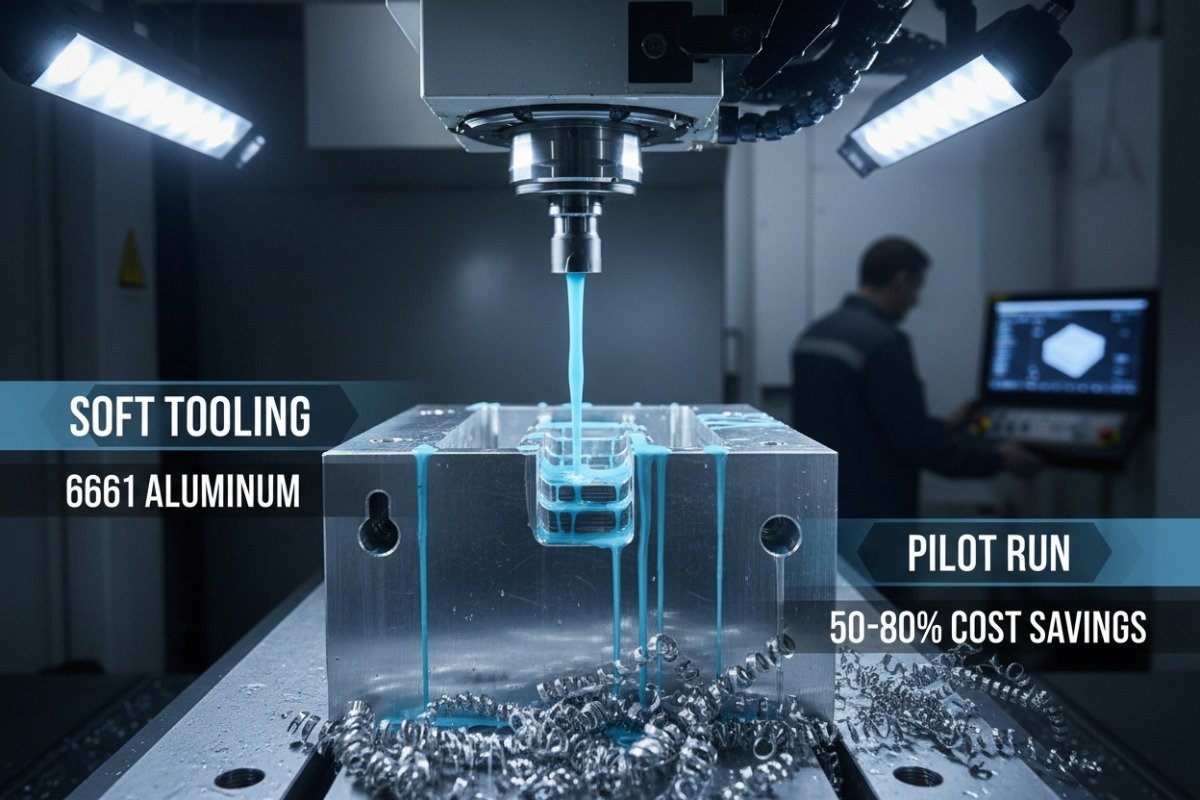
You can reduce upfront tooling costs for low volume production by choosing aluminum or soft steel molds instead of hardened steel, using simplified mold designs with fewer cavities, leveraging 3D-printed mold inserts for pilot runs, and negotiating hybrid tooling that balances cost with durability.
Aluminum vs. Steel: The Core Decision
The single biggest cost lever is your mold material. Hardened steel molds (like H13 or S136) are built to last over one million shots. That durability is overkill for a 500-unit run. Aluminum molds, on the other hand, handle 1,000 to 10,000 shots comfortably and cost a fraction of the price.
| Mold Type | Material | Typical Cost | Shot Life | Best For |
|---|---|---|---|---|
| Soft tooling | Aluminum (6061, 7075) | $1,500 – $5,000 | 1,000 – 10,000 | Prototyping, pilot runs, market testing |
| Semi-hard tooling | P20 or NAK80 steel | $5,000 – $15,000 | 10,000 – 100,000 | Bridge production, higher precision needs |
| Hard tooling | H13 or S136 steel | $15,000 – $80,000+ | 500,000 – 1,000,000+ | Full-scale mass production |
For most low volume projects in the 100 to 5,000 unit range, aluminum is the clear winner. It machines faster, costs less, and still delivers tight tolerances for most geometries.
Simplify Your Mold Design
Every additional cavity, side action, lifter, or complex parting line adds cost. For small batches, a single-cavity mold is usually the smartest choice. Yes, cycle time per part is longer. But you avoid the upfront expense of a multi-cavity tool that you may never fully amortize.
Work with your supplier to simplify. Can you adjust a snap-fit design to eliminate an undercut? Can you add a slight draft angle to avoid a side action? These small changes can shave thousands off your tooling bill.
3D-Printed Mold Inserts
This is a newer approach that is gaining traction fast. Companies like Formlabs have demonstrated that 3D-printed mold inserts 6 — made from high-temperature resins — can produce hundreds of injection-molded parts at a fraction of the cost of machined aluminum. Case studies show cost savings of up to 60% on pilot production runs.
The trade-off is durability. Printed inserts wear out faster and cannot hold the same tolerances as machined metal. But for early-stage market testing or design validation, they are a game-changer.
Negotiate Smart
When we manage tooling procurement for clients, we always negotiate mold ownership, revision terms, and amortization options. Some suppliers will spread the mold cost across your per-part price over an agreed volume. Others offer discounted tooling if you commit to a minimum annual order. Ask about these options. They exist, but suppliers rarely volunteer them.
Also, clarify who owns the mold. In many Asian manufacturing relationships, the supplier retains the mold unless you explicitly negotiate ownership. Get it in writing.
What Quality Control Steps Should I Look for in My Small Batch Manufacturer?
One of the most common complaints we hear from new clients is this: their previous supplier shipped parts that looked fine on the surface but failed in assembly or in the field. The root cause is almost always the same — no structured quality control process. Small batch does not mean small standards.
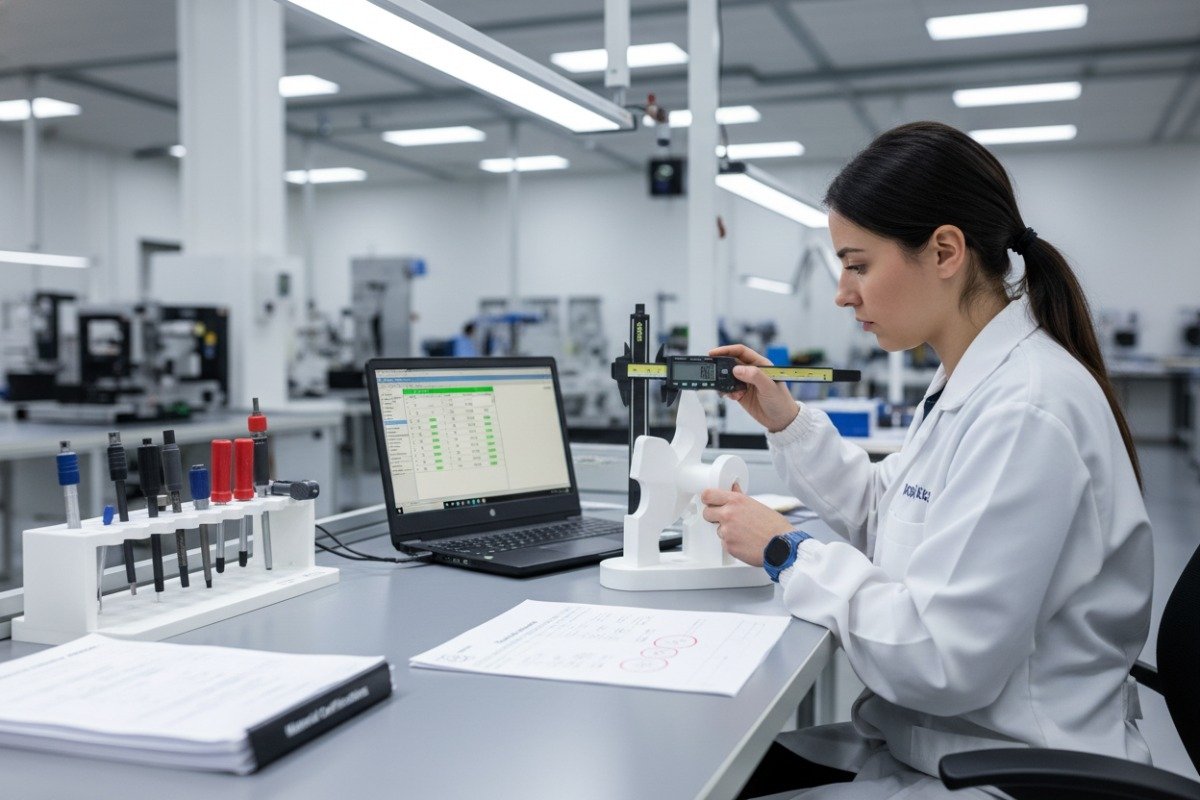
A reliable small batch manufacturer should implement incoming material inspection, scientific molding process control, first article inspection (FAI) with dimensional reports, in-process monitoring, and final inspection with documented acceptance criteria — ensuring every part meets your drawing specifications regardless of batch size.
Why Small Batches Need Rigorous QC
There is a dangerous assumption in the industry: "It's only 500 parts, what could go wrong?" A lot, actually. With small runs, you often have less statistical data to catch drift. If your process window is not dialed in from the start, you can end up with an entire batch of non-conforming parts. And unlike a 100,000-unit run where you can absorb a small scrap rate, 50 bad parts out of 500 is a 10% defect rate. That is unacceptable.
Our quality team follows a structured approach on every project, regardless of volume. Here is what that looks like in practice.
The QC Process, Step by Step
| QC Stage | What Happens | Key Deliverable |
|---|---|---|
| Incoming material inspection | Verify resin grade, lot number, moisture content, and COA (Certificate of Analysis) | Material inspection report |
| Mold trial (T1) | First shots off the new mold; dimensional check against CAD | T1 sample report with measurements |
| First article inspection (FAI) 7 | Full dimensional layout of first production parts per drawing | FAI report (often per AS9102 or PPAP format) |
| In-process monitoring | Monitor key parameters: melt temp, injection pressure, cycle time, cooling time | Process parameter log |
| Final inspection | AQL-based sampling or 100% inspection per customer requirement | Final inspection report with pass/fail |
| Packaging and shipping audit | Verify labeling, packaging integrity, and quantity | Shipping checklist |
Scientific Molding Matters
Scientific molding 8 is a methodology where the process is developed based on data, not guesswork. The molder establishes a process window by running viscosity curves, pressure drop studies, and gate seal studies. This ensures the machine settings produce consistent parts shot after shot.
Ask your supplier: "Do you practice scientific molding?" If they look confused, that is your answer. Move on.
Simulation Software
Many quality-focused molders now use mold flow simulation software 9 (like Moldflow or Moldex3D) to predict fill patterns, weld line locations, sink marks, and warpage before cutting the mold. This is especially valuable for low volume projects because you cannot afford a second mold iteration. Getting it right the first time is not optional — it is the whole point.
When we onboard a new supplier, we require them to provide simulation results as part of the DFM package. It adds a small cost upfront but prevents expensive surprises downstream.
Documentation Is Non-Negotiable
Every inspection should produce a record. If your supplier cannot provide a first article inspection report, a material certificate, or a dimensional report, they are not running a quality operation. They are running a job shop with no traceability. For regulated industries like medical or automotive, this is a compliance risk. For any industry, it is a reliability risk.
How Do I Know if Low Volume Injection Molding Is the Right Choice for My Product Launch?
Before we recommend injection molding for a client's project, we always ask: "How many units do you need in the first 12 months, and what is the part's functional requirement?" The answer determines whether low volume molding makes sense — or whether 3D printing, CNC machining, or urethane casting 10 is a better fit.
Low volume injection molding is the right choice for your product launch if you need 100 to 10,000 production-grade plastic parts with consistent quality, tight tolerances, and material properties that match your end-use requirements — especially when you want to validate market demand before investing in expensive hard tooling.
When Low Volume Molding Makes Sense
The sweet spot for low volume injection molding is clear: you need real, functional parts made from production-intent materials, but you are not ready to commit $30,000+ to a hardened steel mold. Common scenarios include:
- Market testing. You want to sell 500 to 2,000 units to gauge customer response before scaling.
- Bridge production. Your hard tooling is being built, and you need parts now to fulfill early orders.
- Iterative design. You expect to make one or two design changes based on field feedback.
- Niche products. Your total lifetime volume is under 10,000 units, and it will never justify hard tooling.
When It Does Not Make Sense
Low volume injection molding is not always the answer. For ultra-small batches under 100 units, the tooling cost — even for aluminum — may not be justified. In those cases, 3D printing or CNC machining often delivers better per-part economics.
Here is a comparison to help you decide:
| Factor | Low Volume Injection Molding | 3D Printing (FDM/SLS) | CNC Machining |
|---|---|---|---|
| Ideal batch size | 100 – 10,000 | 1 – 100 | 1 – 500 |
| Per-part cost at 500 units | $1 – $10 | $10 – $80 | $15 – $100+ |
| Tooling cost | $1,500 – $10,000 | None | None (fixtures only) |
| Material options | Wide range of thermoplastics | Limited (PLA, ABS, nylon, resin) | Metals and some plastics |
| Surface finish | Excellent (mold-quality) | Moderate (layer lines visible) | Excellent |
| Lead time | 2 – 4 weeks (including tooling) | 1 – 5 days | 1 – 2 weeks |
| Tolerance | ±0.005 inches typical | ±0.010 – 0.020 inches | ±0.001 – 0.005 inches |
The Economics Crossover Point
At around 100 to 200 units, injection molding starts to become more cost-effective than 3D printing on a per-part basis, even after you factor in the mold cost. By 500 units, the gap widens significantly. Our clients who are launching consumer products or industrial components almost always land in this zone.
The key question is not just cost per part today. It is total cost of ownership over the product lifecycle. If you plan to scale to 50,000 units within two years, starting with a low volume aluminum mold lets you validate the design cheaply. Then you invest in hard tooling with confidence, knowing the design is locked.
Real-World Decision Framework
Ask yourself these five questions:
- Do I need more than 100 parts?
- Does the part require specific thermoplastic material properties (heat resistance, chemical resistance, impact strength)?
- Do I need consistent dimensional accuracy across every part?
- Am I planning to scale production within 12–24 months?
- Is the part geometry suitable for molding (no extreme undercuts, reasonable wall thickness)?
If you answered yes to three or more, low volume injection molding is likely your best path. If most answers are no, explore 3D printing or CNC first.
The Agile Manufacturing Trend
The broader industry is moving toward agile, on-demand manufacturing. Low volume injection molding runs now comprise an estimated 20–30% of total injection molding market activity. Cloud-based platforms have made quoting and order management faster than ever. The segment is projected to grow at 6–8% CAGR through 2030, driven by startups, e-commerce brands, and SMEs producing 500 to 5,000 units annually.
This is not a temporary trend. It is a structural shift in how products get made.
Conclusion
Low volume injection molding gives you production-grade parts without production-scale risk. Choose the right partner, control your tooling costs, demand rigorous quality, and match the method to your launch strategy.
Footnotes
1. Official global database for accredited certificates, verifying ISO compliance and standards. ↩︎
2. Replaced HTTP 405 with an authoritative Wikipedia page on Design for Manufacturability. ↩︎
3. Compares aluminum and steel tooling for injection molding, highlighting their suitability for different production volumes. ↩︎
4. Provides an overview of IATF 16949, the international standard for automotive quality management systems. ↩︎
5. Explains PPAP as a standardized process to ensure supplier parts meet engineering specifications and quality requirements. ↩︎
6. Explores the use of 3D printing for creating cost-effective mold inserts for low-volume injection molding. ↩︎
7. Replaced HTTP 404 with an authoritative Wikipedia page on First Article Inspection. ↩︎
8. Defines scientific molding as a data-driven approach to optimize injection molding processes for consistency and quality. ↩︎
9. Describes software used to simulate plastic injection molding, optimizing design and predicting defects. ↩︎
10. Describes urethane casting as a manufacturing process for prototypes and low-volume production using silicone molds. ↩︎

 English
 Español de México
 Deutsch
 Français
 Русский
 العربية