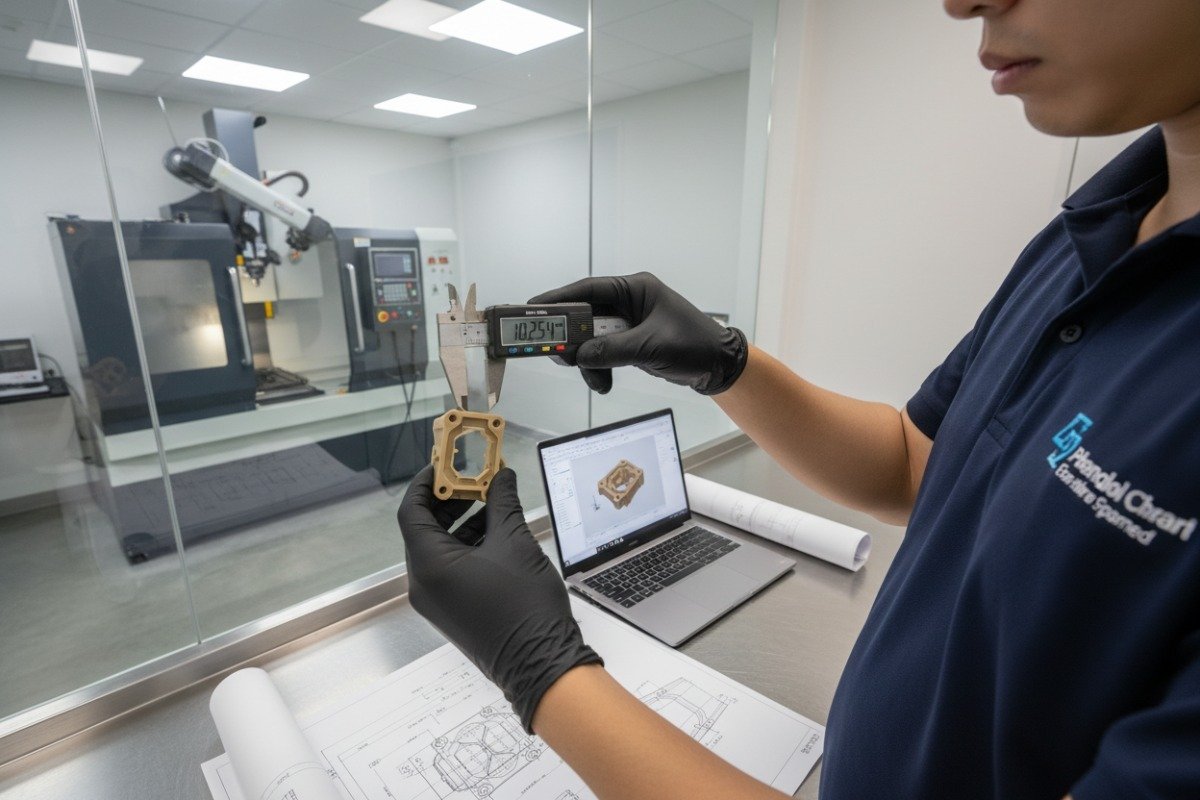
Every week, our engineering team reviews drawings from U.S. clients who need plastic parts held to tolerances once reserved for metal Coordinate Measuring Machines 1. The challenge is real — one wrong material choice or one overlooked shrink rate, and the entire batch fails inspection.
Sourcing tight-tolerance plastic parts is achievable down to +/- 0.0005 inches using advanced CNC machining and injection molding. Success depends on selecting dimensionally stable resins, optimizing tooling, controlling process variables, and partnering with suppliers who have proven inspection capabilities and repeatable quality systems.
The possibilities have expanded dramatically in recent years. Better resins, smarter simulations, and tighter process controls mean plastic now replaces metal in aerospace, medical, and automation applications. But not every supplier can deliver. Let's break down what you need to know before your next sourcing decision.
How Do I Determine the Tightest Tolerances Achievable for My Specific Plastic Components?
Our project engineers get this question on nearly every new RFQ. Clients send drawings with blanket tight tolerances, and the first thing we do is assess which dimensions truly need precision and which can be relaxed.
The tightest achievable tolerance depends on part size, geometry, material choice, and manufacturing process. CNC machining can reach +/- 0.0005 inches on small features in stable plastics like PEEK or acetal, while injection molding typically holds +/- 0.001 to +/- 0.002 inches with optimized tooling and process control.

Start With Your Application Requirements
Not every dimension on your part needs the same level of precision. Press-fits, mating surfaces, and sliding interfaces demand tight control. Clearance holes and non-functional surfaces do not. The first step is to classify each feature by its function.
Ask yourself: Does this feature mate with another part? Does it need a slip-fit or interference fit? Or is it just a mounting surface with generous clearance? This classification drives everything downstream — material, process, tooling, and cost.
Size Matters More Than You Think
Larger parts are harder to hold to tight tolerances. Thermal expansion compounds across longer dimensions. A 12-inch plastic part with a CTE of 3.0 × 10⁻⁵ in/in/°F will grow noticeably with even small temperature swings. Smaller features — under 1 inch — can be held much tighter because CTE effects are minimal.
| Part Feature Size | Typical Achievable Tolerance (CNC) | Typical Achievable Tolerance (Injection Molding 2) |
|---|---|---|
| Under 1 inch | +/- 0.0005 in | +/- 0.001 in |
| 1–6 inches | +/- 0.001 in | +/- 0.002 in |
| 6–12 inches | +/- 0.002 in | +/- 0.003 in |
| Over 12 inches | +/- 0.003 in or more | +/- 0.005 in or more |
Process Selection Drives Your Ceiling
CNC machining 3 gives you the tightest control. The cutter removes material in precise passes. With climate-controlled environments, proper fixturing, and optimized feeds and speeds, sub-0.001-inch precision is routine on the right materials.
Injection molding is faster for volume but introduces variables. Shrink rates differ by resin. Cooling must be uniform. Gate location, packing pressure, and cycle time all affect final dimensions. Mold flow simulation software helps predict outcomes before cutting steel, but real-world validation is still essential.
The Role of GD&T
Geometric Dimensioning and Tolerancing 4 (GD&T) gives you a language to communicate exactly what matters. Instead of blanket tolerances, GD&T lets you specify flatness, concentricity, true position, and runout independently. This flexibility often allows looser linear tolerances while still guaranteeing fit and function — saving cost without sacrificing performance.
A common mistake we see is over-tolerancing. When every dimension is called out at +/- 0.001 inches, tooling costs spike and rejection rates climb. Work with your supplier early to identify which features are critical and which can breathe.
Which Materials Should I Prioritize to Maintain Dimensional Stability in My Precision Parts?
When we quote a tight-tolerance project, material selection is the first conversation our team has with the client. The resin you choose sets the ceiling on what tolerances are realistic — and what they will cost.
For maximum dimensional stability, prioritize engineering plastics with low shrinkage and low thermal expansion. Acetal (POM) and PEEK reliably hold +/- 0.001 inches. Ryton PPS, PEI-Ultem, and glass-filled nylons also perform well. Avoid softer materials like UHMW for critical tolerance features, as they are prone to creep and thermal movement.

Understanding Shrinkage and CTE
Every plastic shrinks as it cools from melt temperature. The amount varies by resin — sometimes by more than 1–2%. If your mold or machining process does not account for this, your parts will be out of spec.
CTE tells you how much a material expands or contracts per degree of temperature change. Metals have low CTE values. Plastics are much higher. This means a plastic part machined at 68°F may measure differently at 90°F. For tight-tolerance work, you need materials where these numbers are small and predictable.
Material Comparison for Tight-Tolerance Work
| Material | Typical Tolerance (CNC) | Shrink Rate (%) | CTE (in/in/°F × 10⁻⁵) | Best For |
|---|---|---|---|---|
| PEEK 6 | +/- 0.001 in | 0.5–1.3 | 2.6 | Aerospace, medical, high-temp |
| Acetal (POM) 7 | +/- 0.001 in | 1.8–2.5 | 5.4 | Gears, bearings, mating parts |
| PEI (Ultem) | +/- 0.001 in | 0.5–0.7 | 3.1 | Electronics, sterilizable devices |
| Ryton PPS | +/- 0.001 in | 0.2–0.5 | 2.7 | Chemical resistance, high-temp |
| Nylon 6/6 | +/- 0.002 in | 1.0–2.5 | 4.5 | Structural, moderate precision |
| UHMW-PE | +/- 0.005 in | 3.0–5.0 | 11.0 | Wear surfaces, non-critical dims |
Why Fillers and Reinforcements Help
Adding glass fiber, carbon fiber, or mineral fillers to a base resin dramatically improves dimensional stability. Glass-filled nylon, for example, shrinks less and has a lower CTE than unfilled nylon. The trade-off is increased tool wear during machining and potential anisotropic shrinkage in molding — meaning the part shrinks differently in flow direction versus cross-flow.
Moisture Absorption Is a Hidden Problem
Nylon absorbs moisture from the air. As it absorbs water, it swells. A nylon part machined to spec in a dry shop may grow out of tolerance in a humid warehouse. If your application involves nylon, factor in equilibrium moisture content and consider dry-as-molded versus conditioned dimensions.
For critical applications, we often recommend PEEK or acetal over nylon precisely because they absorb almost no moisture. The upfront material cost is higher, but the dimensional predictability saves money on rejects and rework downstream.
Match Material to Function
Do not pick a material just because it can hold tight tolerances. Consider the operating environment. Will the part see high temperatures? Chemical exposure? Repeated loading? A material that is dimensionally stable but chemically incompatible with the service environment will fail regardless of how precisely it was machined.
Our approach is to map every functional requirement — tolerance, temperature, chemical resistance, wear, load — and then narrow the resin list. This avoids the common trap of selecting an expensive high-performance polymer when a mid-range engineering plastic would do the job.
How Can I Verify That My Supplier Has the Right Equipment to Inspect My Tight-Tolerance Parts?
During supplier audits at factories across Vietnam and other Asian countries, our quality team has seen firsthand how inspection capability separates reliable suppliers from risky ones. A shop can machine a great part once — but without proper inspection, they cannot prove it or repeat it.
Verify your supplier's inspection capability by requesting their equipment list, calibration records, and sample inspection reports. Look for Coordinate Measuring Machines (CMMs), optical comparators, and climate-controlled inspection rooms. Ask for Gage R&R studies and PPAP documentation to confirm their measurement systems are accurate and repeatable.

The Equipment Checklist
Not all measurement tools are equal. Calipers and micrometers work for standard tolerances. But when you are holding +/- 0.001 inches or tighter, you need equipment with resolution at least 10 times finer than your tolerance band. That means tools reading to 0.0001 inches or better.
Here is what to look for:
| Equipment | What It Measures | Resolution | Best For |
|---|---|---|---|
| CMM (Coordinate Measuring Machine) | 3D geometry, true position, GD&T | 0.0001 in | Complex parts, full GD&T layouts |
| Optical Comparator | Profile, contour, 2D features | 0.0005 in | Flat parts, cross-sections |
| Vision Measuring System | Small features, surface details | 0.0001 in | Micro features, thin walls |
| Pin Gages / Ring Gages | Bore diameters, hole sizes | 0.0001 in | Quick go/no-go checks |
| Surface Profilometer | Surface finish (Ra, Rz) | Micro-inch | Mating surfaces, sealing faces |
| CT Scanner (In-line) | Internal geometry, voids, wall thickness | 0.001 in | Molded parts, internal features |
Calibration and Traceability
Equipment is only as good as its last calibration. Ask your supplier for calibration certificates traceable to NIST or an equivalent national standard. Calibration should be current — not expired six months ago. A supplier who cannot produce these records on request is a red flag.
Gage R&R and Measurement System Analysis
A Gage Repeatability and Reproducibility (Gage R&R) study tells you whether the supplier's measurement system can actually distinguish good parts from bad. Gage R&R studies 8 If the measurement variation is too large relative to the tolerance, the inspection data is meaningless. Industry best practice requires Gage R&R to be under 10% of the tolerance band for critical dimensions.
Ask your supplier: "Have you run a Gage R&R on the features I need inspected?" If they do not know what that means, walk away.
Environmental Controls
Plastic parts change size with temperature. A part measured in a 90°F shop will read differently than the same part measured at 68°F (the standard reference temperature per ASME Y14.5). Suppliers inspecting tight-tolerance plastic parts should have temperature-controlled inspection areas — ideally held at 68°F +/- 2°F.
We have seen cases where a supplier's parts measured in-spec on their shop floor but failed incoming inspection at the client's facility. The root cause was a 15°F temperature difference between the two measurement environments. This is avoidable with proper controls.
PPAP and First Article Inspection
For production runs, request a Production Part Approval Process 9 (PPAP) package. This includes dimensional results on a statistically significant sample, material certifications, process flow diagrams, control plans, and capability studies (Cpk). A supplier who can deliver a complete PPAP demonstrates process maturity.
First Article Inspection (FAI) reports should cover every dimension on the drawing, not just the critical ones. This baseline confirms the process is capable before full production begins.
Remote Verification Tips
If you cannot visit the factory, request video walkthroughs of the inspection area. Ask for photos of equipment nameplates showing model and serial numbers. Cross-reference with calibration certificates. Request sample CMM reports with actual data points — not just pass/fail summaries.
What Are the Cost Implications if I Push for Even Tighter Tolerances in My Production Run?
On many projects we manage, the biggest budget surprise comes not from material or volume — it comes from tolerance callouts. Our estimating team can show you exactly where the cost curve bends, and it bends sharply once you cross certain thresholds.
Tighter tolerances increase costs through premium tooling, slower cycle times, additional machining passes, stress-relief annealing steps, and higher inspection requirements. Moving from +/- 0.002 inches to +/- 0.001 inches can increase part cost by 25–50%, and pushing to +/- 0.0005 inches may double or triple it depending on material and geometry.

Where the Money Goes
Tighter tolerances do not just mean more careful machining. They cascade through the entire production process. Here is a breakdown of the cost drivers:
Tooling: Molds for tight-tolerance injection molding require higher-grade steel, tighter mold tolerances, and often conformal cooling channels. A standard mold might cost $15,000. A precision mold for the same part could run $25,000–$40,000.
Cycle time: Slower injection speeds, longer packing and cooling phases, and additional machining passes all extend cycle time. In CNC, a finish pass at reduced feed rate adds minutes per part. Multiply that by thousands of parts and the cost adds up fast.
Annealing and stress relief: For CNC-machined plastic parts, achieving sub-0.001-inch tolerances often requires rough machining, a multi-day relaxation period, annealing, and then finish machining. This multi-stage process can triple the handling time per part.
Inspection: Tighter tolerances demand more inspection. Instead of sampling 5 parts per lot, you may need 100% inspection on critical dimensions. CMM time is not cheap — typically $50–$150 per hour depending on complexity.
Cost Scaling by Tolerance Band
| Tolerance Band | Relative Part Cost | Inspection Level | Typical Process |
|---|---|---|---|
| +/- 0.005 in (standard) | 1.0x (baseline) | Sample inspection | Standard CNC or molding |
| +/- 0.002 in (tight) | 1.2–1.5x | Increased sampling | Optimized CNC or precision molding |
| +/- 0.001 in (very tight) | 1.5–2.5x | 100% on critical dims | Climate-controlled CNC, precision mold |
| +/- 0.0005 in (ultra-tight) | 2.5–4.0x | 100% CMM inspection | Multi-stage CNC, annealing, controlled environment |
The Over-Tolerancing Trap
Here is the uncomfortable truth: many drawings we receive have tolerances tighter than the application requires. A chain guide with 0.015 inches of clearance does not need +/- 0.001-inch precision. A mounting bracket that bolts through oversized holes does not need true position within 0.002 inches.
Over-tolerancing is the single fastest way to inflate your unit cost without improving product performance. Before locking in your drawing, ask: "What happens if this dimension is 0.003 inches off instead of 0.001?" If the answer is "nothing," loosen it.
When Tight Tolerances Pay for Themselves
There are cases where the investment is justified. Press-fit assemblies that eliminate fasteners save assembly labor. Precision mating surfaces that reduce post-machining fitting operations save time. Medical device housings that must seal reliably save lives.
In aerospace, we have seen clients achieve 20–50% weight reductions by converting metal parts to tight-tolerance PEEK or Ultem components. The per-part cost is higher, but the system-level savings in weight, fuel, and assembly labor far exceed the premium.
How to Optimize Cost Without Sacrificing Function
Work with your supplier during the design phase — not after the drawing is released. Share the application context. Explain which features are critical and why. A good supplier will suggest where tolerances can be relaxed, where GD&T can replace bilateral tolerances, and where material substitution can reduce machining difficulty.
This collaborative approach is what we call Design for Manufacturability 10 (DFM). It does not compromise your product. It makes it smarter and cheaper to produce.
Conclusion
Sourcing tight-tolerance plastic parts is absolutely possible — but success requires the right material, the right process, the right inspection capability, and a clear-eyed view of cost trade-offs. Choose your supplier wisely.
Footnotes
1. Explains how CMMs measure the geometry of physical objects using a probe. ↩︎
2. Provides an overview of the manufacturing process for producing parts by injecting molten material into a mold. ↩︎
3. Explains the automated control of machine tools by a computer. ↩︎
4. Defines the authoritative guideline for the design language of geometric dimensioning and tolerancing. ↩︎
5. Replaced with the Wikipedia page for Thermal expansion, providing a comprehensive and authoritative overview of the topic. ↩︎
6. Replaced with the Wikipedia page for Polyether ether ketone (PEEK), providing an authoritative overview of its properties and applications. ↩︎
7. Replaced with the Wikipedia page for Polyoxymethylene (Acetal), offering a detailed and authoritative description of the material. ↩︎
8. Defines Gage Repeatability and Reproducibility as a method to assess measurement system variation. ↩︎
9. Explains the industry standard process for approving production parts to ensure consistent quality. ↩︎
10. Defines the engineering practice of designing a product to reduce manufacturing cost and ease production. ↩︎

 English
 Español de México
 Deutsch
 Français
 Русский
 العربية