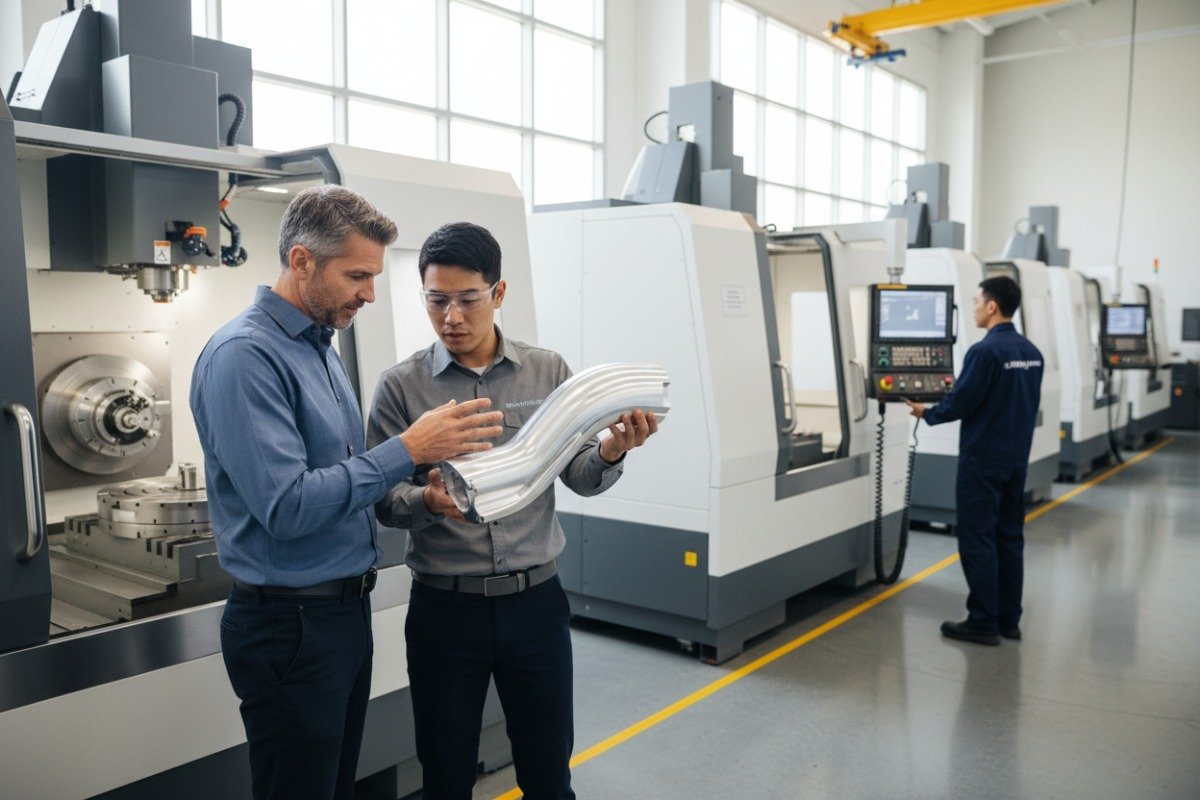
Every week, our project team reviews quotes from dozens of CNC shops across Asia quality control processes 1. The pattern is clear: buyers chase low prices, then pay twice when parts arrive out of spec.
Sourcing high-quality CNC machining from China can save you 30–50% compared to Western suppliers. The key is verifying factory capabilities, demanding strict quality control processes like FAI and PPAP, managing communication with English-speaking teams, and balancing total cost of ownership against precision requirements rather than chasing the lowest bid.
The days of simply finding the cheapest quote on Alibaba 2 are over CMMs 3. In 2026, smart sourcing means building strategic partnerships. It means understanding the full picture — tariffs, logistics, quality systems, and IP protection PPAP submissions 4. Let me walk you through exactly how we help our clients do this, step by step.
How Can I Verify the Actual Manufacturing Capabilities of a CNC Shop in China?
Our engineers in China visit factories almost every week. What we see on a supplier's website and what sits on their shop floor are often two very different things.
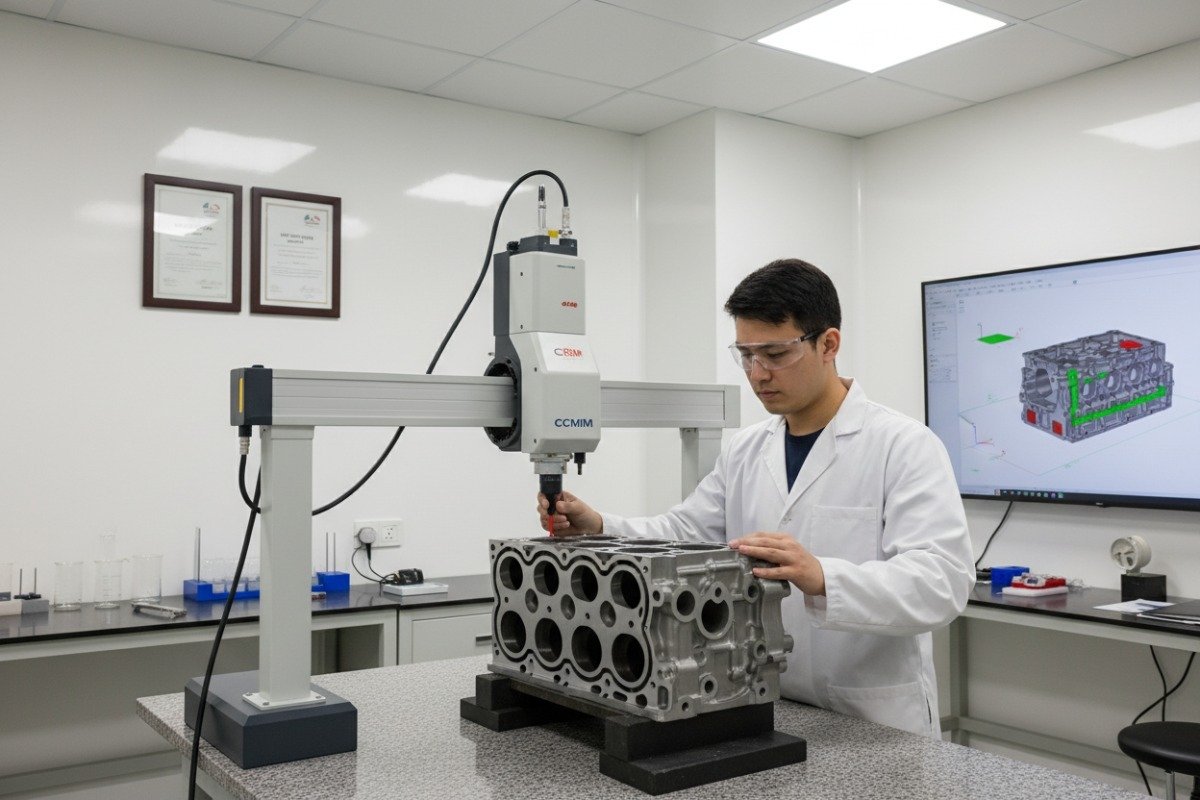
To verify a CNC shop's real capabilities, request a virtual or on-site factory audit. Check their machine list, inspection equipment like CMMs, certifications such as ISO 9001 or IATF 16949, and ask for sample parts with dimensional reports. A credible shop will welcome scrutiny.
Why Website Claims Are Not Enough
Many CNC shops in China present impressive websites. They show photos of 5-axis machines and clean rooms. But here is the reality: some of these shops are trading companies. They do not own a single machine. They receive your order and subcontract it to the lowest bidder. This is one of the biggest risks in China sourcing.
We have seen cases where a "factory" listed 30 CNC machines on their profile. When our team visited, they had 8 machines — and only 5 were running. The rest were old or broken. This is not rare. It happens more often than most buyers expect.
What to Check During a Factory Audit
A proper audit covers several areas. Here is a breakdown of what to look for:
| Audit Area | What to Verify | Red Flag |
|---|---|---|
| Machine List | Brand, model, age, quantity of CNC machines | Old machines with no maintenance records |
| Inspection Equipment | CMM, profilometer, hardness tester, surface roughness gauge | No CMM or reliance on handheld tools only |
| Certifications | ISO 9001 5, IATF 16949, ISO 13485 | Expired certificates or no third-party audit history |
| Workforce | Number of engineers vs. operators, English capability | No engineering staff, only operators |
| Sample Parts | Request actual parts with full dimensional reports | Refusal to share samples or inspection data |
| Sub-contracting | Ask if they outsource any processes | Evasive answers about heat treatment or plating |
Use Platforms Wisely
Platforms like Alibaba, Made-in-China, and Haizol are useful starting points. Alibaba gives you a vast supplier pool. Haizol focuses on verified China-based factories with structured RFQ tools. Xometry suits US and EU prototyping needs. But none of these platforms replace a proper audit.
Our recommendation: use platforms for initial shortlisting. Then verify through a sourcing agent or your own team on the ground. Ask for video calls showing the shop floor in real time. Request recent inspection reports from other projects. A good factory will not hesitate.
Trade Shows Still Matter
Attending trade shows like CIMT (China International Machine Tool Show) 6 or SIMM in Shenzhen gives you face-to-face access. You can see sample parts, talk to engineers, and judge professionalism. In our experience, the suppliers who invest in trade show booths tend to be more established and serious about export business.
Industrial clusters matter too. Shenzhen, Dongguan, and Suzhou are major CNC hubs. Factories in these areas benefit from mature supply chains — raw materials, heat treatment, plating, and assembly services are all nearby. This reduces lead times and improves coordination.
What Quality Control Processes Should I Demand to Protect My Project?
When we onboard a new supplier for a client, the first document we send is not a purchase order. It is a quality agreement. Without clear QC expectations upfront, problems are almost guaranteed.
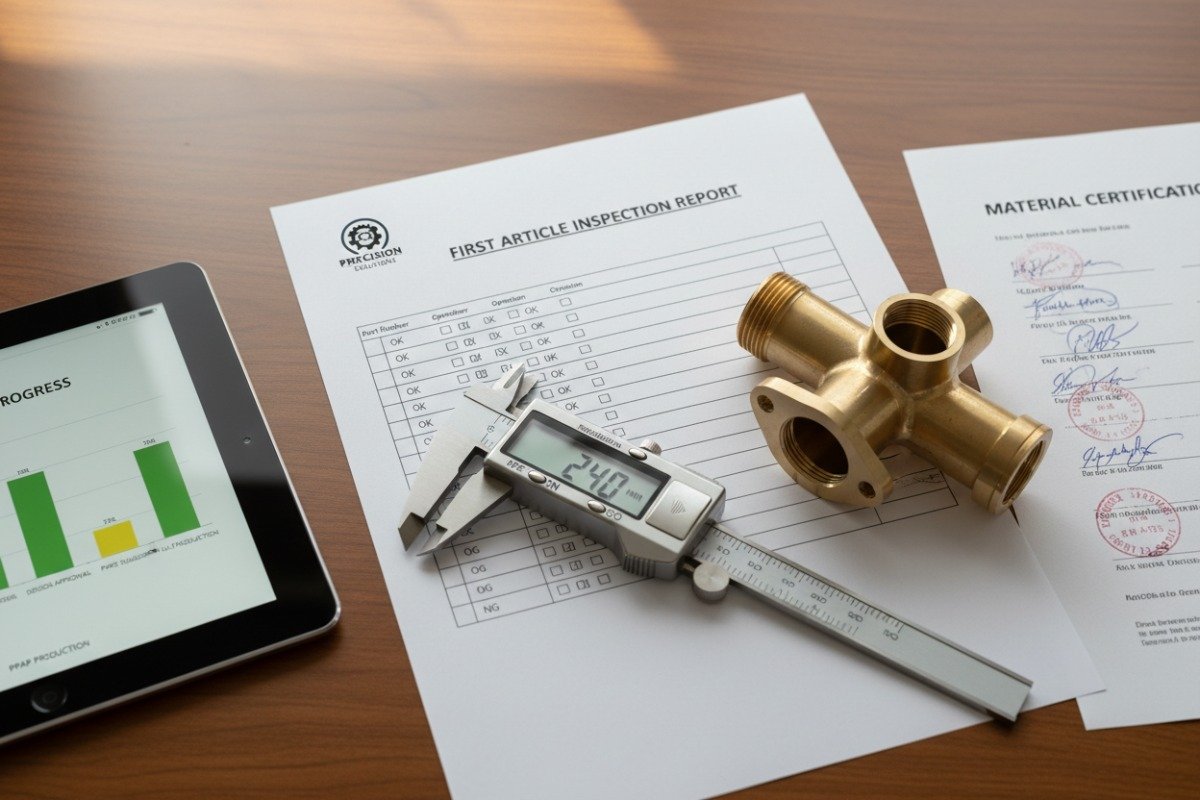
Demand a complete quality control framework: PPAP submissions for new parts, First Article Inspection (FAI) reports, in-process checks at 25%, 50%, and 75% completion, final inspection with CMM data, and material certifications. These processes catch defects early and ensure "right first time" results.
The Cost of Skipping QC
One of our clients came to us after a painful experience. They had ordered 2,000 aluminum brackets from a shop in Dongguan. No FAI was done. No in-process inspection. When the parts arrived in Texas, 40% were out of tolerance. The rework cost more than the original order. This is the "China Price" trap — low bids that lead to expensive failures.
Quality control is not optional. It is the foundation of every successful sourcing project.
Build a QC Framework Step by Step
Here is the QC process we implement for every project:
Step 1: Drawing Review and DFM Analysis. Before production starts, the supplier must review your drawings and flag any concerns. This takes 2–3 days. It catches issues like unrealistic tolerances or material availability problems.
Step 2: PPAP (Production Part Approval Process). For new parts, require a PPAP submission. This includes dimensional results, material certs, process flow diagrams, and control plans. PPAP ensures the supplier understands every requirement before mass production.
Step 3: First Article Inspection (FAI). The supplier produces a small batch — usually 3 to 5 pieces. These are fully inspected with CMM data. You review and approve before production continues. This step alone prevents most quality failures.
Step 4: In-Process Checks. At 25%, 50%, and 75% completion, the supplier provides progress updates with inspection data. This gives you visibility and the chance to catch drift early.
Step 5: Final Inspection. A full inspection of the finished lot. This includes dimensional checks, surface finish verification, and visual inspection. We often use third-party inspectors for critical orders.
Key QC Milestones and Deliverables
| QC Stage | Timing | Key Deliverable |
|---|---|---|
| DFM Analysis 8 | Before production | Finalized 3D models, flagged issues |
| PPAP Submission | Before mass production | Dimensional results, control plan, material certs |
| First Article Inspection | After first 3–5 pieces | FAI report with CMM data, sample approval |
| In-Process Checks | At 25/50/75% completion | Progress photos, dimensional spot checks |
| Final Inspection | After production complete | Full inspection report, packing list |
| Outgoing QC | Before shipping | Visual check, packaging verification |
Certifications to Look For
ISO 9001 is the baseline. If your parts go into automotive applications, look for IATF 16949 9. Medical parts require ISO 13485. Aerospace demands AS9100. These certifications are not just logos on a website. Ask for the actual certificate, check the expiry date, and verify the certifying body.
A certified factory has documented processes, trained inspectors, and traceable records. An uncertified shop may still produce good parts — but you are taking a bigger risk.
How Do I Manage the Communication and Logistics for My Custom CNC Parts?
Our team in China handles communication with suppliers every day. The number one cause of non-conforming parts is not bad machines. It is miscommunication. A missed note on a drawing. An assumed tolerance. An email that was never answered.
Manage communication by providing complete technical drawings with all tolerances, materials, and finishes clearly specified. Use English-speaking project managers as single points of contact. For logistics, work with suppliers experienced in export packaging, customs documentation, and door-to-door freight coordination to avoid delays.

Why Communication Fails
Chinese CNC shops often have skilled machinists but limited English capability. Technical terms get lost in translation. Drawing notes are overlooked. And here is a common problem: the salesperson who speaks English is not the same person running the machine. Information gets filtered, simplified, or lost between departments.
We solve this by placing our own bilingual engineers between the client and the factory. They review drawings in both languages. They sit in on production meetings. They catch the small details that cause big problems.
How to Prepare Your Drawings
Your drawings are your contract. If they are incomplete, you will get incomplete parts. Here is what every drawing package should include:
- 2D drawings with GD&T (Geometric Dimensioning and Tolerancing)
- 3D CAD files (STEP or IGES format preferred)
- Material specification with grade and standard (e.g., ASTM A36, 6061-T6)
- Surface finish requirements (Ra values, not vague terms like "smooth")
- Coating or plating specs (type, thickness, color, standard)
- Critical dimensions highlighted so the shop knows where to focus
- Quantity, packaging, and labeling requirements
Missing any of these creates room for assumptions. And assumptions lead to rejects.
Communication Best Practices
Use a single point of contact on both sides. Avoid sending emails to multiple people at the factory — it creates confusion. Set up weekly progress calls during production. Use shared folders for drawings, revisions, and inspection reports.
When changes happen — and they always do — issue formal Engineering Change Notices (ECNs). Do not rely on verbal agreements or chat messages for spec changes. Everything must be documented and acknowledged in writing.
Managing Logistics
Shipping custom parts from China involves several steps. Here is a typical logistics flow:
| Logistics Stage | Duration | Key Action |
|---|---|---|
| Export packaging | 1–2 days | Custom crating, moisture barrier bags, labeling |
| Customs documentation | 1–2 days | Commercial invoice, packing list, certificate of origin |
| Ocean freight (to US West Coast) | 18–25 days | FCL or LCL depending on volume |
| Air freight (to US) | 3–5 days | For urgent or small shipments |
| US customs clearance | 1–3 days | HS code classification, tariff payment |
| Last-mile delivery | 1–3 days | Truck delivery to your facility |
Tariffs and Total Cost
Do not forget tariffs. Depending on the HS code and current trade policy, duties on CNC parts from China can range from 7.5% to 25% or more. Factor this into your total cost of ownership (TCO). Some buyers are now exploring dual sourcing — keeping China for high-volume runs while using Vietnam or other ASEAN countries for tariff-sensitive items. Our Singapore headquarters and Vietnam office help clients navigate exactly this kind of strategy.
Freight costs also vary. Ocean freight is cheapest but slowest. Air freight is fast but expensive. For most custom CNC projects, ocean freight with proper lead time planning is the best balance.
What Are the Best Ways for Me to Balance Cost Savings with High Precision Requirements?
When we quote a project for a US client, we never start with price. We start with the tolerance map. Because the tightest tolerance on your drawing determines the machine, the cycle time, and ultimately the cost. Get this balance wrong, and you either overpay or get bad parts.
Balance cost and precision by specifying only the tolerances you truly need, using DFM feedback to simplify designs, consolidating orders for volume discounts, and evaluating total cost of ownership including tariffs, shipping, and quality costs rather than comparing unit prices alone.
The Tolerance Trap
Here is something we see constantly: engineers specify ±0.01 mm on every dimension. They do it "just to be safe." But tight tolerances require slower machining, more inspection, and sometimes grinding or EDM operations. Each of these adds cost.
Top-tier Chinese factories can hold tolerances as tight as ±0.0127 mm (±0.0005 inches). But not every dimension needs that level of precision. A good DFM review identifies which dimensions are critical and which can be relaxed. This alone can reduce machining cost by 15–30%.
Design for Manufacturability (DFM)
DFM is not just a buzzword. It is a practical review where the supplier's engineers analyze your design and suggest changes that reduce cost without affecting function. Common DFM suggestions include:
- Replacing tight tolerances on non-critical features with standard machining tolerances
- Changing internal corner radii to match standard tool sizes
- Reducing the number of setups by redesigning features that can be machined in one orientation
- Switching to a more machinable material grade that meets the same performance requirements
A good supplier completes DFM analysis in 2–3 days. If a shop skips this step and just quotes your drawing as-is, that is a warning sign. They either do not have the engineering capability or they plan to figure it out later — at your expense.
Cost Comparison: China vs. Western Machining
| Cost Factor | Western Supplier | China Supplier | Savings |
|---|---|---|---|
| Raw material (aluminum 6061) | $8–12/kg | $4–7/kg | 30–45% |
| Machining labor rate | $80–150/hr | $25–50/hr | 50–70% |
| Tooling and setup | $2,000–5,000 | $800–2,000 | 50–60% |
| Surface treatment (anodizing) | $3–8/part | $1–3/part | 50–65% |
| Shipping to US (per kg, ocean) | N/A | $0.50–2.00 | Added cost |
| Tariff (if applicable) | N/A | 7.5–25% | Added cost |
Even after adding shipping and tariffs, the total cost from China is typically 30–50% lower than domestic Western machining for medium-to-high volume orders. For prototypes or very small batches, the savings shrink because setup costs are spread over fewer parts.
Think in Total Cost of Ownership
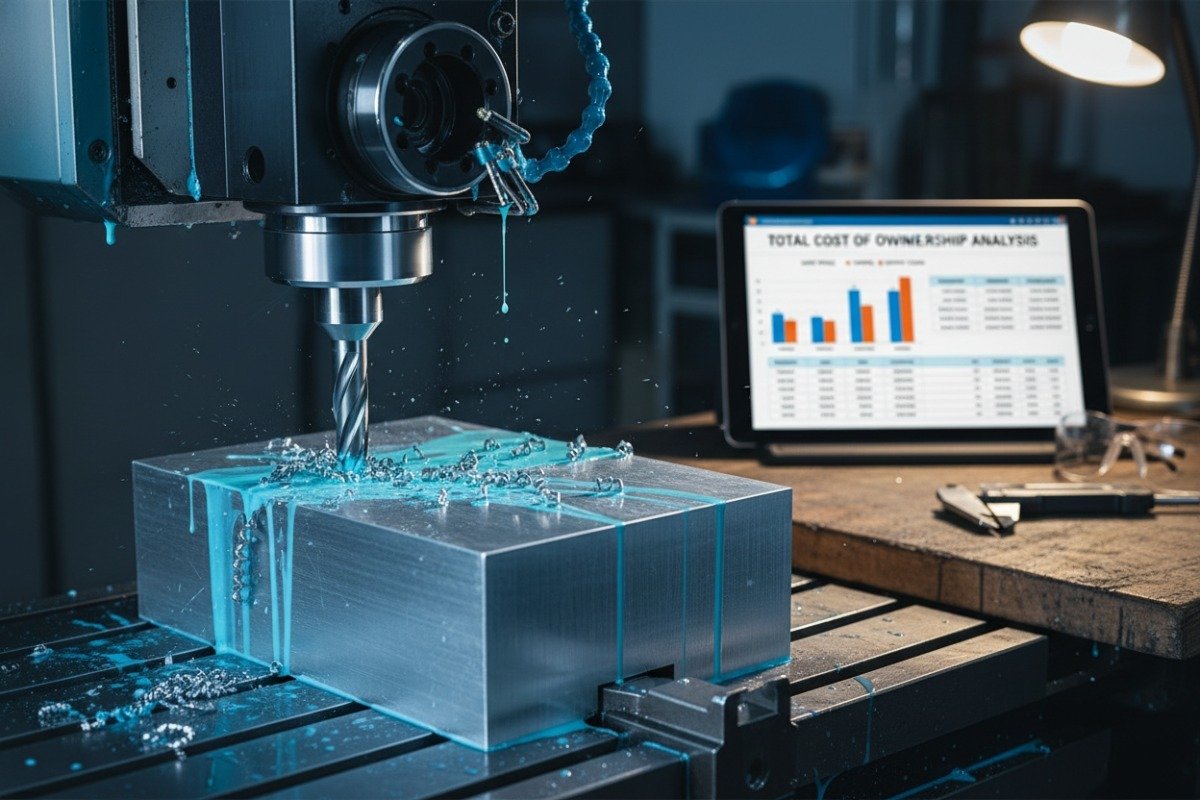
Unit price is misleading. A quote of $5.00 per part from China versus $12.00 from a local shop looks like a clear win. But add shipping ($0.80), tariff ($1.25), inspection costs ($0.30), and the risk cost of potential rejects ($0.50), and the real comparison is $7.85 versus $12.00. Still cheaper — but the gap is smaller than it first appeared.
Smart buyers calculate TCO before making decisions. They factor in:
- Unit price
- Tooling and setup amortization
- Shipping and insurance
- Import duties and tariffs
- Quality inspection costs
- Risk cost of potential rework or returns
- Payment terms (60–90 day open account terms improve your cash flow)
Volume Strategy
For high-volume production, China's advantage is strongest. Factories run 24/7 shifts. They buy raw materials in bulk at lower prices. Cycle times are optimized through automation and dedicated fixtures. Production runs that would take 8 weeks domestically can be completed in 4–5 weeks in China.
For prototypes, consider a hybrid approach. Use a local shop or a platform like Xometry for the first iteration. Once the design is locked, move to a Chinese factory for production. This gives you speed on prototyping and savings on volume.
Emerging Trends in 2026
AI-driven quoting platforms are changing the game. Some Chinese factories now use AI to analyze your 3D model and generate instant quotes with DFM suggestions. This speeds up the RFQ process from days to hours.
Green machining is another trend. Eco-conscious buyers are asking about energy consumption, coolant recycling, and waste reduction. Leading Chinese factories are investing in these areas to attract European and American clients with ESG requirements.
Digital twin technology allows virtual simulation of machining processes before cutting metal. This reduces prototyping cycles and catches design issues earlier. It is still emerging, but forward-thinking factories are adopting it.
Conclusion
Sourcing CNC machining from China is not about finding the cheapest quote. It is about building a verified, quality-driven supply chain that delivers precision parts on time, every time.
Footnotes
1. Defines quality control processes and their importance in maintaining product standards. ↩︎
2. Official overview of Alibaba Group, a leading platform for global wholesale trade. ↩︎
3. Replaced with a Wikipedia article defining Coordinate-measuring machines (CMMs), adhering to the preference for authoritative sources. ↩︎
4. Replaced with a Wikipedia article explaining the Production Part Approval Process (PPAP), aligning with the preference for authoritative sources. ↩︎
5. Official overview of ISO 9001, a global standard for quality management systems. ↩︎
6. Information on CIMT, one of the world’s largest machine tool shows. ↩︎
7. Replaced with a Wikipedia article providing a comprehensive overview of CNC machining, aligning with the preference for authoritative sources. ↩︎
8. Wikipedia entry explaining Design for Manufacturability (DFM) to reduce production costs. ↩︎
9. Official information on IATF 16949, the international standard for automotive quality management systems. ↩︎
10. Defines FAI as a verification process for new or revised parts in manufacturing. ↩︎

 English
 Español de México
 Deutsch
 Français
 Русский
 العربية