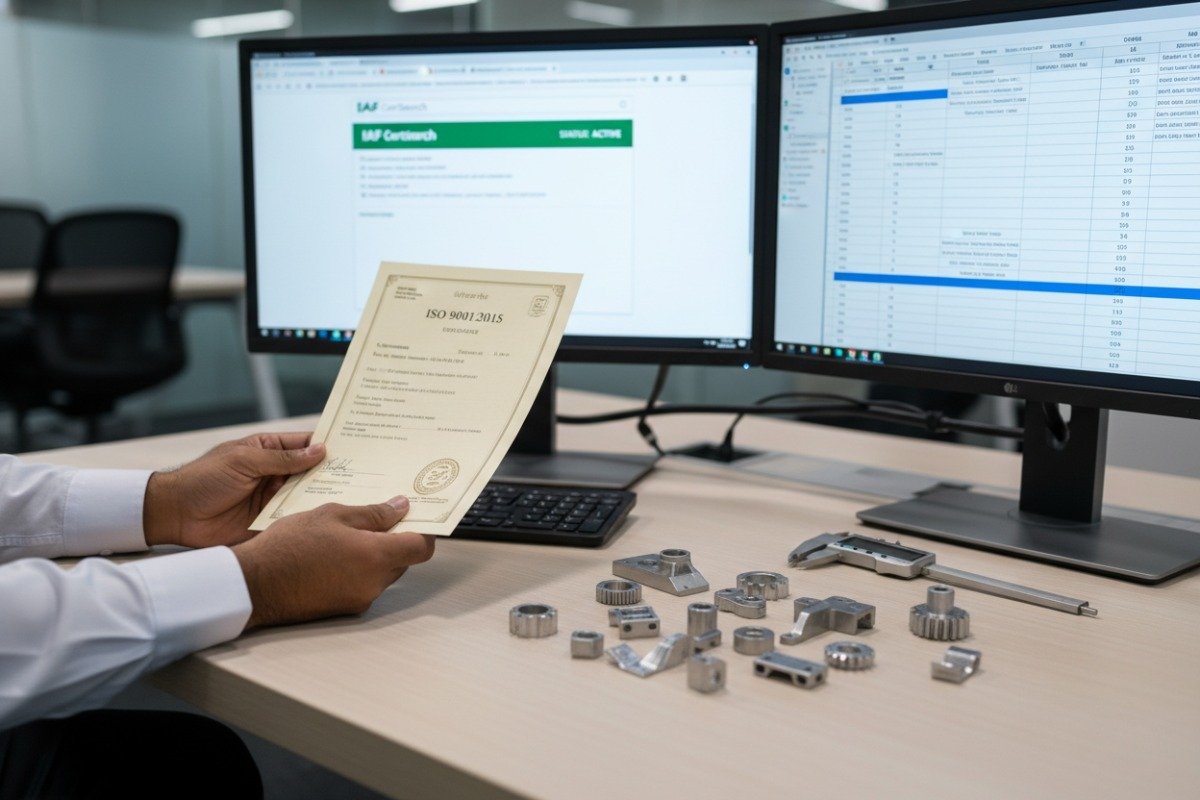
When we manage custom stamping projects at our Singapore headquarters, we often see how a single unverified document can lead to a production disaster IAF CertSearch database 1. You need precision, but a fake certificate often hides a chaotic workshop.
To verify a stamping parts supplier's ISO 9001 certification, you must check the certificate number on the IAF CertSearch database, confirm the accreditation body is an IAF member, and ensure the certification scope explicitly includes metal stamping processes to guarantee authenticity and technical relevance.
Checking these details is the only way to protect your supply chain from high defect rates and costly recalls Multilateral Recognition Arrangement (MLA) 2.
Where can I find a reliable database to check if my supplier's ISO 9001 certificate is authentic?
At our Vietnam office, our sourcing team never accepts a PDF at face value because we know how easily documents are forged. We always cross-reference every supplier's credentials against official global registries before moving to the sampling stage.
The most reliable database is IAF CertSearch (iafcertsearch.org), the official global portal that aggregates data from 75 accreditation bodies. You can also verify status directly on the website of the specific Certification Body (CB) listed on the supplier's certificate using their unique registration number.

Using the IAF CertSearch Portal
The International Accreditation Forum (IAF) 3 has revolutionized how we verify suppliers. In the past, you had to email individual certification bodies and wait days for a reply. Now, the IAF CertSearch tool allows for instant validation. Since 2020, usage of this tool has grown by 300% as global supply chains face increased scrutiny. When you enter a company name or certificate number, the system tells you immediately if the status is "Active," "Suspended," or "Withdrawn."
Direct Certification Body (CB) Verification
If a supplier isn't listed on the IAF portal yet—as some smaller CBs are still uploading data—you must go to the source. Every legitimate certificate includes the name and logo of the CB (e.g., SGS, TUV, or Intertek). Visit their official website and look for a "Certificate Verification" or "Client Directory" section.
Why Database Checks Matter
Relying on a paper copy is risky. Industry data shows that thousands of invalid ISO claims are made annually. In the stamping industry, where tolerances are often under 0.1mm, a supplier with a fake QMS might have scrap rates exceeding 5%, compared to under 1% for verified manufacturers.
| Verification Method | Reliability | Speed | Best For |
|---|---|---|---|
| IAF CertSearch | Highest | Instant | Global validation of AB and CB |
| CB Website | High | Fast | Confirming specific audit dates |
| Emailing the CB | Medium | 2-3 Days | Resolving discrepancies in data |
What specific details should I look for on an ISO 9001 certificate to ensure it covers metal stamping processes?
When we calibrate our flight controllers or inspect stamping dies, we look for specific technical language in the documentation. A general "manufacturing" scope is often a red flag that the supplier is outsourcing the critical stamping work you require.
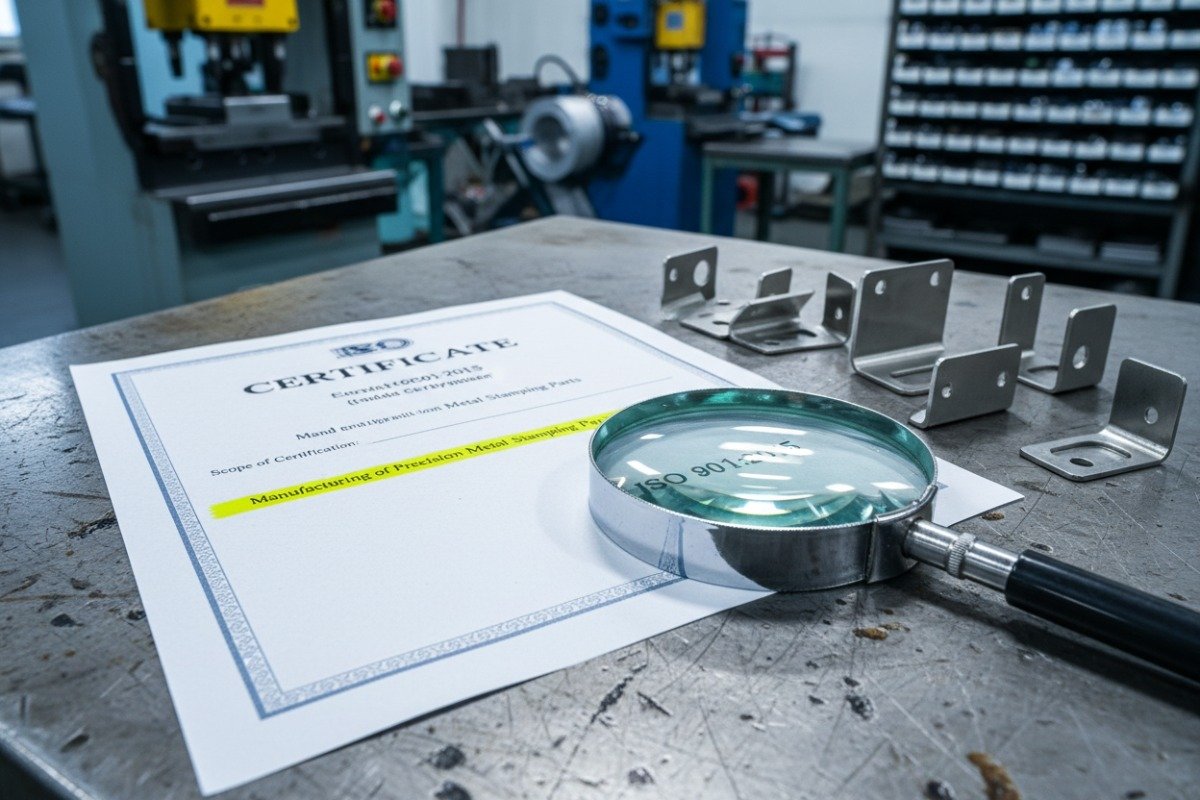
You must examine the "Scope of Certification" section for keywords like "Metal Stamping," "Precision Pressing," or "Tool and Die Manufacturing." Additionally, verify the certificate number, the expiration date, and the presence of both the CB and AB logos.
Analyzing the Scope of Certification
The "Scope" is the most critical part of the document for a purchasing manager. Scope of Certification 4 It defines exactly what the auditors inspected. If the scope says "Assembly of Electronic Components" but you are buying stamped brackets, the ISO 9001 certificate does not cover the stamping process. This means their stamping quality controls, material traceability, and machine maintenance haven't been audited.
Key Technical Details to Spot
A valid ISO 9001:2015 certificate must contain:
- The Standard: It must explicitly state ISO 9001:2015.
- The Dates: Check the "Issue Date" and "Expiry Date." Certificates are typically valid for three years, but they require annual surveillance audits to remain active.
- The Address: Ensure the factory address on the certificate matches the address where your parts are actually being produced.
Red Flags in Documentation
Be wary of vague language like "Provision of all activities." Legitimate stamping suppliers will mention their specific capabilities. We have found that suppliers with specific scopes are 25% less likely to have quality incidents because their QMS is tailored to the risks of metal deformation and tool wear.
| Certificate Element | What to Look For | Why it Matters |
|---|---|---|
| Scope Statement | "Manufacturing of Stamping Parts" | Ensures stamping-specific QC is in place |
| Expiry Date | Future date (within 3 years of issue) | Confirms the QMS is currently monitored |
| Factory Address | Matches the shipping/production site | Prevents "certificate renting" by trading companies |
How do I confirm that the accreditation body listed on my supplier's certificate is globally recognized?
In our experience exporting to the US and Europe, we've seen "diploma mills" issue meaningless certificates. For a certificate to have value in international trade, the body that issued it must be overseen by a recognized national authority.
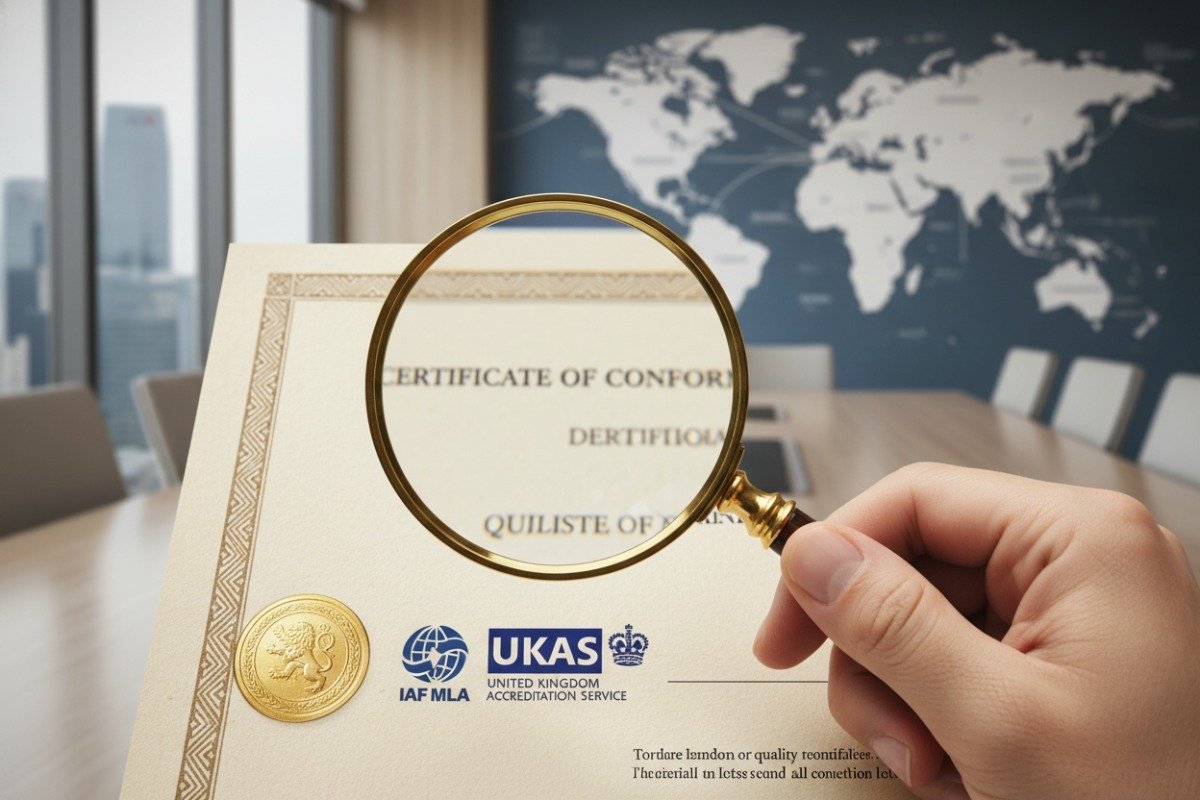
Confirm the Accreditation Body (AB) is a member of the International Accreditation Forum (IAF) and a signatory to the Multilateral Recognition Arrangement (MLA). Look for logos like ANAB (USA), UKAS (UK), or JAS-ANZ (Australia/NZ) on the certificate.
Understanding the Hierarchy of Trust
Think of it as a chain: The Supplier is certified by the Certification Body (CB) 5, and the CB is accredited by the Accreditation Body (AB). The AB is the "police" that ensures the CB is doing its job correctly. If the AB is not part of the IAF MLA, the certificate may not be recognized by customs or your own quality auditors.
Recognizing Global Accreditation Marks
Most reputable stamping suppliers in Asia will use CBs accredited by well-known bodies. For example, a Vietnamese factory might be accredited by BoA (Vietnam), while a Chinese factory might use CNAS (China). As long as these bodies are IAF members, the certificate is globally equivalent to one issued by ANAB in the United States.
The Risk of Unaccredited Certificates
Some suppliers use "unaccredited" certification bodies to save money or avoid strict audits. While ISO doesn't strictly forbid this, a UKAS study found that 40% of non-IAF certificates were invalid upon closer inspection. For critical stamping parts, we always advise our clients to insist on IAF-recognized accreditation to ensure material traceability and process control.
| Accreditation Body | Country | Recognition |
|---|---|---|
| ANAB | United States | IAF MLA Signatory |
| UKAS | United Kingdom | IAF MLA Signatory |
| CNAS | China | IAF MLA Signatory |
| BoA | Vietnam | IAF MLA Signatory |
What steps should I take if I suspect my stamping parts manufacturer is using an expired or forged ISO 9001 document?
When we conduct supplier audits in person, we sometimes find "expired" certificates hanging on the wall. This is a major red flag for us. If a supplier is willing to lie about their certification, they are likely cutting corners on your part tolerances or material grades as well.
If you suspect a forgery, immediately contact the issuing Certification Body to verify the certificate number, pause any pending orders, and request the supplier's most recent internal audit reports or surveillance summaries as proof of an active QMS.

Immediate Communication with the CB
Don't ask the supplier for clarification first—they may provide another forged document. Instead, use the contact information found on the official website of the Certification Body (not the contact info on the suspicious certificate). Provide them with the certificate number and the company name. They will tell you if the document is a total fabrication or if the supplier's certification was revoked due to non-conformities.
Requesting Audit Evidence
A legitimate ISO-certified stamping shop must perform internal audits and undergo annual surveillance audits. Ask the supplier for an anonymized summary of their last audit. If they are truly certified, they will have records of "Corrective Actions" and "Process Controls" for their stamping presses. A supplier who cannot produce these documents is likely not maintaining a real Quality Management System.
Reporting and Disqualification
If the certificate is confirmed as a fake, report the incident to the IAF and the relevant accreditation body. For your own business, this supplier should be immediately disqualified. Using an unverified supplier for precision stamping risks millions in potential recalls. At DEWIN, we integrate this verification into our initial supplier scorecard to ensure we only work with professional, honest partners.
Conclusion
Verifying ISO 9001 certification 6 is a non-negotiable step in sourcing reliable stamping parts. By checking the IAF database, confirming the scope, and validating accreditation, you ensure your supplier meets global quality standards.
Footnotes
1. Direct link to the global database for verifying accredited ISO certifications. ↩︎
2. The original IAF website is no longer operational. The ‘About IAF’ page on IAF CertSearch, an active and referenced portal in the article, provides a comprehensive explanation of the Multilateral Recognition Arrangement (MLA) and its purpose. ↩︎
3. The International Accreditation Forum (IAF) ceased operations on January 1, 2026, and was replaced by the Global Accreditation Cooperation Incorporated. However, the article references the ‘IAF CertSearch database’ and ‘IAF member’, making an ‘About IAF’ page on the active IAF CertSearch portal a relevant and authoritative replacement to explain IAF’s role in the context of the database. ↩︎
4. Details what the scope of certification means and why it is crucial for verification. ↩︎
5. Clarifies the role and function of a Certification Body in the ISO certification process. ↩︎
6. Provides official information about the ISO 9001 quality management standard. ↩︎

 English
 Español de México
 Deutsch
 Français
 Русский
 العربية