
In our experience exporting custom metal assemblies to the US custom metal assemblies 1, overlooking environmental regulations can result in customs seizures. We prioritize compliance early to avoid costly delays for our clients.
Primary environmental compliance requirements include RoHS, which restricts lead and cadmium, alongside REACH for chemical disclosures and Conflict Minerals regulations for ethical sourcing PFAS (Per- and Polyfluoroalkyl Substances) 2. US buyers must also consider California Proposition 65 and EPA TSCA standards to ensure full legal adherence for imported welding assemblies.
Let’s examine the specific regulations that form the foundation of a compliant supply chain.
Besides RoHS, does REACH or conflict minerals legislation apply to my welding parts procurement?
We often see specifications that list RoHS but forget the broader regulatory landscape. specifications that list RoHS 3 This oversight can cause major headaches when we export finished assemblies to the EU or US markets.
Yes, these regulations are critical. REACH requires tracking Substances of Very High Concern within the chemical supply chain, while Conflict Minerals legislation mandates proving that tin, tungsten, tantalum, and gold (3TG) in your welding alloys do not fund armed conflict.
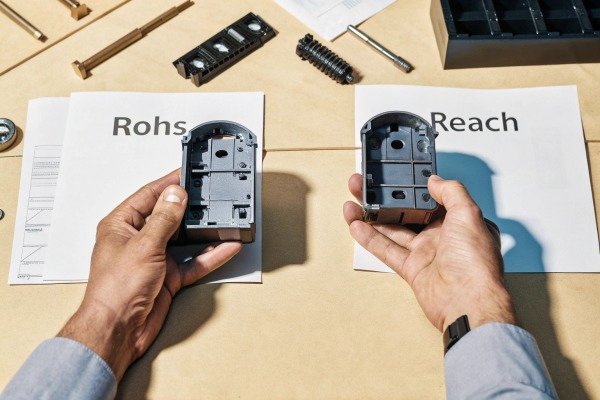
While RoHS (Restriction of Hazardous Substances) is the most famous directive, focusing primarily on the electronic and electrical equipment sectors, it is a mistake to assume it is the only rule that matters for welding parts. In our daily operations, we manage a matrix of regulations that interact with one another. If you are sourcing welding components, you are likely dealing with alloys, coatings, and solders, all of which trigger multiple compliance frameworks.
The Reach of REACH
REACH (Registration, Evaluation, Authorisation and Restriction of Chemicals) is often harder to manage than RoHS because it covers a much wider array of substances—Substances of Very High Concern (SVHCs). Unlike RoHS Substances of Very High Concern 4, which bans specific elements, REACH focuses on the disclosure и safe use of chemicals.
- Welding Relevance: Welding wires, fluxes, and anti-spatter sprays are chemical mixtures. If a welding wire contains a specific hazardous element above 0.1% weight by weight (w/w), and you import more than one ton per year into the EU, you have heavy reporting obligations.
- The Difference: RoHS is a ban; REACH is largely about communication and registration (though it does restrict some substances).
Conflict Minerals (3TG)
For our US clients, Section 1502 of the Dodd-Frank Act is vital. Dodd-Frank Act 5 This regulation concerns the sourcing of "3TG" minerals: Tin, Tantalum, Tungsten, and Gold.
- Tin: Used extensively in soldering and plating.
- Tungsten: A primary material for TIG welding electrodes.
- Gold: Often found in contact plating for high-end electronic welding interfaces.
- Tantalum: Less common in welding but found in associated electronics.
If your supply chain cannot prove these minerals come from conflict-free zones conflict-free zones 6 (primarily outside the DRC region), publicly traded companies face significant legal and reputational risks. We have to map our supply chain back to the smelter level to satisfy these audits.
California Proposition 65
If your welding parts enter California, you must warn consumers about exposure to chemicals known to cause cancer or reproductive harm. Welding fumes (containing Nickel or Chromium) and certain plastic handles (containing phthalates) are frequent targets.
Comparison of Key Regulatory Frameworks
| Regulation | Primary Focus | Key Relevance to Welding | Consequence of Non-Compliance |
|---|---|---|---|
| RoHS | Restriction of 10 specific substances (e.g., Lead, Cadmium). | Lead-free solder, Cr6+ free coatings. | Market ban in EU/Global markets. |
| REACH | Management of chemical risks (SVHCs). | Disclosure of chemicals in fluxes/wires. | Import blocks, fines, mandatory recalls. |
| Conflict Minerals | Ethical sourcing of 3TG metals. | Traceability of Tungsten electrodes & Tin. | SEC filing issues, reputational damage. |
| Prop 65 | Consumer warning labels. | Nickel/Cobalt in alloys, welding fumes. | Civil lawsuits, penalties per violation. |
How can I verify that my overseas suppliers strictly adhere to environmental compliance standards?
In our Vietnam facility, we have learned that a supplier's verbal promise is rarely enough. Vietnam facility 7 We have seen "compliant" documents that were clearly photocopied from another company.
Effective verification requires a combination of onsite factory audits, reviewing raw material mill test certificates, and conducting independent X-Ray Fluorescence (XRF) screening. Never accept a simple letter of intent; insist on traceable evidence that links specific batches to valid laboratory test results.
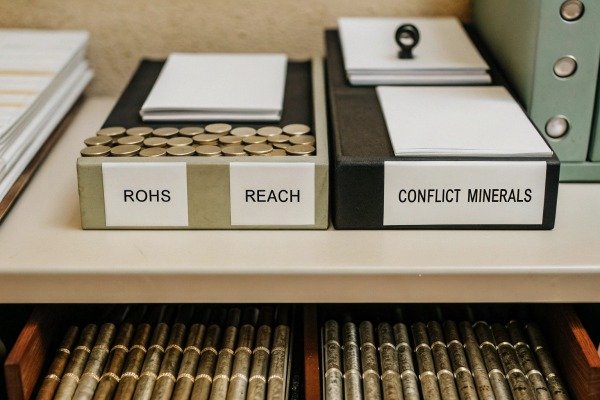
Blind trust in a supply chain is a strategy for failure. When we manage sourcing for our clients, we operate under the assumption that a part is non-compliant until proven otherwise. This skepticism is healthy and necessary. Verification is not a one-time event; it is a continuous process that involves multiple layers of scrutiny.
The "Homogeneous Material" Concept
One of the biggest misunderstandings we see is how suppliers test products. RoHS applies to every "homogeneous material" within a part. This means you cannot just grind up a whole welding torch and test the dust. You must test:
- The metal casing.
- The rubber grip.
- The paint on the label.
- The solder on the joint.
- The plating on the screw.
If the screw's plating contains Hexavalent Hexavalent Chromium 8 Chromium, the entire unit fails, even if the plating is only 0.01% of the total weight. We ensure our suppliers understand this granular level of testing.
Practical Verification Methods
We utilize a tiered approach to verification to balance cost and risk.
- Tier 1: Document Review: We check the Mill Test Certificates (MTC) from the raw material provider. This tells us the chemical composition of the steel or alloy batch. However, MTCs often don't list contaminants, only the target alloy elements.
- Tier 2: XRF Screening: X-Ray Fluorescence (XRF) is our first line of defense. It is a handheld gun that scans a material and gives a breakdown of elemental composition in seconds. It is excellent for spotting high levels of Lead (Pb) or Cadmium (Cd) in incoming goods. It is non-destructive and relatively cheap.
- Tier 3: Wet Chemical Analysis: If XRF results are inconclusive or borderline, we send samples to a third-party certified lab (like SGS or Intertek). They dissolve the material and use ICP-OES (Inductively Coupled Plasma Optical Emission Spectroscopy) for precise measurement. This is the only way to legally prove compliance in a court of law.
Assessing Supplier Maturity
We verify the supplier's process, not just the product. Does the supplier segregate leaded and lead-free solder in their factory? Do they have separate production lines? Cross-contamination is a major risk. A supplier might buy compliant wire but use a dirty solder pot that contains lead residue.
Verification Strategy Matrix
| Method | Cost | Speed | Accuracy | Best Use Case |
|---|---|---|---|---|
| Supplier Declaration | Низкие | Fast | Низкие | Initial screening of low-risk parts. |
| Mill Test Cert (MTC) | Низкие | Fast | Средний | Verifying base metal alloys (e.g., Steel, Aluminum). |
| Handheld XRF | Средний | Minutes | High (Screening) | Incoming Quality Control (IQC) at the dock. |
| Lab Analysis (ICP-OES) | Высокие | Days | Definitive | Final validation for high-risk or new components. |
What material declarations and test reports should I demand before approving a shipment?
When we prepare a shipment for our US clients, the documentation pack is as heavy as the parts. Missing one sheet can mean expensive demurrage charges at the port.
You must demand a project-specific RoHS Declaration of Conformity, Mill Test Reports (MTRs) verifying base metal chemistry, and Safety Data Sheets (SDS) for all surface treatments. Ideally, require a Full Material Declaration (FMD) to ensure transparency across every homogeneous material in the assembly.
Documentation is the "passport" for your products. Without it, your goods are essentially illegal immigrants in the destination market. We have established a strict protocol for what constitutes a complete data package (CDP) for welding parts.
The Hierarchy of Declarations
Not all documents are created equal. A simple email saying "We comply" is worthless.
- Certificate of Compliance (CoC): This must reference the specific PO number, part number, and the specific regulations (e.g., "Compliant with Directive 2011/65/EU and amendment 2015/863"). It must be signed by an authorized quality manager, not a sales rep.
- Full Material Declaration (FMD): This is the gold standard. It lists every substance in the product by CAS number and weight. With an FMD, you can check compliance against any future regulation because you know exactly what is in your part.
- Test Reports (SGS/TÜV/Intertek): These should be less than 12 months old. If a supplier sends a test report from 2018, reject it. Raw material sources change, and so does chemical composition.
Managing Safety Data Sheets (SDS)
For welding consumables like flux, paste, and gases, the SDS is mandatory. It serves two purposes:
- Safety: It tells your workers how to handle the material safely (OSHA requirement). OSHA requirement 9
- Environment: Section 3 (Composition) and Section 12 (Ecological Information) reveal if the product contains REACH SVHCs or aquatic toxins. We review these to ensure no hidden hazards are entering the facility.
Traceability to the Batch
A common trick in the industry is using a "Golden Sample" test report to cover years of production. We demand batch-specific traceability. The Heat Number on the steel tube must match the Heat Number on the Mill Test Report. If they don't match, the document is irrelevant.
Required Documentation Checklist
| Document Name | Назначение | Critical Checkpoint |
|---|---|---|
| RoHS Declaration of Conformity | Legal statement of adherence. | Must cite the current directive (including phthalates). |
| Mill Test Report (MTR) | Verifies base metal chemistry. | Match "Heat Number" on doc to the physical part. |
| Safety Data Sheet (SDS) | Chemical safety & composition. | Check Section 15 for Regulatory Info (TSCA, Prop 65). |
| 3rd Party Lab Report | Independent verification. | Check date (must be <1 year) and photo of the tested sample. |
| Conflict Minerals Report (CMRT) | Supply chain ethics tracking. | Ensure smelter IDs are verified compliant lists. |
Which hazardous substances are commonly found in welding components that I need to restrict?
Our engineering team constantly monitors consumable lists because hazardous elements often hide in plain sight. A "standard" galvanizing process can unexpectedly introduce prohibited heavy metals.
Restrict Lead (Pb) commonly found in older solder and free-machining alloys, and Cadmium (Cd) often used in corrosion-resistant plating and brazing fillers. Additionally, strictly monitor Hexavalent Chromium (Cr6+) levels in conversion coatings and passivates applied to galvanized steel components.

Knowing what to look for is half the battle. In the world of welding and metal fabrication, hazardous substances are not usually added maliciously; they are often traditional ingredients that provide specific performance characteristics. We have to actively engineer them out of the product.
Lead (Pb): The Usual Suspect
Lead is the most common offender. Lead is the most common 10
- Where it hides: Solders (tin-lead), brass alloys (added for machinability), and some older cable insulations.
- The Welding Risk: If you use "free-machining" steel or brass fittings in your welding assembly, they might contain lead. While there are exemptions for copper alloys (up to 4% lead), general steel is strictly limited.
- The Solution: Specify lead-free solders (SAC305) and ensure steel is strictly compliant.
Cadmium (Cd): The Silent Killer
Cadmium is highly toxic and strictly regulated (limit is 0.01%, ten times stricter than lead).
- Where it hides: Silver brazing filler metals (used to lower melting points), corrosion-resistant plating on bolts/fasteners, and some electrical contacts.
- The Welding Risk: Using a cadmium-bearing brazing rod releases deadly fumes.
- The Solution: Use Cadmium-free silver brazing alloys and specify Zinc-Nickel plating instead of Cadmium plating.
Hexavalent Chromium (Cr VI): The Coating Trap
This is the most common failure point for steel parts.
- Where it hides: The "yellow" or "gold" chromate conversion coating applied over zinc plating to prevent rust.
- The Welding Risk: Many welding assemblies are plated after fabrication. If the plating shop uses the traditional yellow chromate, it likely contains Cr VI.
- The Solution: You must specify "Trivalent Chromium" (Cr III) or "Clear/Blue Passivate." Be careful: some "yellow" dyes are added to Trivalent coatings to mimic the old look, but you need to verify the chemistry.
Welding Fume Components
While not always part of the final product compliance, buying parts that generate toxic fumes creates liability.
- Manganese: Essential in steel, but high-manganese fumes are a neurotoxin.
- Nickel: Found in stainless steel; a known carcinogen.
- PFAS (Per- and Polyfluoroalkyl Substances): These "forever chemicals" are increasingly regulated. They can be found in high-performance seals, gaskets, or non-stick coatings on welding jigs. We are now scanning our supply chain to eliminate PFAS ahead of upcoming strict EPA and EU regulations.
Заключение
Navigating environmental compliance for welding parts is complex, but non-negotiable. By understanding regulations like RoHS and REACH, verifying suppliers through audits and testing, and demanding precise documentation, you protect your business. We handle these rigorous checks daily to ensure every part we ship is compliant and market-ready.
Сноски
1. Overview of professional sheet metal fabrication and custom assembly services. ↩︎
2. Official EPA resource explaining PFAS chemicals and regulations. ↩︎
3. Official European Commission page detailing the RoHS directive and its requirements. ↩︎
4. Official ECHA list defining SVHCs under REACH regulations. ↩︎
5. Official SEC page detailing conflict minerals disclosure requirements. ↩︎
6. Industry standards for identifying and auditing conflict-free mineral supply chains. ↩︎
7. Global testing and certification services available in the Vietnam manufacturing region. ↩︎
8. Comprehensive background on the properties and environmental risks of hexavalent chromium. ↩︎
9. Official OSHA standard mandating Safety Data Sheets. ↩︎
10. Scientific research and technical data regarding lead-free solder in engineering applications. ↩︎

 English
 Español de México
 Deutsch
 Français
 Русский
 العربية