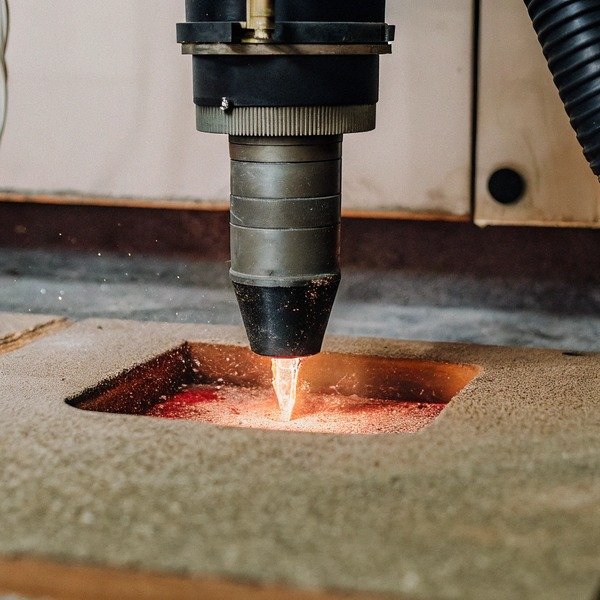
We often see production lines halted because a cheaper nozzle shattered under heat. When we audit suppliers in Vietnam, we prioritize testing protocols that prevent these costly disruptions for our clients.
Testing heat resistance involves a combination of thermal shock cycling and high-temperature endurance runs. You must subject the nozzle to rapid heating followed by quenching to identify fracture points, while also measuring dimensional stability and checking for micro-cracks using dye penetrants after extended exposure to peak welding Аргонодуговая сварка 1 amperages.
Here is a detailed breakdown of the procedures and standards necessary to ensure nozzle reliability.
What specific thermal shock testing procedures should I follow for ceramic nozzles?
During our initial product development phases, we noticed that gradual heating rarely reveals flaws. The real challenge comes when our engineers simulate the instant heat of an arc start.
You should utilize the Hasselmann Method or similar water-quench protocols where nozzles are heated to operational temperatures and immediately submerged in cool fluid. Repeat this cycle multiple times to verify the material’s ability to resist fracture from rapid thermal expansion and contraction without structural failure.
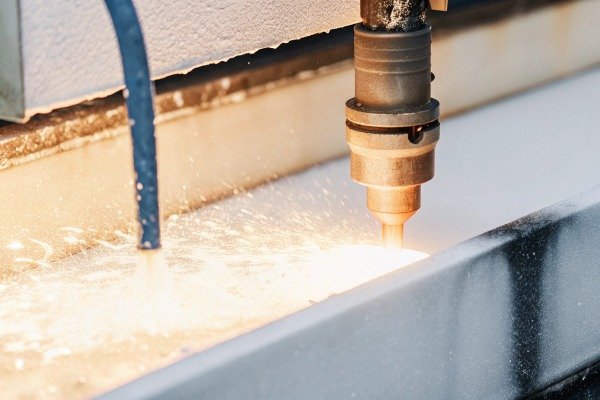
Testing for thermal shock is the single most critical step in validating a ceramic welding nozzle. In a real-world welding environment, a nozzle does not warm up slowly. It goes from room temperature to over 1,000°C in a matter of seconds when the arc is struck. If the material cannot handle this rapid expansion, catastrophic failure occurs immediately.
The Quench Test Methodology
To simulate this aggressive environment, we recommend a standardized quench test. You begin by heating the ceramic nozzle samples in a furnace to a specific temperature delta ($\Delta T$), typically starting at around 200°C and increasing in increments. Once the target temperature is reached and stabilized, the sample is dropped directly into a water bath kept at room temperature (approximately 20°C).
This rapid cooling forces the outer surface of the ceramic to contract while the core remains hot, creating immense tensile stress. After retrieval, you must inspect the sample for strength loss. A material that retains its flexural strength after a high $\Delta T$ quench demonstrates superior reliability. For high-performance welding, we look for materials that can withstand a $\Delta T$ of at least 400°C to 600°C without cracking.
Cycle Repetition
A single shock is rarely enough. In our testing labs, we run these cycles repeatedly to mimic the "trigger on, trigger off" nature of manual welding or robotic spot welding. We have found that fatigue accumulates. A nozzle might survive the first ten shocks but fail on the eleventh due to slow crack growth. We advise running at least 20 to 30 thermal cycles to ensure the lifespan meets industrial requirements.
Material-Specific Protocols
Different ceramics require different baselines. For example, Alumina is cost-effective but brittle, while Silicon Nitride handles shock much better. Silicon Nitride 2 We adjust our pass/fail criteria based on the material grade being used.
| Ceramic Material | Recommended Start Temp | Critical $\Delta T$ (Approx.) | Thermal Shock Resistance |
|---|---|---|---|
| Alumina (95-99%) | 200°C | 200°C – 250°C | Низкая или средняя |
| Zirconia (ZTA) | 350°C | 350°C – 450°C | Moderate (Tough) |
| Silicon Carbide | 400°C | 400°C – 500°C | Высокие |
| Silicon Nitride | 600°C | > 600°C | Отличная |
Which international standards govern the heat resistance requirements for welding ceramics?
We navigate complex compliance landscapes daily to ensure our shipments to the U.S. meet strict criteria. Ignoring established norms often leads to rejected batches at customs or the assembly line.
The primary standards include ASTM C1525 for determining thermal shock resistance and ASTM G99 for wear testing under thermal stress. Additionally, ASTM C1161 is often used for flexural strength testing at ambient and elevated temperatures to ensure the ceramic maintains structural integrity under welding conditions.
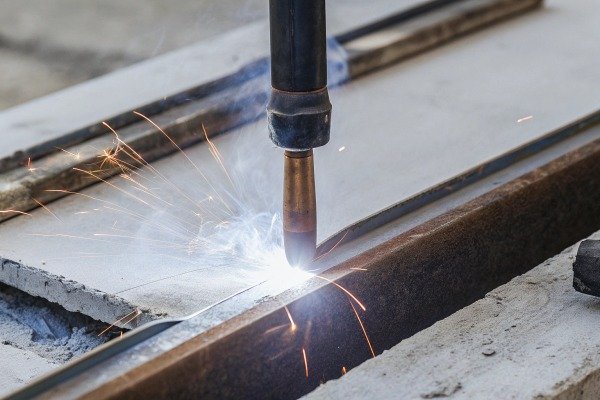
When sourcing custom parts from Asia, relying on a supplier's internal "good enough" standard is a recipe for disaster. You need objective benchmarks. In the ceramic industry, ASTM (American Society for Testing and Materials) standards provide the common language that defines quality.
ASTM C1525: The Thermal Shock Standard
This is the gold standard we reference when discussing rapid temperature changes. ASTM C1525 outlines the specific method for determining the thermal shock resistance ASTM C1525 3 of advanced ceramics using the water quench technique mentioned earlier. It dictates sample sizes, heating rates, and the calculation for the critical temperature difference ($\Delta T_c$). Following this standard ensures that your test results are comparable to data sheets from other premium manufacturers. premium manufacturers 4 It eliminates the variables of bucket size or water temperature that might skew informal tests.
ASTM C1161: Strength at Temperature
Heat resistance isn't just about not cracking; it is about staying strong while hot. ASTM C1161 covers the flexural strength (modulus of rupture) of ceramics. We often modify this test to run at elevated temperatures. A nozzle might be very hard at room temperature but become plastic or brittle at 1,200°C. By applying this standard, you measure exactly how much load the nozzle can bear when it is red-hot, ensuring it won't deform if it accidentally bumps the workpiece during a weld.
ISO and DIN Equivalents
For our clients exporting to Europe or sourcing globally, we also cross-reference ISO standards. It is important to know that ISO 14704 is roughly equivalent to ASTM C1161 regarding flexural strength. flexural strength 5 ISO 14704 6 Understanding these equivalencies helps when comparing material certificates from different countries.
Why Standardization Matters for Procurement
Using these standards protects your supply chain. If a batch fails in the field, you can go back to the test data. If the data shows compliance with ASTM C1525, the issue might be operational misuse. If the data is missing or non-compliant, the liability sits with the manufacturer.
| Standard Code | Область фокусировки | Relevance to Welding Nozzles |
|---|---|---|
| ASTM C1525 | Thermal Shock Resistance | Simulates rapid heating/cooling cycles (start/stop welding). |
| ASTM C1161 | Flexural Strength | Ensures nozzle won't snap under mechanical load while hot. |
| ASTM G76 | Erosion by Solid Particle | Tests resistance to spatter and gas-borne particulates. |
| ASTM G99 | Wear Testing | Evaluates durability of nozzle tip against wire friction. |
How can I detect microscopic cracks or structural failures after high-temperature exposure?
Our QC team in China rejects many visually perfect parts that fail under deeper scrutiny. Relying solely on the naked eye is a gamble we never take with high-performance components.
Effective detection requires fluorescent dye penetrant inspection to reveal surface fissures invisible to the naked eye. For internal structural integrity, we recommend acoustic emission monitoring during cooling cycles or scanning electron microscopy (SEM) on sample cross-sections to identify micro-structural degradation or phase changes.
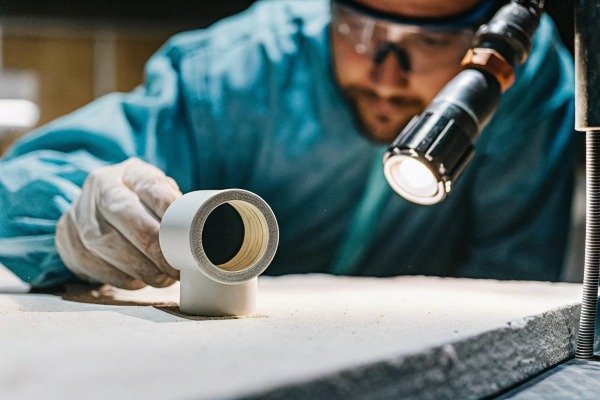
After a heat resistance test, a ceramic nozzle might look perfectly fine. It retains its shape, color, and general appearance. However, ceramics are notorious for failing due to microscopic flaws that propagate over time. Visual inspection is simply not enough for critical applications.
Dye Penetrant Inspection (DPI)
This is the most practical method for batch testing. We apply a highly penetrating fluorescent liquid to the surface of the tested nozzle. After a set dwell time, we wipe the surface clean and apply a developer. The dye that seeped into microscopic cracks bleeds back out, creating high-contrast lines. Under UV light, even the faintest hairline fractures glow brightly. This is a non-destructive test that we perform on a percentage of every shipment before it leaves our facility.
Scanning Electron Microscopy (SEM)
For deep failure analysis—usually during the prototype phase—we use SEM. This allows us to look at the grain structure of the ceramic. High heat can sometimes cause "grain growth" or phase transformation (like in Zirconia), which weakens the material. phase transformation 7 SEM images reveal if the heat exposure has degraded the internal bonding of the material, even if the surface is intact. It helps us understand почему a failure occurred, not just если it occurred.
Acoustic Emission Monitoring
This is an advanced technique used during the test itself. Sensors are attached to the ceramic while it cools. If a micro-crack forms, it releases a high-frequency sound wave (acoustic emission). acoustic emission 8 By monitoring these waves, we can pinpoint exactly at what temperature the cracking starts. This data is invaluable for setting safe operating limits for the welder.
Dimensional Stability Checks
Finally, simple precision measurement is vital. We use digital calipers to measure the nozzle bore and length before and after heat cycling. Any expansion, shrinkage, or warping indicates that the material is not stable at those temperatures, likely due to sintering continuing during use or stress relaxation.
| Метод обнаружения | Defect Type Detected | Сложность | Стоимость |
|---|---|---|---|
| Визуальный осмотр | Large cracks, spalling, discoloration | Низкие | Низкие |
| Dye Penetrant | Surface micro-cracks, porosity | Низкая-средняя | Низкие |
| Ultrasonic/Acoustic | Internal voids, active cracking | Высокие | Высокие |
| SEM Analysis | Microstructural changes, grain growth | Очень высокий | Высокие |
What temperature parameters should I set to simulate realistic welding environments?
We calibrate our testing equipment to match the exact specs of the welding torches our clients use. Guesswork in temperature settings usually results in field failures that damage buyer trust.
Set your test parameters to match the specific nozzle material limits, typically ranging from 1,000°C for standard alumina to over 1,600°C for silicon nitride. You must replicate the rapid heating rate of an arc start, reaching peak temperature within seconds, followed by variable cooling periods to simulate duty cycles.
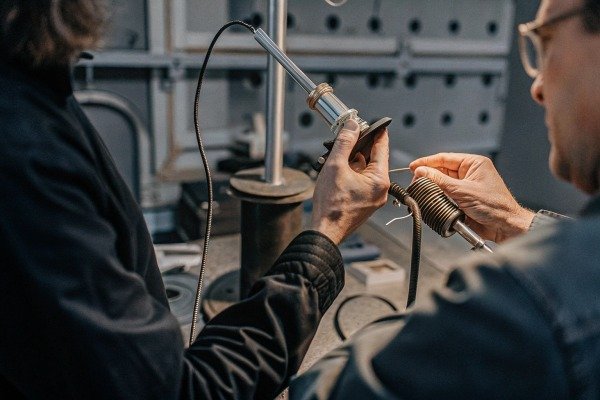
Setting the right temperature parameters is about context. A nozzle used for light TIG welding on aluminum faces a completely different thermal profile than a nozzle used for high-amperage MIG welding on thick steel plates сварка MIG 9. To test effectively, your parameters must mirror reality.
Defining Peak Temperatures
The first parameter is the maximum soak temperature. This is the highest temperature the nozzle tip will endure.
- Standard MIG/MAG: The nozzle is near the arc but cooled by shielding gas. Test at 400°C to 600°C.
- High-Amperage Spray Transfer: The radiant heat is intense. Test at 800°C to 1,000°C.
- Plasma or TIG: These are the hottest environments. Test at 1,200°C to 1,500°C depending on proximity to the plasma column.
We always advise testing slightly above the rated service temperature (about 10-15% higher) to build in a safety factor. safety factor 10 If your customer runs at 400 amps, test as if they are running at 450 amps.
Heating Rates (Ramp Up)
In a lab furnace, it is easy to heat a sample slowly (e.g., 10°C per minute). This is useless for welding simulation. A welding arc reaches thousands of degrees in milliseconds. While you cannot replicate that instantly in a furnace, you should use the fastest ramp rate your equipment allows, or use the "drop-in" method where a cold sample is placed directly into a pre-heated hot zone. This shock heating is the primary killer of ceramic nozzles.
Duty Cycles and Cooling
Welding is rarely continuous. A welder welds for two minutes, stops to reposition, then welds again. Your test must simulate this.
- Параметр: Hold at peak temp for 5 minutes.
- Параметр: Cool to 100°C (using forced air to simulate shielding gas flow).
- Параметр: Repeat.
We configure our thermal cycling rigs to blow compressed air through the nozzle during the cooling phase. This mimics the shielding gas that flows through the nozzle in actual use, which actually creates a complex thermal gradient—the inside is being cooled by gas while the outside is being heated by the arc. This "hot-out, cool-in" gradient is a major source of stress that static oven testing misses completely.
Заключение
Testing the heat resistance of ceramic welding nozzles requires a rigorous approach that moves beyond simple observation. By combining standardized thermal shock protocols, precise crack detection methods, and realistic temperature simulations, you ensure the final product can withstand the harsh reality of industrial welding. We implement these stringent controls to guarantee that the parts we deliver perform flawlessly from the first arc strike.
Сноски
1. Industry guide for TIG welding processes, including equipment selection and thermal management. ↩︎
2. Technical data and performance characteristics of silicon nitride ceramics in high-temperature environments. ↩︎
3. Official standard specification for thermal shock resistance of ceramics. ↩︎
4. Official ASTM standard for testing the thermal shock resistance of advanced ceramic materials. ↩︎
5. Standard test method for flexural strength of advanced ceramics at ambient temperatures. ↩︎
6. International standard for determining the flexural strength of fine ceramics at room temperature. ↩︎
7. Scientific background on zirconia ceramics and their phase transformations under thermal stress. ↩︎
8. Authoritative explanation of this non-destructive testing method. ↩︎
9. Defines the high-heat welding process requiring robust nozzle testing. ↩︎
10. General properties and thermal limits for alumina, a common ceramic used in welding nozzles. ↩︎

 English
 Español de México
 Deutsch
 Français
 Русский
 العربية