
When our procurement team reviews supplier quotes each quarter, we see the same problem. Metal prices swing wildly. Budgets break. Projects stall.
To lock in stamping part prices amid raw material fluctuations, negotiate long-term contracts with fixed pricing clauses, build detailed cost models to benchmark quotes, and establish price adjustment mechanisms tied to verified material indices. Collaborative supplier relationships and strategic material pre-purchasing also provide stability.
The good news is you can protect your bottom line. Below, I will share proven strategies our team uses when sourcing stamping parts from Asia. These methods help you gain control over costs and reduce surprises.
How Can I Negotiate Fixed Pricing for Stamping Parts When Metal Costs Are Unstable?
Our engineers have spent years working with stamping suppliers across Vietnam and China. We learned that fixed pricing is possible. But it requires preparation.
Negotiate fixed pricing by presenting suppliers with detailed cost models, committing to minimum order quantities, and agreeing on multi-year contracts with escalation caps. Suppliers accept fixed prices when buyers offer volume certainty and share market risk through transparent forecasting.

Start With a Should-Be Cost Model
Before you negotiate, you need data. A should-be cost model breaks down what a part should cost based on its attributes. This includes material weight, tolerance, geometry, and annual volume.
When we prepare for negotiations, we request detailed cost breakdowns from suppliers. We compare these against our internal models. This reveals overpricing. Common issues include excessive tooling amortization or inflated offal percentages.
Here is a typical cost breakdown for stamped parts:
| Компонент затрат | Percentage of Total Cost |
|---|---|
| Raw Materials | 50-60% |
| Tooling & Labor | 20-30% |
| Overhead & Profit | 10-20% |
Understanding this breakdown gives you leverage. You can challenge specific line items instead of arguing about total price.
Commit to Volume for Better Rates
Suppliers take risks when they lock prices. They worry about material cost spikes eating their margins. You can reduce their risk by committing to volume.
Minimum order quantities (MOQs) give suppliers confidence. They can negotiate better rates with their own material suppliers. They can plan production schedules efficiently.
In our experience, annual volumes under 100,000 units inflate per-piece pricing by up to 40%. annual volumes under 100,000 1 Higher volumes unlock economies of scale. This makes fixed pricing more attractive for both parties.
Use Multi-Year Agreements With Caps
A multi-year contract protects you from sudden price jumps. But suppliers need protection too. The solution is escalation caps.
An escalation cap limits how much prices can increase each year. For example, you might agree that prices can rise by a maximum of 5% annually. This gives suppliers room to adjust while protecting your budget.
We recommend tying caps to verified material indices. The London Metal Exchange (LME) publishes aluminum and steel prices. tied to verified material 2 These provide objective benchmarks that both parties can trust.
Build Relationships, Not Just Contracts
Fixed pricing works best with trusted partners. When we audit suppliers in Vietnam, we look beyond price. We evaluate their communication, quality systems, and financial stability.
A supplier who understands your business will work with you during market swings. They might absorb small increases to maintain the relationship. This flexibility comes from trust built over time.
What Clauses Should I Add to My Contract to Manage Raw Material Volatility?
When we draft contracts with stamping suppliers, we include specific clauses for price protection. These clauses define how both parties handle market changes.
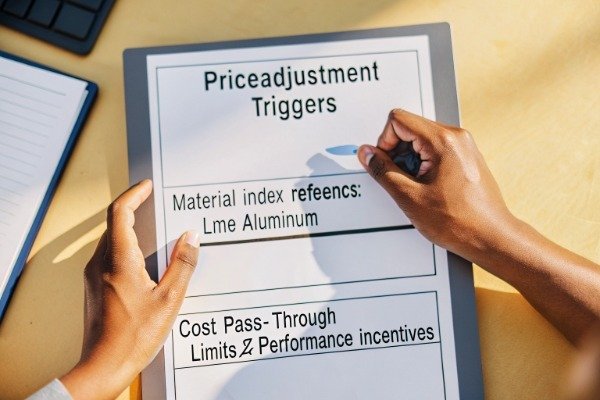
Add clauses for price adjustment triggers, material index references, cost pass-through limits, and force majeure conditions. Include performance incentives for quality and delivery. These clauses create a fair framework that protects both buyer and supplier interests.
Price Adjustment Trigger Clauses
A price adjustment trigger defines when prices can change. Without this clause, suppliers might request increases whenever they want. With it, changes follow clear rules.
Common triggers include:
- Material index changes exceeding a threshold (e.g., 10%)
- Currency exchange rate fluctuations beyond a set range
- Government tariffs or import duties Government tariffs or import 3
We recommend quarterly reviews. This frequency balances stability with market responsiveness.
Material Index Reference Clauses
Your contract should specify which indices determine material costs. Vague language creates disputes. Specific references create clarity.
| Тип материала | Recommended Index |
|---|---|
| Алюминий | LME Aluminum |
| Сталь | CRU Steel Price Index |
| Медь | LME Copper |
| Stainless MEPS Stainless Steel 5 Сталь | MEPS Stainless Steel |
When both parties agree on the index, price discussions become objective. You compare current prices against the baseline. The math determines the adjustment.
Cost Pass-Through Limits
Even with triggers and indices, you need limits. A cost pass-through limit caps how much of a material increase the supplier can pass to you.
For example, if steel prices rise 20%, your contract might allow the supplier to pass through only 15%. The supplier absorbs the remaining 5%. This shared risk encourages suppliers to manage their own costs efficiently.
Performance Incentive Clauses
Price is not everything. Quality and delivery matter too. Performance incentives reward suppliers who meet targets.
Consider these incentive structures:
- Rebates for on-time delivery rates above 95%
- Bonuses for quality yields exceeding 98%
- Shared savings from value engineering improvements
These clauses align supplier interests with yours. They encourage continuous improvement rather than just cost cutting.
Force Majeure and Hardship Clauses
Extreme events happen. Pandemics, wars, and natural disasters disrupt supply chains. Force majeure clauses address these situations. Pandemics, wars, and natural 6
A hardship clause is different. It covers severe market changes that make contract performance unreasonably difficult. For example, a 50% material price spike might trigger renegotiation rights.
We include both clauses in our contracts. They provide flexibility during crises while maintaining the overall agreement structure.
Can I Pre-Purchase Raw Materials to Lock in Costs for My Production Run?
Our team in China has helped clients pre-purchase materials for large projects. This strategy works well in certain situations. But it requires careful planning.
Yes, you can pre-purchase raw materials to lock in costs. Work with your supplier to buy materials at current prices and store them for future production. This strategy suits high-volume runs with predictable schedules but requires upfront capital and storage arrangements.

When Pre-Purchasing Makes Sense
Pre-purchasing works best when you have:
- High annual volumes (100,000+ units)
- Predictable production schedules
- Available capital for upfront investment
- Confidence in material price increases
If your volumes are low or schedules uncertain, pre-purchasing creates risk. You might end up with excess material you cannot use.
How to Structure a Pre-Purchase Agreement
A pre-purchase agreement defines who buys, stores, and owns the material. There are several models:
| Model | Buyer Responsibility | Supplier Responsibility |
|---|---|---|
| Buyer-Owned Inventory | Purchase and own material | Store and process material |
| Consignment | Pay upon usage | Purchase, store, and own until used |
| Supplier Pre-Buy | Provide purchase order commitment | Buy and store at agreed price |
We often recommend the supplier pre-buy model. The supplier purchases material based on your committed orders. They store it at their facility. You pay the agreed price regardless of market changes.
Managing Storage and Quality Risks
Stored materials can degrade. Steel rusts. Aluminum oxidizes. Proper storage conditions are essential.
Your agreement should specify:
- Storage location and conditions
- Maximum storage duration
- Quality inspection requirements before use
- Insurance and liability terms
We conduct regular audits of supplier storage facilities. This ensures materials remain in good condition throughout the storage period.
Calculating the Financial Impact
Pre-purchasing requires upfront capital. You need to calculate whether the savings justify the investment.
Consider this example:
- Annual material cost: $500,000
- Expected price increase: 15%
- Pre-purchase savings: $75,000
- Capital cost (interest): $15,000
- Net savings: $60,000
In this case, pre-purchasing makes financial sense. But if price increases are smaller or capital costs higher, the calculation changes.
Combining Pre-Purchase With Hedging
Some buyers combine physical pre-purchasing with financial hedging. They buy futures contracts to lock in prices for materials they will purchase later.
This approach requires financial expertise. It also involves counterparty risk. We recommend consulting with financial advisors before implementing hedging strategies.
How Do I Set Up a Fair Price Adjustment Mechanism With My Supplier?
When we negotiate with stamping suppliers, we aim for mechanisms that work for both sides. Unfair terms create resentment. They lead to quality problems and delivery delays.
Set up a fair price adjustment mechanism by agreeing on transparent cost formulas, using verified market indices, establishing review frequencies, and defining adjustment caps. Both parties should understand and accept the methodology before signing the contract.

The Transparency Principle
Fair mechanisms start with transparency. Both parties must understand how prices are calculated. Hidden formulas create distrust.
We ask suppliers to provide fully-costed Bills of Materials (BOMs). These show: fully-costed Bills of Materials 7
- Material type and weight per part
- Material price per kilogram
- Processing costs
- Tooling amortization
- Overhead and profit margins
With this information, both parties can verify calculations. Disputes become discussions about data, not accusations about fairness.
Choosing the Right Index
The index you choose affects adjustment outcomes. Some indices are more volatile than others. Some update daily while others update monthly.
Consider these factors when selecting an index:
- Relevance to your specific material grade
- Update frequency
- Historical volatility
- Accessibility and cost
We prefer widely-used indices like LME for base metals. They are transparent, accessible, and accepted by most suppliers.
Setting Review Frequency
How often should prices adjust? More frequent reviews track market changes closely. Less frequent reviews provide budget stability.
| Review Frequency | Преимущества | Недостатки |
|---|---|---|
| Ежемесячно | Tracks market closely | Administrative burden |
| Ежеквартально | Balances tracking and stability | May miss short-term swings |
| Semi-Annual | Simplifies planning | Larger adjustments when they occur |
| Ежегодно | Maximum budget stability | Significant market exposure |
We typically recommend quarterly reviews. This frequency captures meaningful market movements without creating excessive administrative work.
Defining Adjustment Caps and Floors
Caps limit upward adjustments. Floors limit downward adjustments. Together, they create a band of acceptable price changes.
Например:
- Cap: Maximum 8% increase per quarter
- Floor: Maximum 8% decrease per quarter
Caps protect buyers from extreme spikes. Floors protect suppliers from being forced to sell below cost during market crashes.
Handling Disputes
Even with clear mechanisms, disputes happen. Your contract should define a resolution process.
We recommend a tiered approach:
- Operational teams discuss and attempt resolution
- Management review if teams cannot agree
- Third-party mediation if management cannot resolve
- Arbitration as final resort
Most disputes resolve at the first or second tier. Having a clear process prevents small disagreements from becoming major conflicts.
Building Long-Term Partnership Value
The best price adjustment mechanisms evolve over time. As you work with a supplier, you learn what works and what does not.
We schedule annual contract reviews with key suppliers. During these reviews, we discuss:
- What worked well in the past year
- What created friction or confusion
- How to improve the mechanism going forward
This collaborative approach builds partnerships that survive market volatility. Both parties invest in the relationship because both parties benefit from its success.
Заключение
Locking in stamping part prices requires preparation, clear contracts, and strong supplier relationships. Use these strategies to protect your budget and build partnerships that deliver value through market cycles.
Сноски
1. Provides general context for economies of scale. ↩︎
2. The LME is a major source of metal prices, as mentioned in the article. ↩︎
3. The WTO covers international trade and tariffs. ↩︎
4. Directly references the LME Aluminum index. ↩︎
5. MEPS is a source for stainless steel pricing data. ↩︎
6. Ready.gov provides information about disaster preparedness. ↩︎
7. Investopedia provides a definition of Bill of Materials. ↩︎

 English
 Español de México
 Deutsch
 Français
 Русский
 العربية