
Every week, our project team reviews supplier qualification files for titanium parts — and the gap between a capable shop and a risky one is staggering AS9100 or ISO 13485 1. If you source titanium components for aerospace, medical, or defense applications, one wrong partner choice can cost you months of delays, scrapped parts, and damaged client relationships.
Choosing the best CNC machining titanium manufacturer means verifying certifications like AS9100 or ISO 13485, confirming hands-on experience with your specific titanium grade, auditing their equipment for 5-axis rigidity and high-pressure coolant systems, and testing quality control processes through a prototype order before committing to production volumes.
The following sections break down the exact steps, red flags, and evaluation criteria you need ISO 9001 for general quality management 2. Let's walk through each one so you can make a confident, informed decision.
What Specific Certifications Should I Verify Before Hiring a Titanium CNC Partner?
When we onboard a new machining supplier in Vietnam or across Asia, the very first documents our quality engineers request are certifications — because without them, nothing else matters in regulated industries AS9100 for aerospace compliance 3.
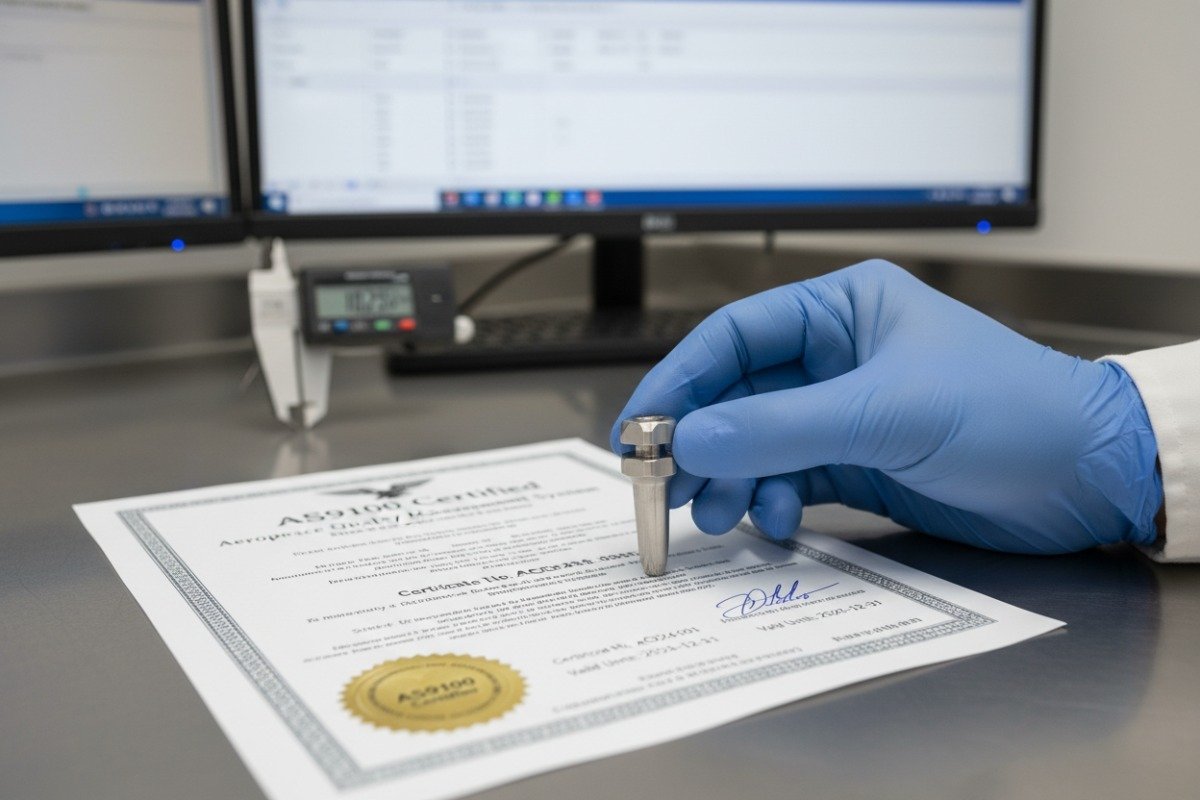
Before hiring a titanium CNC partner, verify ISO 9001 for general quality management, AS9100 for aerospace compliance, ISO 13485 for medical device parts, and ITAR registration for defense work. These certifications confirm the manufacturer follows documented processes, traceability standards, and audit-ready quality systems required by end-use industries.
Why Certifications Matter More for Titanium Than Other Metals
Titanium parts often end up in life-critical applications ISO 13485 for medical device parts 4. A hip implant. A jet engine bracket. A submarine valve. In these cases, your end customer isn't just buying a part — they're buying proof that every step was controlled, documented, and repeatable ITAR registration for defense work 5.
Certifications are that proof. They tell your customer's auditor that the shop follows standardized procedures for прослеживаемость материалов 6, process control, inspection, and corrective action. Without them, you carry all the risk.
The Core Certifications to Check
Here is a quick reference table for the most important certifications and what they cover:
| Сертификация | Отраслевая направленность | Что это доказывает |
|---|---|---|
| ISO 9001:2015 | Общее производство | Basic quality management system is in place |
| AS9100D | Аэрокосмическая и оборонная промышленность | Meets strict aerospace quality and traceability requirements |
| ISO 13485 | Медицинские изделия | Соответствие нормам производства медицинских изделий |
| ITAR Registration | Оборонная промышленность США | Authorized to handle defense-related technical data and parts |
| NADCAP | Специальные процессы в аэрокосмической отрасли | Accredited for specific processes like heat treatment or NDT |
Don't Just Ask — Verify
A certificate on a website means little if it's expired or covers a different facility. Our team always requests the actual certificate document, checks the expiration date, and confirms the scope covers the specific processes we need — such as CNC milling or turning of titanium alloys.
You should also check if the certification body is accredited. A certificate from an unrecognized auditor is a red flag. Look for accreditation from bodies like ANAB, UKAS, or DAkkS.
Material Traceability Is Non-Negotiable
For titanium, full material traceability from the mill to the finished component is essential. This means the manufacturer should provide mill test reports (MTRs) 7 that match the raw material to your specific order. In aerospace, this is a hard requirement under AS9100. In medical, ISO 13485 demands it too.
If a shop cannot produce an MTR on request, walk away. We have seen cases where suppliers substituted titanium grades without disclosure, leading to catastrophic field failures. Traceability prevents this.
Beyond the Certificate: Look at Audit History
Ask the manufacturer for their last external audit report summary. A shop that has zero non-conformances in five years is either exceptional or hiding something. A shop that had findings and closed them with effective corrective actions shows maturity. That's the partner you want.
How Can I Assess If a Manufacturer Has Enough Experience With the Complexities of My Titanium Grade?
Our engineers in China and Vietnam have worked with Grade 2, Grade 5, and Grade 23 titanium across hundreds of projects — and each grade behaves differently on the machine. A shop that treats all titanium the same will burn through tools and deliver out-of-spec parts.
To assess a manufacturer's titanium grade experience, request case studies of parts made from your specific grade, ask about their tooling strategies and cutting parameters, and verify they understand the grade's unique properties — such as Grade 5's work-hardening tendency or Grade 2's galling risk — through detailed technical conversations during the RFQ process.

Why Titanium Grade Knowledge Separates Experts From Generalists
Not all titanium is the same. The difference between Grade 2 and Grade 5 is enormous in terms of machinability, strength, and application. A manufacturer who machines mostly aluminum or stainless steel may claim they "can do titanium," but that claim falls apart when tight tolerances and complex geometries are involved.
Titanium's low thermal conductivity means heat stays in the cutting zone. Its high strength-to-weight ratio means higher cutting forces. Its tendency to work-harden means aggressive feeds are sometimes better than conservative ones. These are counterintuitive behaviors that only experienced shops understand.
Key Titanium Grades and Their Challenges
| Titanium Grade | Ключевые свойства | Распространенные области применения | Сложность обработки |
|---|---|---|---|
| Grade 2 (CP) | Excellent corrosion resistance, good weldability | Chemical processing, marine, general industrial | Moderate — galling risk on tools |
| Grade 5 (Ti-6Al-4V) 8 | High strength, good ductility, heat resistant | Aerospace structural parts, high-performance components | High — work-hardens rapidly |
| Grade 23 (Ti-6Al-4V ELI) | Enhanced ductility, biocompatible | Medical implants, surgical instruments | High — requires precise coolant control |
| Grade 9 (Ti-3Al-2.5V) | Good strength, lightweight, weldable | Hydraulic tubing, bicycle frames, aerospace tubing | От умеренного до высокого |
Questions to Ask During the RFQ
When you send your RFQ, include these questions:
- What titanium grades have you machined in the last 12 months?
- Can you share a case study or sample part made from my specific grade?
- What tooling do you use for this grade? Coated carbide? Ceramic?
- What spindle speeds and feed rates do you typically run?
- How do you manage heat buildup during long cycle times?
A confident, detailed answer is a green flag. A vague response like "we can machine any material" is a red flag.
Test With a Prototype Order
We always recommend starting with a prototype or small pilot order. This is the fastest way to see if a manufacturer can hold your tolerances — often ±0.0002 inches or ±0.005mm for titanium aerospace parts. It also reveals their communication style, lead time accuracy, and inspection quality.
A good shop will deliver a prototype in 3 to 7 days with a full dimensional report. A struggling shop will ask for extensions, deliver incomplete paperwork, or miss critical dimensions.
The Cost of Getting It Wrong
Surveys show that 70% of titanium machining failures trace back to poor partner selection. Scrap rates at inexperienced shops can exceed 10%, compared to under 1% at expert facilities. When titanium raw material costs 3 to 5 times more than aluminum, that scrap adds up fast.
What Are the Key Red Flags I Should Watch Out for During My Initial Supplier Evaluation?
During our supplier audits across Asia, we have developed a sharp eye for warning signs. Some problems are obvious on the factory floor. Others hide in how a supplier responds — or fails to respond — to your technical questions.
Key red flags during initial supplier evaluation include vague or delayed responses to technical questions, lack of high-pressure coolant systems on their CNC machines, missing or expired certifications, no in-house CMM inspection capability, unwillingness to share case studies, and quoting unusually low prices that suggest they underestimate titanium's machining complexity.
Red Flag #1: Vague Technical Responses
When you ask a supplier what cutting tools they use for Grade 5 titanium, you should get a specific answer. Something like: "We use coated carbide inserts with TiAlN coating, running at 40-60 m/min surface speed with high-pressure coolant at 70 bar." If instead you hear "we use standard tooling," that's a problem.
Titanium machining demands specialized knowledge. A supplier who cannot articulate their approach likely does not have one.
Red Flag #2: No High-Pressure Coolant System
Titanium generates extreme heat at the cutting zone. Without high-pressure coolant — typically 70 bar or higher — chips weld to the tool, surface finish degrades, and tools break. high-pressure coolant systems 9 Standard flood coolant is not enough.
If you visit a shop or ask about their coolant setup and they mention only standard systems, they are not equipped for serious titanium work.
Red Flag #3: No In-House Inspection
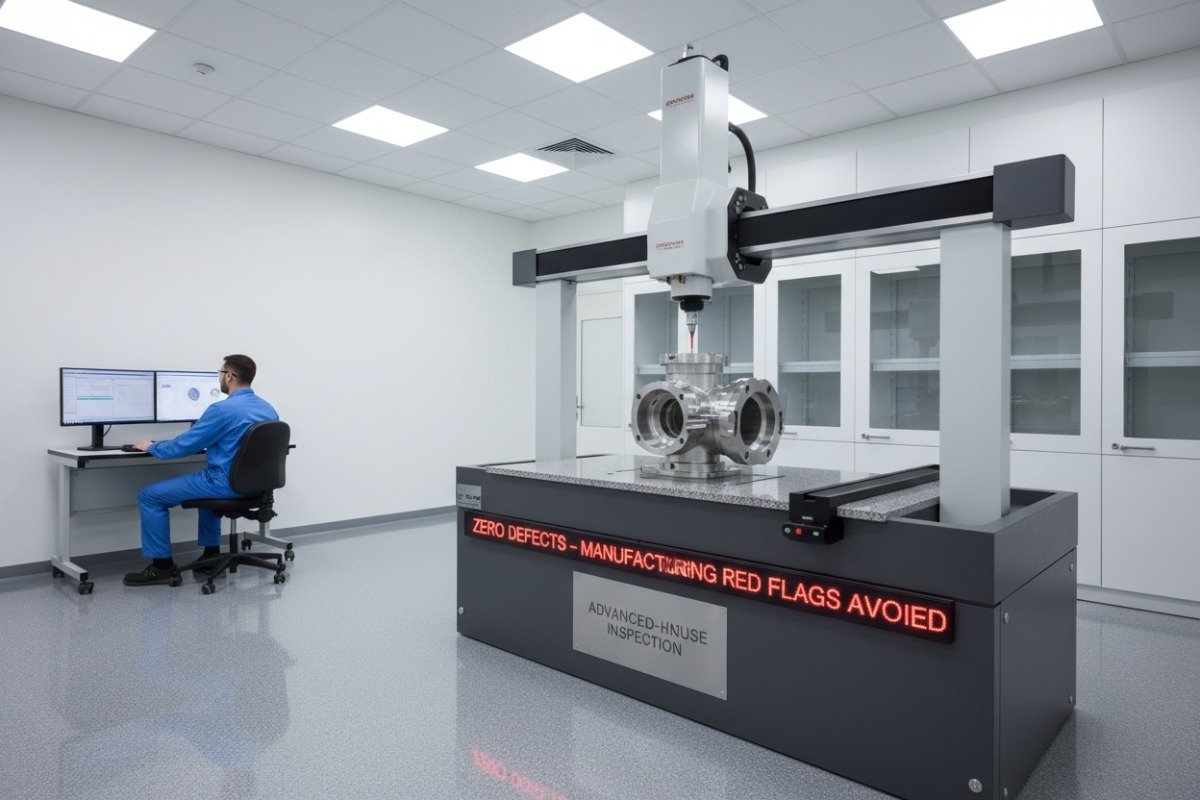
A titanium part with a ±0.0002-inch tolerance needs CMM (Coordinate Measuring Machine) verification 10. If the shop outsources inspection, turnaround slows, accountability blurs, and errors multiply.
Our quality team insists on in-house CMM capability with calibrated equipment and trained operators. We also look for surface roughness testers and optical comparators as secondary verification tools.
Red Flag #4: Price That Seems Too Good
Titanium machining costs 3 to 5 times more than aluminum machining. Tools wear 30 to 50% faster. Cycle times are longer. If a quote comes in close to aluminum pricing, the supplier is either inexperienced, cutting corners, or planning to renegotiate later.
We have seen U.S. buyers chase low quotes from unqualified shops, only to face rejected parts, missed deadlines, and total project restarts. The "savings" evaporated — and then some.
Red Flag #5: No Portfolio or Case Studies
A manufacturer proud of their titanium work will show it. They'll have photos, dimensional reports, and customer testimonials. If they cannot provide a single example of a titanium part they've made, treat that as a serious warning.
Green Flags to Look For
To balance the picture, here are signs of a strong partner:
- They offer DFM (Design for Manufacturability) feedback before quoting
- They have a dedicated engineer assigned to your project
- They proactively flag potential issues in your drawing
- They provide a detailed inspection plan with your quote
- They can scale from prototype to production without outsourcing
Quick Comparison: Red Flags vs. Green Flags
| Красный флаг | Зеленый флаг |
|---|---|
| Vague answers to technical questions | Specific tooling, speed, and coolant details |
| No certifications or expired ones | Current AS9100, ISO 13485, or ISO 9001 |
| Outsourced inspection | In-house CMM with calibration records |
| Unusually low pricing | Transparent cost breakdown with material + machining |
| No case studies or portfolio | Documented examples of similar titanium parts |
| Slow or unresponsive communication | Replies within 24 hours with detailed information |
How Do I Balance High-Quality Precision With My Budget When Sourcing Titanium Components?
On our production floor, we see this tension every day — clients need aerospace-grade precision but face real budget constraints. The good news is that balancing quality and cost is possible. It just requires smart decisions at the right stages.
To balance precision and budget when sourcing titanium components, invest in DFM optimization to reduce unnecessary complexity, specify only the tolerances your application truly requires, start with prototype validation to avoid costly rework, and choose a manufacturer whose equipment and expertise minimize scrap rates — because the cheapest quote rarely delivers the lowest total cost.

Understand Total Cost, Not Just Unit Price
The biggest mistake buyers make is comparing unit prices on quotes. Titanium sourcing costs include far more than the per-part price. You need to account for:
- Raw material cost (titanium bar stock is expensive and volatile)
- Tooling wear and replacement
- Контроль и документация
- Scrap and rework rates
- Shipping and lead time reliability
- Communication overhead and project management
A shop quoting $50 per part with a 12% scrap rate and frequent delivery delays will cost you more than a shop quoting $65 per part with under 1% scrap and on-time delivery. We help our clients model this total cost before they commit.
DFM: Your Biggest Cost-Saving Tool
Design for Manufacturability feedback is where the real savings happen — before the first chip is cut. A skilled titanium manufacturer will review your drawing and suggest changes like:
- Relaxing tolerances on non-critical features from ±0.001" to ±0.005"
- Adjusting wall thicknesses to reduce vibration during machining
- Simplifying internal geometries to allow standard tooling access
- Recommending a more machinable titanium grade if your application allows it
These changes can reduce cycle time by 20 to 40% without affecting part performance.
Оптимизация допусков
Not every feature on your part needs the tightest tolerance. Over-tolerancing is one of the most common — and most expensive — mistakes in titanium sourcing.
Here's a practical example of how tolerance affects cost:
| Уровень допуска | Типичное применение | Relative Machining Cost | Inspection Requirement |
|---|---|---|---|
| ±0.010" (±0.25mm) | General structural features | 1x (базовый уровень) | Standard caliper or micrometer |
| ±0.005" (±0.13mm) | Mating surfaces, fit features | 1,5x | Micrometer or CMM spot check |
| ±0.002" (±0.05mm) | Precision assemblies | 2.5x | Full CMM inspection |
| ±0.0005" (±0.013mm) | Aerospace critical dimensions | 4-5x | CMM with temperature-controlled environment |
By specifying tight tolerances only where they are functionally necessary, you can cut machining and inspection costs significantly.
Prototype Before Production
We always advise clients to run a prototype order first. A prototype costs a fraction of a failed production run. It validates the manufacturer's capability, confirms dimensional accuracy, and reveals any communication gaps before they become expensive problems.
A capable shop will deliver a titanium prototype in 3 to 7 days. Use this as your test. Check the dimensions, surface finish, documentation quality, and communication responsiveness. If everything checks out, move to production with confidence.
The Long-Term View: Capability Over Price
In our experience exporting to the U.S. and Europe, the clients who achieve the best outcomes are those who select partners based on capability first and negotiate price second. A manufacturer with rigid 5-axis machines, in-house CMM, experienced titanium operators, and strong project management will deliver right-first-time parts. That eliminates rework, returns, and the hidden costs that destroy budgets.
Paying 20 to 30% more per part for a qualified shop often saves 40 to 50% in total project cost over a 12-month period. That's not theory — it's what we see in our own client data.
AI and Advanced Toolpaths: The New Cost Frontier
Emerging technologies are also helping. AI-optimized toolpaths can reduce titanium cycle times by up to 20% by dynamically adjusting feed rates and tool engagement. Adaptive machining strategies minimize vibration and extend tool life. These technologies are becoming standard at top-tier shops, and they directly reduce your per-part cost without sacrificing quality.
Ask your prospective manufacturer if they use adaptive toolpath software like Mastercam's Dynamic Motion or similar. It's a sign they invest in continuous improvement — and that investment benefits your bottom line.
Заключение
Choosing the right CNC machining titanium manufacturer comes down to certifications, grade-specific experience, honest evaluation, and smart cost management. Prioritize capability over price — your long-term results depend on it.
Сноски
1. Explains the AS9100 standard for quality management in aerospace. ↩︎
2. Found an authoritative and working URL from ISO’s official website for ISO 9001 quality management systems. ↩︎
3. Details the specific requirements of AS9100 for the aerospace industry. ↩︎
4. Explains the ISO 13485 standard for medical device manufacturing quality systems. ↩︎
5. Clarifies the purpose and requirements of ITAR for defense-related manufacturing. ↩︎
6. Defines material traceability and its importance in the manufacturing supply chain. ↩︎
7. Explains what mill test reports are and their role in material verification. ↩︎
8. Identified a comprehensive and authoritative resource from Xometry, a reputable manufacturing marketplace, detailing Titanium Alloy 6-4 (Grade 5). ↩︎
9. Discusses the benefits and working principles of high-pressure coolant in CNC machining. ↩︎
10. Describes the function and importance of Coordinate Measuring Machines in precision manufacturing. ↩︎

 English
 Español de México
 Deutsch
 Français
 Русский
 العربية