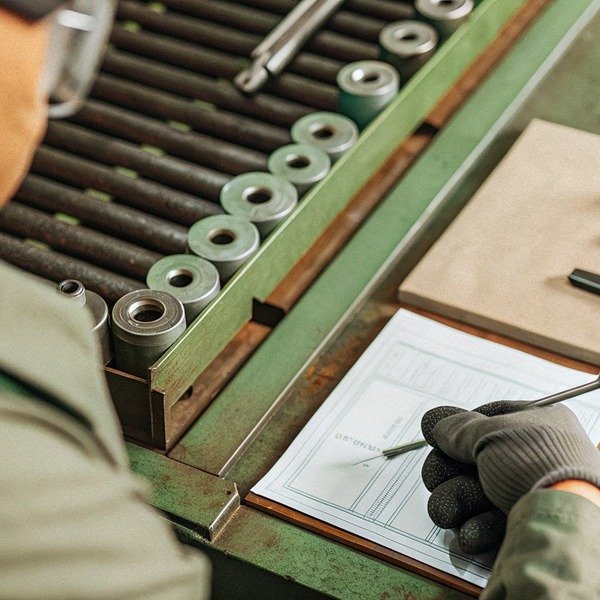
We often see clients jeopardize their entire production line because they accepted a supplier’s quality documentation at face value without digging deeper.
To verify hardness test report authenticity, confirm the laboratory holds valid ISO/IEC 17025 accreditation and cross-reference the heat number on the report with physical stamps on the welding parts ASTM E18 1. Additionally, contact the issuing lab to validate the certificate number and check for variance in data points to detect fabrication.
Here are the specific red flags and verification steps we recommend to ensure your components meet safety standards. safety standards 2
What are the most common signs of a falsified hardness test report that I should watch out for?
In our experience managing supply chains across Asia, we frequently audit sub-supplier documents to catch subtle inconsistencies before they ever reach our US clients.
Common signs of falsified reports include perfectly uniform data with zero variance, missing calibration dates for testing equipment, and mismatched font types indicating digital alteration. Also, watch for reports lacking specific reference standards like ASTM E92 or ISO 6507, which legitimate laboratories always cite explicitly.
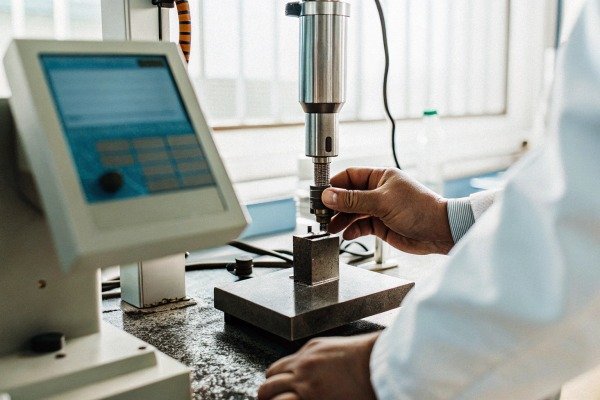
Detecting a fake report often comes down to understanding the physics of metal. In our daily operations, we know that metal hardness is rarely uniform across a welded zone. When a supplier hands you a report where every single reading is identical (e.g., every point reads exactly 55 HRC), it is statistically impossible and a clear sign of data fabrication. Real-world testing always produces minor deviations due to material microstructure and surface finish.
Another major red flag involves the equipment traceability. A legitimate report must list the specific machine used, the indenter type, and the date it was last calibrated. If a report lists "Hardness Tester" without a serial number or calibration certificate reference, the data is unverifiable. We also instruct our quality teams to look for "digital artifacts." If the dates or heat numbers appear in a different font or size than the rest of the document, it suggests someone simply pasted new numbers over an old PDF.
You must also verify the test method against the standard. We often see suppliers claim compliance with ISO standards but report results ISO standards 3 using a method (like Leeb rebound testing) that isn't approved for that specific qualification procedure. If the standard cited is ASTM E18 (Rockwell) but the values look like ASTM E18 4 Brinell numbers without conversion, the report is suspect.
Comparison of Authentic vs. Suspicious Report Characteristics
| Характеристика | Authentic Report Characteristics | Suspicious Report Characteristics |
|---|---|---|
| Data Variance | Shows natural, minor fluctuations (e.g., 221, 224, 219 HB). | Shows identical values across all points (e.g., all 220 HB). |
| Calibration | Lists machine serial # and valid calibration date. | Lists generic equipment names or missing dates. |
| Visuals | Consistent font, clear stamps, original layout. | Mismatched fonts, pixelated logos, altered dates. |
| Standards | Cites specific method (e.g., ISO 6507-1). | Cites generic "International Standards" or none. |
| Signatures | Signed by a named, qualified technician. | Unsigned or generic "Quality Dept" stamp only. |
How can I verify that the testing points on the weldment strictly follow my drawing specifications?
Our engineers always map out specific testing coordinates on the technical drawing to ensure the supplier cannot avoid testing the most fragile areas of the joint.
Verify testing points by requesting a macro-etch photograph accompanying the hardness report, showing physical indentation locations relative to the weld, heat-affected zone (HAZ), and base metal. Compare these visible locations against your engineering drawing’s specified critical zones to ensure the supplier tested the mechanically vital areas.

The location of the test is just as important as the result itself. In welding, the greatest risk of failure often lies in the Heat-Affected Zone (HAZ) Heat-Affected Zone (HAZ) 5 Heat-Affected Zone 6—the area of base metal that wasn't melted but had its properties altered by high heat. Unethical suppliers sometimes perform "lazy testing." They might test the base metal far away from the weld because it is easier to prepare and guarantees a passing result. This is deceptive because it tells you nothing about the integrity of the joint itself.
To prevent this, we require our suppliers to provide a hardness survey profile. This involves a series of indentations in a straight line moving from the unaffected base metal, through the HAZ, into the weld metal, and out to the other side. This profile reveals the metallurgical changes caused by the welding process. For example, in many steel alloys, a spike in hardness in the HAZ indicates brittleness and susceptibility to cracking.
We also insist on photographic evidence. Modern hardness testers, especially Vickers micro-hardness machines, can take a digital photo Vickers micro-hardness machines 7 of the indentation. If your report includes a diagram but no actual photo of the indentations on the cross-section, you cannot be certain where the test was performed. You should demand a "macro" image where the weld structure is visible, and the tiny diamond-shaped indentations can be counted and matched to your drawing requirements.
Critical Testing Zones in Welded Joints
| Zone Name | Why It Must Be Tested | Common Failure Risk |
|---|---|---|
| Base Metal | Establishes the baseline hardness of the raw material. | Wrong material grade used. |
| Heat-Affected Zone (HAZ) | The area most altered by thermal cycling. | Hydrogen cracking or brittle fracture. |
| Weld Metal (Fusion Zone) | The actual filler material mixed with base metal. | Incomplete fusion or incorrect filler wire. |
| Root Pass | The first layer of the weld, often hardest to reach. | Lack of penetration defects. |
Should I require third-party laboratory validation to ensure the accuracy of the supplier's internal data?
When we manage projects involving safety-critical loads for US customers, we usually bypass the factory's internal lab and mandate external verification to eliminate bias.
You should require third-party validation for safety-critical components or when a new supplier lacks a proven track record. Independent ISO 17025 accredited labs provide unbiased results, eliminating conflicts of interest and verifying that the supplier’s internal equipment calibration and testing procedures meet international accuracy standards.
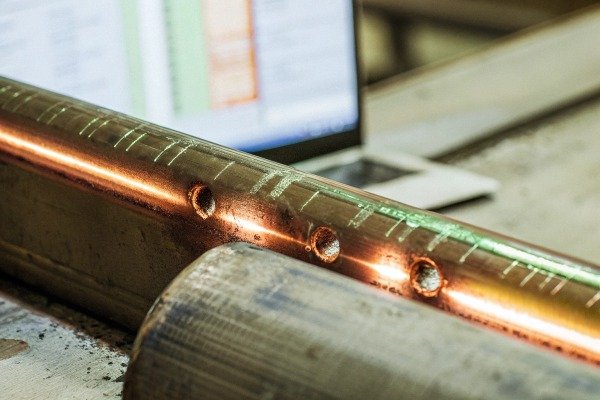
Relying solely on a supplier's internal lab results creates an inherent conflict of interest. The production team is under pressure to ship products on time, and a failed hardness test stops shipment. This pressure can lead to "cherry-picking" results—testing multiple times until a passing value is found and only reporting that one. By using a third-party laboratory, you introduce a neutral arbiter whose only job is to report accurate data, regardless of the commercial consequences.
We recommend a "split-sample" approach for new suppliers. When the first batch is produced, we have the supplier test one piece internally and send an adjacent piece to an independent, accredited lab. We then compare the two reports. If the supplier's internal report shows 58 HRC and the third-party lab shows 52 HRC, we know there is a calibration issue or intentional manipulation. This validation step is crucial during the First Article Inspection (FAI) or Production Part Approval Process (PPAP). Production Part Approval Process (PPAP) 8 Процесс утверждения производственной детали 9
However, third-party testing adds cost and lead time. It is not necessary for every single shipment of non-critical parts. The smart strategy is to establish a risk-based schedule. For high-risk structural frames or pressure vessels, 100% third-party batch verification might be needed. For standard brackets, an annual or quarterly "spot check" audit is usually sufficient to keep the supplier honest.
Decision Matrix: When to Use Third-Party Testing
| Scenario | Risk Level | Recommended Action |
|---|---|---|
| New Supplier Qualification | Высокие | Mandatory 3rd party validation for initial samples. |
| Safety-Critical Parts | Высокие | Frequent 3rd party batch testing (e.g., every 5th batch). |
| Routine Commodity Parts | Низкие | Rely on supplier reports; annual random spot check. |
| Disputed Results | Средний | Use 3rd party as the final arbitrator. |
How do I cross-check the test results against material heat numbers to guarantee full traceability?
Our logistics team tracks every material batch code from the steel mill to the final assembly in Vietnam to ensure no unauthorized materials enter the production line.
Cross-check results by matching the heat number listed on the hardness report with the material test report (MTR) and the physical die-stamped ID on the welded part. Ensure the chemical composition in the MTR aligns with the expected hardness values, as discrepancies often indicate a loss of traceability.

Traceability is the chain of evidence that links a finished part back to the raw ore. A hardness report is useless if you cannot prove it belongs to the specific frame sitting on your loading dock. The key link is the "Heat Number" or "Batch ID." When we inspect parts, we first look at the physical product. Is the heat number permanently stamped or etched onto the metal? If so, does that number appear exactly on the hardness report? If the report says "Batch A" but the part says "Batch B," the test is invalid for that shipment.
Beyond simple number matching, you can use metallurgy to spot fakes. Hardness is directly related to the chemical composition of the metal, particularly its carbon content. We advise our clients to compare the Mill Test Report (MTR)—which lists the chemistry—against the hardness report. If the MTR shows a low-carbon mild steel, but the hardness report shows values typical of high-carbon heat-treated steel, something is wrong. The chemistry and the mechanical properties must tell a consistent story.
Finally, check the chronology of the documentation. We verify that the date on the hardness report is после the date of the welding process and после any post-weld post-weld heat treatment (PWHT) 10 heat treatment (PWHT). It sounds simple, but we often catch suppliers submitting reports dated before the parts were even welded, indicating they simply reused an old report from a previous job. Ensuring the timeline makes sense is a quick, zero-cost way to verify authenticity.
Заключение
Verifying hardness test reports requires looking beyond the pass/fail result. By checking for accreditation, analyzing data variance, validating test locations, and ensuring full traceability, you protect your business from the risks of structural failure. We believe that rigorous document validation is the foundation of a reliable supply chain.
Сноски
1. Official standard specification for Rockwell hardness testing. ↩︎
2. OSHA safety standards for welding and material handling. ↩︎
3. Official ISO page for the laboratory accreditation standard mentioned. ↩︎
4. Standard test method for Rockwell hardness of metallic materials. ↩︎
5. Authoritative technical definition of the heat-affected zone in welding. ↩︎
6. General background on the metallurgical changes in the HAZ. ↩︎
7. Technical documentation for micro-hardness testing equipment. ↩︎
8. Official industry organization defining the PPAP standard. ↩︎
9. Explanation of the PPAP quality assurance process. ↩︎
10. Technical explanation of post-weld heat treatment procedures. ↩︎

 English
 Español de México
 Deutsch
 Français
 Русский
 العربية