Every week, our project team reviews new insert molding inquiries from U.S. buyers who have already been burned by a previous supplier PPAP (Процесс утверждения производственной оснастки) 1. The stories are painfully similar: misaligned inserts, cracked plastic around brass threads, late deliveries, and thousands of dollars lost in rework.
The best insert molding manufacturer combines precision tooling under 0.01 mm tolerance, proven DFM analysis, relevant industry certifications like ISO 9001 or IATF 16949, transparent communication, and a total-cost-of-ownership approach that accounts for tooling, shipping, tariffs, and potential rework costs.
This guide walks you through the exact questions to ask, the red flags to watch for, and the evaluation framework we recommend to our own clients. Let's break it down section by section.
What Quality Certifications and Standards Should I Look for in a Potential Insert Molding Partner?
When we audit factories across Vietnam and other Asian countries for our clients, certifications are the very first filter we apply. A supplier without the right paperwork is a risk no purchasing manager should take.
Look for ISO 9001 as a baseline, IATF 16949 for automotive projects, ISO 13485 for medical devices, and FDA registration if your parts contact food or patients. These certifications prove the manufacturer follows documented quality systems, material traceability, and continuous improvement processes.
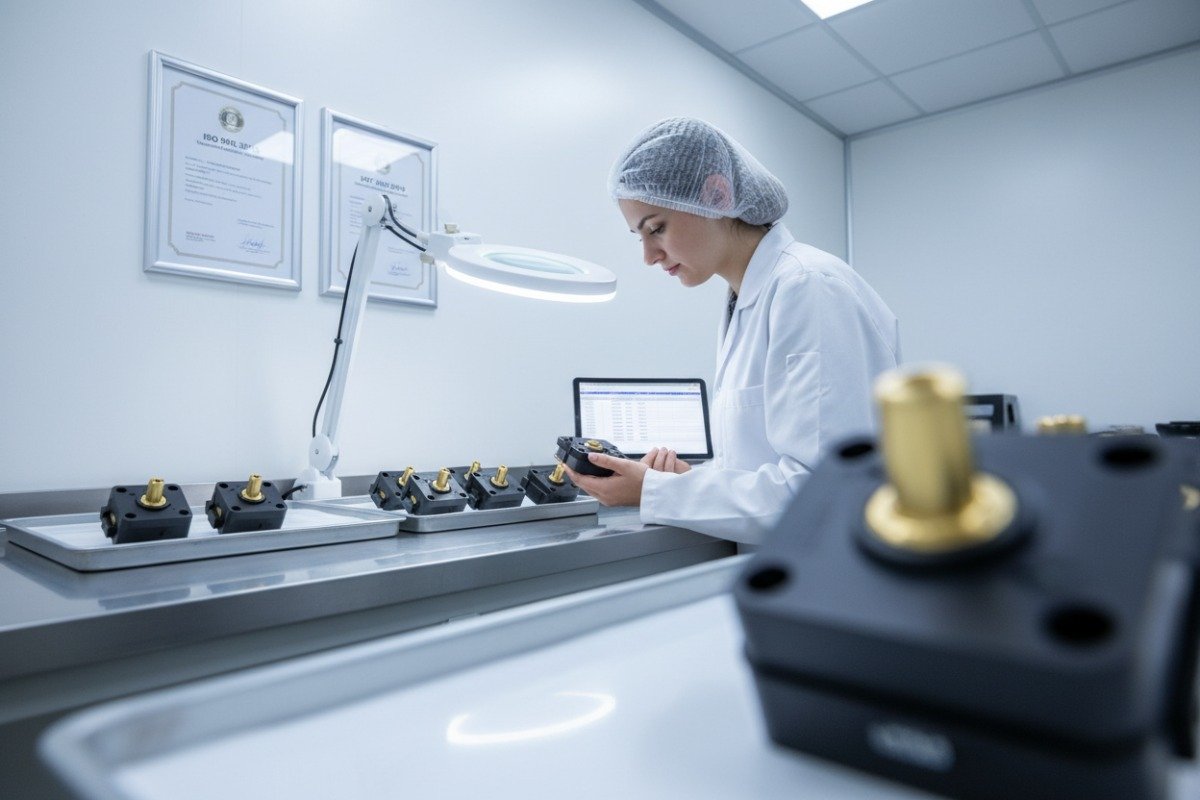
Почему сертификаты имеют большее значение, чем вы думаете
Certifications are not just wall decorations. They represent audited systems. An ISO 9001 2 certificate means a third-party auditor verified that the factory documents its processes, tracks nonconformances, and takes corrective actions. Without this, you are trusting a supplier's word alone.
For regulated industries, the stakes are even higher. Medical device buyers need ISO 13485 3 because it adds design controls and risk management on top of standard quality management. Automotive buyers need IATF 16949 4 because it demands PPAP (Production Part Approval Process), FMEA (Failure Mode and Effects Analysis), and control plans specific to each part number.
Certification Quick-Reference Table
| Сертификация | Отрасль | Что охватывает |
|---|---|---|
| ISO 9001 | Общее производство | Quality management system, process documentation, corrective actions |
| IATF 16949 | Автомобильная промышленность | PPAP, FMEA, control plans, supplier management |
| ISO 13485 | Медицинские изделия | Design controls, risk management, sterile packaging |
| Регистрация FDA 5 | Medical / Food contact | Facility registration, compliance with 21 CFR |
| ITAR | Оборона / Аэрокосмическая промышленность | Export control of defense-related articles and data |
| ISO 14001 6 | All (sustainability) | Environmental management, waste reduction |
Beyond the Certificate: What to Probe
A certificate alone does not guarantee good parts. Here is what we always dig into during supplier audits:
- Inspection equipment. Does the factory own CMMs (Coordinate Measuring Machines) 7, optical comparators, or pin gauges for insert position verification? Or do they rely on handheld calipers only?
- Material traceability. Can they show you a material certificate for every batch of resin and every lot of brass inserts? If not, walk away.
- Defect handling. Ask them to describe their process when a defective part is found mid-run. A mature factory will stop the line, quarantine suspect parts, and perform root cause analysis. An immature factory will sort and ship.
- Calibration records. All gauges and instruments should have current calibration stickers. Expired calibration means unreliable measurements.
We once visited a factory in Southeast Asia that proudly displayed an ISO 9001 certificate in the lobby. But when we asked to see their internal audit records, they had none. The certificate was real, but the system behind it had collapsed. That supplier did not make our approved list.
Кибербезопасность и защита интеллектуальной собственности
This is an area many buyers overlook. Your CAD files contain proprietary geometry. Ask the manufacturer about their data protection protocols. Do they use encrypted file transfers? Do they restrict USB access on factory computers? For defense-related projects, Соответствие ITAR 8 is mandatory, and violations carry severe penalties.
How Can I Verify That a Manufacturer Has the Technical Expertise to Handle My Specific Project Requirements?
Our engineers spend a lot of time reviewing DFM reports from potential suppliers before we recommend them to clients. The quality of that DFM feedback tells us almost everything about a factory's real capability.
Verify technical expertise by requesting DFM analysis on your actual part, reviewing case studies of similar projects, confirming their experience with your specific materials and insert types, and asking about simulation tools like Moldflow for predicting thermal expansion, shrinkage, and melt flow behavior.
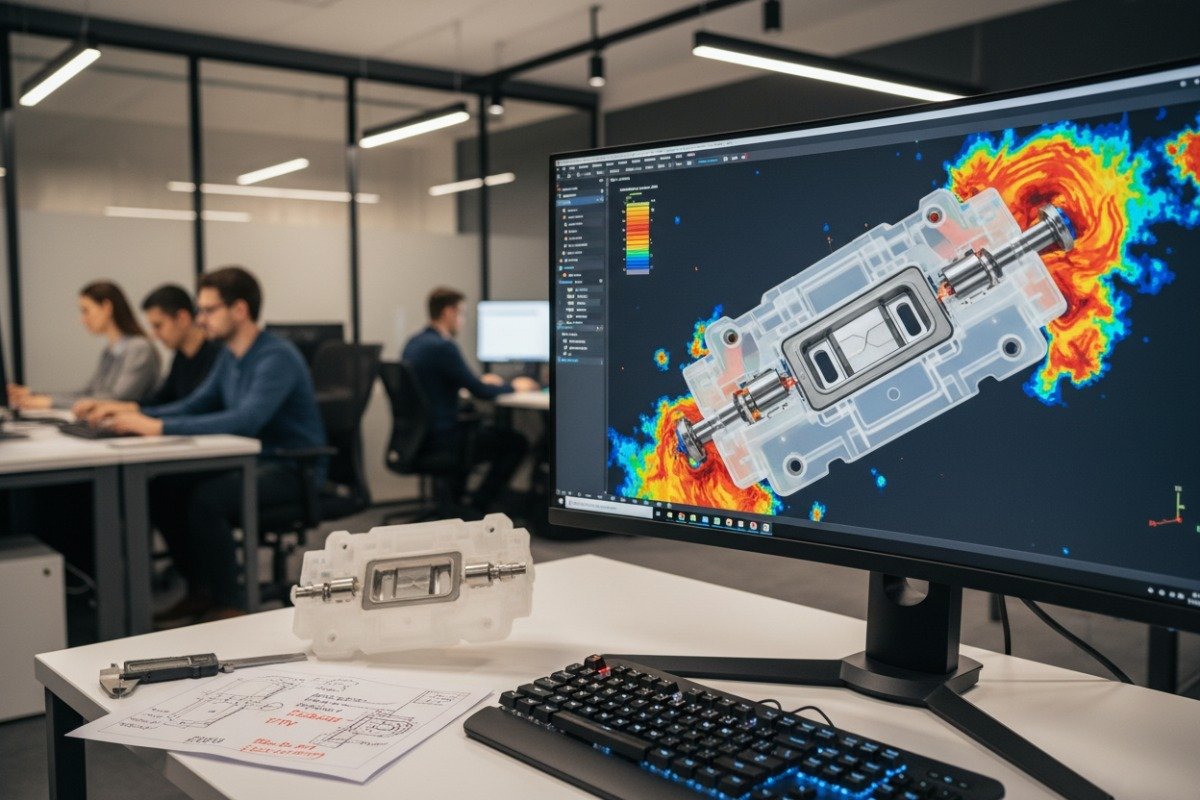
The DFM Test
Design for Manufacturability analysis is the single best litmus test for a supplier's engineering depth. Send your CAD file and drawing to three potential suppliers. Then compare the DFM reports they return.
A strong supplier will flag issues like:
- Insufficient wall thickness around the insert
- Sharp corners on the insert that could cause stress cracking
- Sink marks on cosmetic surfaces opposite thick ribs
- Minimum embedment depth violations (below 0.4 mm is risky)
- Insert-to-plastic volume ratio problems
A weak supplier will simply quote a price and say "no problem." That silence is a red flag.
Insert-Specific Challenges
Insert molding is not standard injection molding. The insert—often a threaded brass bushing or a stainless steel pin—sits inside the mold cavity before plastic is injected around it. This creates unique challenges:
- Thermal expansion mismatch. Metal and plastic expand at different rates. If the supplier does not account for this, parts will warp or crack after cooling.
- Insert positioning accuracy. The insert must be held precisely in the mold. Ask about fixturing methods. Manual placement works for low volumes, but automated pick-and-place robots are better for high volumes.
- Knurling design. Brass inserts should have rounded knurling, not sharp diamond knurling. Sharp edges can act as stress concentrators in the surrounding plastic.
Руководство по выбору материалов
A technically strong manufacturer will guide you on material selection based on your application. Here is a comparison of common insert molding materials:
| Material | Ключевые свойства | Лучше всего подходит для | Ограничения |
|---|---|---|---|
| полипропилен (ПП) | Low cost, chemical resistant, flexible | Hinges, non-critical housings, medical parts | Warps in thick sections, low heat resistance |
| ABS/PC Blend | High impact strength, good surface finish | Telecom housings, consumer electronics | Higher cost than PP, moderate chemical resistance |
| Nylon (PA6/PA66) | Wear resistant, high strength | Gears, structural brackets, automotive clips | Absorbs moisture, dimensional changes |
| ПЭЭК | Extreme heat and chemical resistance | Aerospace, semiconductor, medical implants | Very expensive, requires high mold temperatures |
| PBT (Polybutylene Terephthalate) | Good electrical properties, dimensional stability | Electrical connectors, automotive sensors | Brittle at low temperatures |
When we help clients source insert-molded engine covers for automotive applications, we often recommend PA66 with glass fill for vibration resistance. For medical connectors, we lean toward PC or PEEK depending on sterilization requirements. A good supplier will have this conversation with you proactively.
Ask for Proof
Do not just take their word for it. Request:
- Case studies of similar parts they have produced, including tolerances achieved and volumes delivered.
- Sample parts so you can measure them yourself or send them to a third-party lab.
- Toolmaker credentials. Who builds their molds? In-house toolmaking is a strong sign. If they outsource, ask where and how they control quality.
- Simulation reports. Moldflow 9 or similar software output showing fill patterns, weld lines, and cooling analysis.
A tier-1 automotive supplier we work with replaced a bolted assembly with an insert-molded engine cover. The result was 20% cost savings and better vibration performance. That kind of case study, with real numbers, is what you want to see from a potential partner.
What Key Questions Should I Ask to Ensure My Supplier Can Meet My Production Deadlines and Volume?
Delivery delays are the number one complaint we hear from U.S. purchasing managers working with overseas suppliers. In our experience managing production timelines across multiple Asian factories, the root cause is almost always poor planning—not bad intentions.
Ask about lead times for tooling and production separately, confirm their monthly capacity in machine hours, request their on-time delivery rate for the past 12 months, and demand a detailed production schedule with milestones. Suppliers who cannot provide these specifics are likely to miss your deadlines.
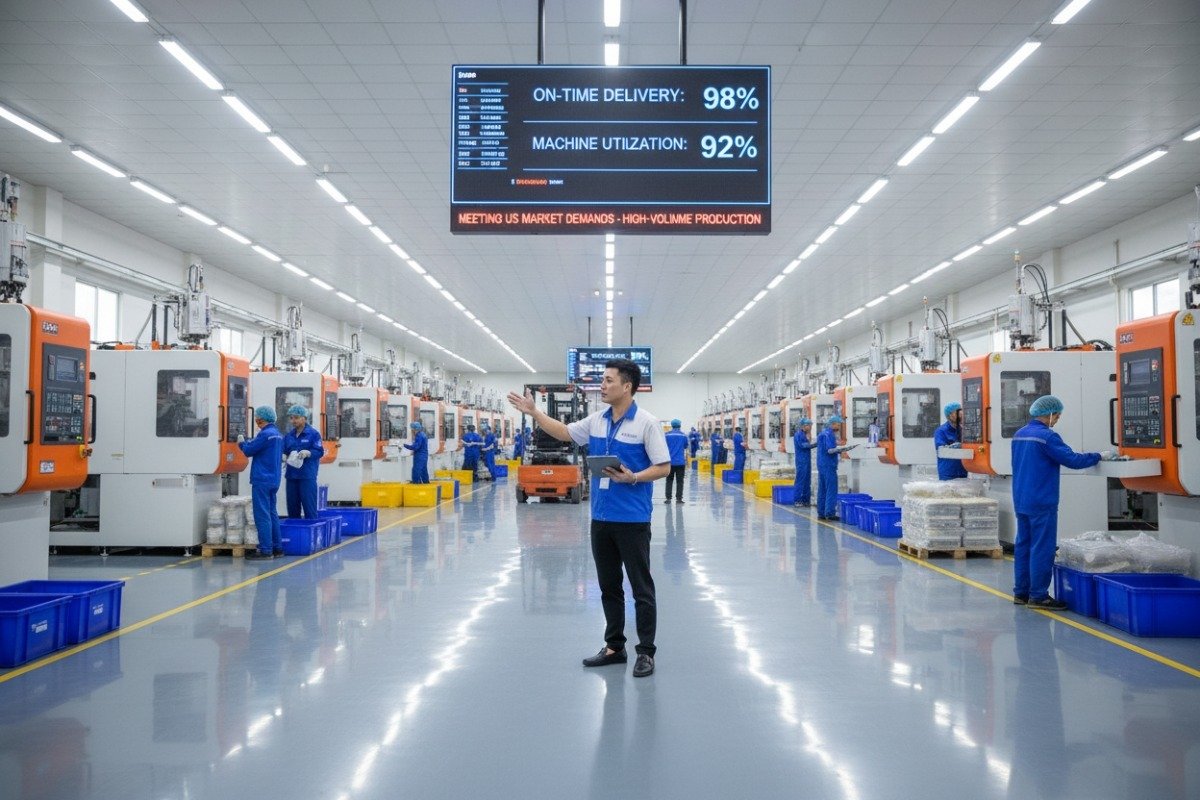
Break Down the Timeline
Most buyers ask "What is your lead time?" and accept a single number. That is a mistake. You need to break the timeline into phases:
- DFM and design review: 3–7 дней
- Tooling fabrication: 4–8 weeks depending on complexity
- First article / T1 samples: 1–2 weeks after tooling
- Sample approval (your side): varies
- Production run: depends on volume and cycle time
- Inspection and packing: 2–5 дней
- Доставка: 2–5 weeks by sea, 5–7 days by air
Each phase has its own risks. Tooling delays are the most common. Ask the supplier how many molds their tool shop is currently building. If they are overloaded, your mold goes to the back of the queue.
Capacity Verification
Do not just ask "Can you handle 100,000 pieces per month?" Ask these specific questions:
- How many injection molding machines do you have, and what tonnage range?
- How many shifts do you run?
- What is your current utilization rate?
- Do you have backup machines if one goes down?
- How do you handle insert placement at high volumes—manual or automated?
A factory running at 95% utilization has no room for your order if anything goes wrong. A factory at 70% utilization has buffer capacity.
Вопрос о своевременной доставке
Ask for their on-time delivery rate over the past 12 months. A good manufacturer tracks this metric and will share it. If they cannot provide a number, that tells you they do not measure it—which means they do not manage it.
We recommend targeting suppliers with on-time delivery rates above 95%. Below 90% is a serious concern.
Production Schedule Template
Request a Gantt chart or milestone table like this:
| Этап | Start | End | Ответственное лицо | Результат |
|---|---|---|---|---|
| DFM review | Week 1 | Week 1 | Supplier engineering | DFM report with recommendations |
| Tooling fabrication | Week 2 | Неделя 7 | Supplier tool shop | Completed mold, ready for T1 |
| T1 samples + PPAP | Неделя 8 | Неделя 9 | Supplier QC | First articles, dimensional report, material certs |
| Customer approval | Неделя 10 | Week 11 | Покупатель | Written approval or revision request |
| Массовое производство | Week 12 | Week 14 | Supplier production | Finished goods, inspection reports |
| Отгрузка | Week 15 | Week 18 | Logistics partner | Delivered to buyer's warehouse |
This table forces both sides to commit to dates. It also makes it obvious where delays are happening.
Red Flags in Communication
Pay attention to how the supplier communicates during the quoting phase. If they are slow to respond, vague on details, or avoid answering direct questions, expect the same behavior during production. In our experience, communication quality during quoting is the best predictor of partnership reliability.
A confident, capable manufacturer will:
- Respond within 24 hours on business days
- Provide a detailed quote breakdown (not just a lump sum)
- Offer a named project manager as your single point of contact
- Proactively flag potential risks or long-lead-time materials
Negotiate SLAs
For ongoing production, negotiate a Service Level Agreement that includes:
- On-time delivery target (e.g., 95% or higher)
- Penalties or credits for late shipments
- Defined communication cadence (e.g., weekly status updates)
- Escalation process for issues
This is standard practice in professional B2B relationships. Any supplier who resists an SLA discussion may not be confident in their own performance.
How Do I Evaluate the Total Cost of Ownership When Comparing Quotes From Different Manufacturers?
One lesson we have learned after managing hundreds of custom part projects is this: the lowest quote almost never delivers the lowest total cost. Our clients who chase the cheapest price per piece end up paying more in rework, delays, and air freight.
Total cost of ownership (TCO) includes the unit price, tooling amortization, shipping and duties, quality inspection costs, potential rework or scrap rates, payment terms impact on cash flow, and the hidden cost of engineering time spent managing a difficult supplier. Always compare TCO, not just piece price.

What Goes Into TCO
Most buyers compare quotes by looking at the unit price. That is like comparing cars by sticker price alone without considering fuel economy, insurance, and maintenance. Here is what a complete TCO analysis should include:
TCO Breakdown Table
| Статья расходов | Low-Cost Supplier | Mid-Range Supplier | Premium Supplier |
|---|---|---|---|
| Unit price (per piece) | $0.85 | $1.10 | $1.35 |
| Стоимость оснастки | $8,000 | $12,000 | $14,000 |
| Tooling life (shots) | 100,000 | 500,000 | 500,000 |
| Scrap rate | 5–8% | 1–2% | <1% |
| Rework cost per incident | $3,000–$5,000 | $500–$1,000 | Rare |
| Shipping (sea freight) | $0.05/pc | $0.05/pc | $0.05/pc |
| Import duties | 3–5% | 3–5% | 3–5% |
| Engineering support hours | 20+ hrs/project | 5–10 hrs/project | 3–5 hrs/project |
| Условия оплаты | 100% авансом | 30-day net | 60–90 day net |
| Своевременность доставки | 75% | 90% | 97% |
Look at the low-cost supplier column. The unit price is attractive, but the 5–8% scrap rate means you are paying for parts you cannot use. The short tooling life means you will need a new mold sooner. The 100% upfront payment ties up your cash. And the 75% on-time delivery rate means one in four shipments will be late, forcing you to expedite by air freight at 5–10x the sea freight cost.
The Hidden Cost of Poor Quality
When an insert-molded part fails incoming inspection at your customer's facility, the costs multiply fast:
- Sorting costs: Someone has to inspect every piece in the shipment.
- Return shipping: You pay to send bad parts back or scrap them locally.
- Replacement production: The supplier remakes the parts, but you wait weeks.
- Air freight: To recover the schedule, you ship replacements by air.
- Relationship damage: Your customer loses confidence in you.
We have seen a single quality escape cost a buyer $15,000 in sorting, air freight, and production downtime. That wipes out any savings from a cheaper unit price.
Условия оплаты и денежный поток
This is an underappreciated factor. If Supplier A demands 100% payment before shipping and Supplier B offers 60-day net terms, Supplier B is effectively financing your inventory. For a $50,000 order, 60-day terms mean you have that cash working for you for two months. At scale, this matters enormously.
We offer open account payment terms to qualified clients specifically because we understand this pressure. It is a competitive advantage that does not show up in a simple price comparison.
How to Run a Fair Comparison
Use a structured scorecard. Rate each supplier on a 1–5 scale across these dimensions:
- Technical capability: DFM quality, simulation tools, insert molding experience
- Quality systems: Certifications, inspection equipment, defect rates
- Delivery performance: On-time rate, capacity buffer, schedule transparency
- Total cost: Unit price + tooling + scrap + shipping + duties + rework risk
- Коммуникация: Response time, proactiveness, dedicated project manager
- Financial terms: Payment terms, willingness to negotiate SLAs
- Sustainability: Waste reduction, recyclable material options, energy efficiency
Weight each dimension based on your priorities. For most of our clients, quality and delivery outweigh price by a wide margin.
Sample Runs Before Commitment
Always request a sample run before committing to mass production. This validates:
- Dimensional accuracy against your drawing
- Insert pull-out strength
- Surface finish and cosmetic requirements
- Shrinkage behavior (especially important for PP and Nylon)
- Melt flow consistency across the run
A sample run of 50–200 pieces costs relatively little but can save you from a catastrophic production failure. If a supplier refuses to do a sample run, consider that a disqualifying red flag.
Domestic vs. Overseas: A Balanced View
Some buyers argue that domestic sourcing is always better for speed and IP protection. There is truth in that for rush jobs and highly sensitive defense projects. But for most commercial applications, a well-managed overseas supply chain delivers significant cost advantages without sacrificing quality.
The key word is "well-managed." That means having someone on the ground who speaks the language, understands the culture, and can walk the factory floor. This is exactly what our teams in Vietnam and China do for our clients. We bridge the gap so you get overseas pricing with domestic-level oversight.
Заключение
Choosing the right insert molding manufacturer comes down to certifications, technical proof, delivery discipline, and total cost thinking. Do your homework, ask tough questions, and partner with a supplier who earns your trust through transparency.
Сноски
1. Official AIAG standard for Production Part Approval Process in the automotive industry. ↩︎
2. Explains ISO 9001 standard and certification for quality management systems. ↩︎
3. Explains the international quality management system standard for medical devices. ↩︎
4. Provides an overview of the international standard for automotive quality management systems. ↩︎
5. Official FDA requirements for medical device establishment registration and listing. ↩︎
6. Provides an overview of the international standard for environmental management systems. ↩︎
7. Explains the function and types of Coordinate Measuring Machines in manufacturing. ↩︎
8. Official U.S. Department of State information on International Traffic in Arms Regulations. ↩︎
9. Official information on Autodesk Moldflow simulation software for injection molding. ↩︎
10. Explains the engineering practice of designing products for easier and cheaper manufacture. ↩︎

 English
 Español de México
 Deutsch
 Français
 Русский
 العربية