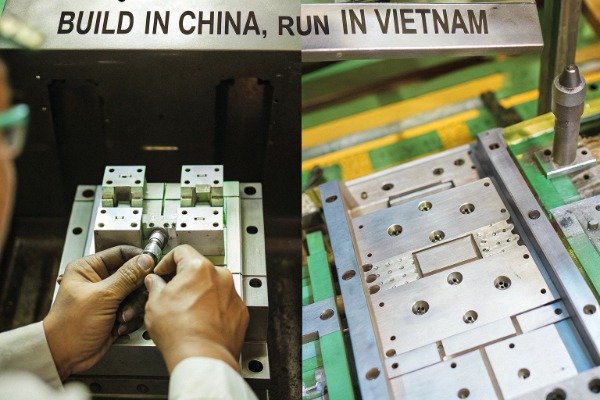
When we quote projects for our US clients, the price gap between our Shenzhen and Ho Chi Minh facilities often surprises them. High tariffs and rising wages are eroding your margins.
Sourcing stamping parts from Vietnam typically reduces total landed costs by 15% to 30% compared to China. This savings stems from labor rates that are 50% lower and the avoidance of 25% Section 301 tariffs, making Vietnam highly competitive for labor-intensive, mid-volume metal components destined for the US market.
Let’s break down the specific cost drivers we see daily in our export operations to help you decide where to place your next order.
How do labor rates and US import tariffs differ between Vietnam and China for metal stamping?
Our payroll data shows a stark contrast between our two production bases. You are likely overpaying for manual press operations if you rely solely on Chinese suppliers.
Vietnam offers a distinct advantage with manufacturing labor costs averaging $3 per hour, roughly half of China’s $6.50 rate. Furthermore, Vietnamese exports to the US generally avoid the punitive 25% Section 301 tariffs applied to Chinese goods, creating a massive total cost reduction for stamped metal parts.

When we analyze the cost structure of a metal stamping project, two massive line items usually dictate the final price: the cost of the people running the machines and the taxes paid to the government upon arrival. In our daily operations managing factories in both countries, we see a widening gap that heavily favors Vietnam for specific types of products.
The Hourly Wage Gap
The manufacturing landscape in Asia has shifted dramatically over the last decade. In our China facilities, the workforce is aging, and wages have risen significantly as the country moves toward high-tech manufacturing. Conversely, Vietnam is currently enjoying a “demographic dividend.” The workforce is younger, eager to learn, and available at a much lower rate.
For a standard stamping run—which involves material handling, press operation, deburring, and packing—labor constitutes a significant portion of the unit price. In China, we typically budget around $6.00 to $7.00 per hour for a skilled operator. In Vietnam, that same role costs us between $2.50 and $3.50 per hour. For high-volume orders requiring manual secondary operations (like tapping, drilling, or assembly), this 50-70% reduction in labor cost translates directly to a lower piece price for you.
The Tariff Impact
The second major factor is the trade environment. Since the implementation of Section 301 tariffs, most metal components from China face an additional 25% duty on top of standard rates. This effectively destroys the profit margin for many of our US clients.
Vietnam, however, benefits from Most Favored Nation (MFN) status with the US and does not suffer from these punitive tariffs. While you still pay standard duties, avoiding that extra 25% is often enough to justify moving production. Below is a breakdown of how these costs stack up for a hypothetical order of 50,000 stamped brackets.
Most Favored Nation (MFN) status 1
Cost Comparison: China vs. Vietnam (Hypothetical Order)
| Cost Component | China Production (USD) | Vietnam Production (USD) | Savings / Difference |
|---|---|---|---|
| Unit Price (Ex-Works) | $1.00 | $0.85 | Vietnam is 15% cheaper due to labor |
| Shipping (Per Unit) | $0.10 | $0.12 | Vietnam is slightly higher |
| Standard Duty (e.g., 3%) | $0.03 | $0.025 | Proportional to unit price |
| Section 301 Tariff (25%) | $0.25 | $0.00 | Major Savings |
| Total Landed Cost | $1.38 | $0.995 | ~28% Total Savings |
As you can see, even if the ex-works price difference was small, the tariff impact makes Vietnam the clear winner for US-bound shipments. This is why we actively help our clients migrate suitable projects to our Vietnamese production lines.
Will shipping and logistics costs from Vietnam impact my total landed cost significantly?
We frequently ship containers from Haiphong and Shenzhen, and the logistics dynamics differ. You might worry that higher freight costs will wipe out your production savings.
Shipping from Vietnam does not significantly increase total landed costs compared to China. While transit times to the US West Coast may be 2–4 days longer, ocean freight rates are comparable. The slight increase in logistics complexity is negligible when weighed against the substantial savings in duty and labor.

A common misconception we hear from procurement managers is that Vietnam’s infrastructure is too undeveloped to support reliable logistics, leading to exorbitant shipping costs. While it is true that Vietnam’s logistics network is not as mature as China’s massive port ecosystem, the gap is closing rapidly, and the cost difference is rarely a deal-breaker.
Raw Material Logistics
One reality we must manage is that Vietnam does not yet have the same depth of raw material production as China. For specialized alloys or specific grades of stainless steel, we often import the raw coil from China to our Vietnam factory.
Does this kill the cost advantage? Usually, no. Vietnam shares a land border with China. We can truck raw materials from Southern China to our facilities in Northern Vietnam very efficiently. This “Just-in-Time” cross-border supply chain allows us to leverage China’s material availability while utilizing Vietnam’s labor and tariff advantages. The cost of transporting raw material is a fraction of the finished goods’ value, so the impact on the final unit price is minimal.
Ocean Freight Realities
When it comes to shipping the finished stamped parts to you, the rates from major Vietnamese ports like Haiphong (North) or Cat Lai (South) are competitive with Chinese ports. Major shipping alliances call at these ports regularly.
- Transit Time: You might experience a delay of 2 to 5 days compared to shipping from Shenzhen, depending on whether the vessel is direct or requires transshipment via Singapore or Hong Kong.
- Cost: Spot rates fluctuate, but generally, shipping a 40ft container from Vietnam to Los Angeles is comparable to shipping from Shanghai.
Logistics Comparison Table
| Feature | China (Shenzhen/Shanghai) | Vietnam (Haiphong/Ho Chi Minh) | Impact on Buyer |
|---|---|---|---|
| Port Infrastructure | World-class, highly automated | Improving rapidly, occasional congestion | Minor delays possible in peak season |
| Vessel Frequency | Daily sailings | Weekly/Bi-weekly direct sailings | Requires better planning |
| Transit Time (to US West) | ~14-18 days | ~18-22 days | Add 1 week to lead time buffer |
| Inland Trucking | Very efficient | Good in industrial zones | Comparable cost |
We advise our clients to simply adjust their inventory planning by adding one week of safety stock. This small adjustment protects your supply chain while allowing you to bank the significant cost savings we discussed earlier.
Are the initial tooling and die costs in Vietnam competitive with Chinese suppliers?
When we develop new molds, we notice distinct differences in engineering speed and cost. You need to know if lower part prices justify potentially higher upfront tooling expenses.
Initial tooling costs in Vietnam are often 10–15% higher than in China due to a less mature local supply chain for specialized die steel and components. However, for long-running projects, the lower per-unit piece price in Vietnam quickly amortizes this initial premium, resulting in better long-term ROI.
This is where the nuance of the “China Plus One” strategy becomes important. If you are looking for a quick, one-off production run of 500 parts, China is almost always cheaper and faster because the tooling ecosystem there is incredibly dense. You can find a shop to cut a die in days. In Vietnam, the tooling industry is still developing.
China Plus One 2
The Engineering Ecosystem
In China, we can source standard mold bases, punches, and die springs from a dozen suppliers within a 10-mile radius. In Vietnam, we sometimes have to import high-precision tooling components or specialized die steels. This adds time and a slight cost premium to the NRE (Non-Recurring Engineering) charges.
However, for stamping production, the tool is a one-time investment. The “piece price” is a recurring cost. If you are running a project for 3 to 5 years, paying an extra $1,000 upfront for a tool in Vietnam is negligible if you are saving $0.20 on every part for 100,000 units.
Calculating the Break-Even Point
We encourage you to look at the Total Cost of Ownership (TCO) over the life of the project.
- China: Low Tooling Cost + High Part Cost (Tariffs + Labor)
- Vietnam: Moderate Tooling Cost + Low Part Cost (No Tariffs + Low Labor)
For simple progressive dies or single-stage tooling, our Vietnamese local partners are very capable and competitive. It is only when we get into extremely complex, multi-stage deep draw dies that the engineering gap becomes apparent. In those cases, we often build the tool in China (leveraging the expertise there) and export the tool to our Vietnam facility for mass production. This hybrid approach gives you the best of both worlds: Chinese engineering precision and Vietnamese production savings.
XRF analyzers 3
Tooling Strategy Matrix
| Project Type | Recommended Strategy | Reasoning |
|---|---|---|
| Low Volume / Prototype | Stay in China | Speed and low tooling cost are priority. |
| High Volume / Simple Part | Build & Run in Vietnam | Fast ROI on tooling; max labor savings. |
| High Volume / Complex Part | Build in China -> Run in Vietnam | Best quality tooling; best production cost. |
By understanding these dynamics, we can structure the project to minimize your capital expenditure while maximizing your unit cost savings.
ISO standards 4
Can I maintain high quality standards while reducing costs by moving production to Vietnam?
Our quality engineers in Vietnam follow the same strict PPAP protocols we use in China. You cannot afford to sacrifice product integrity just to save a few cents.
PPAP protocols 5
You can maintain high quality in Vietnam by implementing strict process controls and third-party inspections. While China has a more established quality ecosystem, reputable Vietnamese manufacturers now adhere to ISO standards. We ensure consistency by applying the same rigorous PPAP and final inspection protocols used in our Chinese facilities.

Total Cost of Ownership (TCO) 6
The biggest fear our clients have is the “fade” in quality. There is a historical perception that lower labor costs equal lower quality. While this can be true if you source from the cheapest bidder without due diligence, it is not the reality for professional export-oriented manufacturers.
shipping a 40ft container 7
Workforce Skill Levels
It is true that the average factory worker in China might have 10 years of experience, while a worker in Vietnam might have 3. However, stamping is a process heavily dependent on the machine and the die. Once the press is set up and the die is calibrated, the operator’s role is largely feeding material and monitoring.
We bridge the skill gap by investing heavily in training and process control. Our management team in Vietnam includes senior engineers transferred from our Chinese operations. They bring the “institutional memory” and technical discipline required to set up the lines correctly. This ensures that the parts coming off the press in Hai Duong meet the exact same tolerances as the parts from Dongguan.
demographic dividend 8
Ensuring Consistency
To guarantee quality, we do not rely on hope; we rely on data. We implement the same Quality Management System (QMS) across borders.
- Material Verification: We use XRF analyzers to verify the chemical composition of incoming steel coils, ensuring no sub-par material enters the press.
- First Article Inspection (FAI): Production does not start until the first 5 pieces are measured and signed off.
- In-Process QC: Inspectors roam the floor every hour to check critical dimensions.
Quality Risk Mitigation Strategy
| Facteur de risque | China Situation | Vietnam Situation | Our Mitigation Strategy |
|---|---|---|---|
| Material Quality | High availability of certified mills | Reliance on imports | We mandate Mill Test Certificates (MTC) and independent lab testing. |
| Worker Skill | High experience | Moderate experience | We deploy senior technical leads from China to supervise setup. |
| QMS Maturity | Mature (ISO 9001 common) | Developing | We enforce our own internal SOPs regardless of local norms. |
Moving to Vietnam does not mean accepting defects. It means you need a partner who understands that quality is non-negotiable, regardless of the country code on the shipping label.
manufacturing labor costs 9
Conclusion
Sourcing from Vietnam offers massive tariff and labor savings. By managing tooling and quality proactively, we help you lower landed costs without compromising performance.
Section 301 tariffs 10
Notes de bas de page
- Explains the international trade status that allows for lower import duties. ↩︎
- Defines the specific business strategy of diversifying manufacturing beyond China. ↩︎
- Explains the analytical technique used for verifying metal composition. ↩︎
- Official site for the international standards organization mentioned regarding quality. ↩︎
- Describes the standardized process used to ensure manufacturing quality. ↩︎
- Explains the financial estimate method used to calculate direct and indirect costs. ↩︎
- Details the standard intermodal shipping units used in global logistics. ↩︎
- Defines the economic growth potential resulting from shifts in a country’s age structure. ↩︎
- Provides context on Vietnam’s economic structure and industrial wage advantages. ↩︎
- Official US government resource detailing the specific trade tariffs mentioned. ↩︎

 English
 Español de México
 Deutsch
 Français
 Русский
 العربية