When we review supplier quotes for our US partners, vague branding charges often delay the entire project approval process. You need precise cost breakdowns to calculate your margins precise cost breakdowns 1 accurately and avoid surprise invoices later.
Suppliers typically charge a one-time setup fee between $50 and $300, combined with a per-unit variable cost that decreases as volume increases. Final pricing depends on cycle time, which is driven by logo complexity, material hardness, and whether the part requires specialized fixturing during the engraving process.
Understanding this pricing structure allows you to negotiate better terms and choose the right customization level for your budget.
Which engraving method is the most cost-effective for high-volume welding orders?
Our production teams in Vietnam often advise clients to finalize branding decisions before assembly begins to save significant labor hours. Moving a heavy welded frame onto a marking table is far slower than marking flat components. marking flat components 2
Laser marking flat components prior to welding is the most cost-effective method for high-volume orders because it minimizes handling time and eliminates the need for complex jigs. While physical stamping offers lower unit costs for massive runs, laser marking provides the best balance of flexibility, speed, and low setup fees.
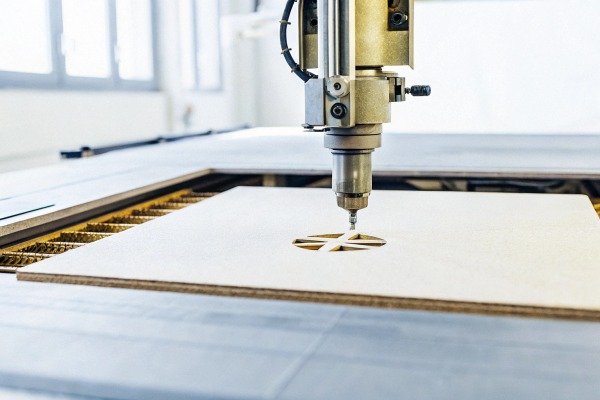
When we manage supply chains for custom parts, we constantly evaluate the trade-off between speed and cost. For welding projects specifically, the method you choose dictates your unit price.
Pre-Weld vs. Post-Weld Engraving
The timing of the engraving process is the single biggest factor engraving process 3 in cost efficiency. In our factory workflows, handling a small, flat steel plate takes seconds. An operator can load twenty plates onto a laser bed at once. However, once that plate is welded into a complex frame—like the aluminum structure described in your product context—the logistics change.
Engraving a finished weldment requires an operator to lift a heavy, awkward object, position it precisely under the laser head, and often build a custom support fixture to keep the engraving surface level. This manual handling drastically increases "cycle time." If we engrave before welding, we reduce handling time by up to 80%. handling time 4
Laser Etching vs. Physical Stamping vs. CNC Milling
For high-volume orders (typically 500+ units in our custom manufacturing sector), we break down the methods as follows: custom manufacturing sector 5
- Laser Etching: This is the industry standard for a reason. It is fast, clean, and requires no physical contact. It works exceptionally well on stainless steel and aluminum. The setup involves programming a file, which is cheap.
- Physical Stamping (Press Marking): This involves a hardened steel die slamming into the part. It is incredibly fast (less than 1 second per part). However, the die costs hundreds of dollars to make. If you change your logo, you buy a new die. This is only viable if you order thousands of identical parts annually.
- CNC Milling/Engraving: This uses a rotating bit to cut into the metal. It looks premium and deep but is very slow. We generally only recommend this for high-value, low-volume luxury components or heavy industrial parts that will be painted thick, where a laser mark might get covered.
Comparative Cost Breakdown
To help you visualize the financial impact, here is a comparison based on a typical batch of 500 stainless steel welding brackets.
| Engraving Method | Initial Setup/Tooling Fee | Estimated Cycle Time | Cost Per Unit (Approx.) | Flexibility for Design Changes |
|---|---|---|---|---|
| Laser Marking (Pre-Weld) | $45 – $80 | 10 – 30 seconds | $0.20 – $0.50 | High (Instant software update) |
| Laser Marking (Post-Weld) | $80 – $150 (Includes jig) | 2 – 5 minutes | $1.50 – $4.00 | Élevé |
| Physical Stamping | $300+ (Die cost) | < 2 seconds | $0.05 – $0.10 | Low (Requires new die) |
| CNC Engraving | $100+ | 5 – 10 minutes | $5.00+ | Élevé |
By analyzing this table, you can see why we steer most clients toward laser marking before the welding stage. It keeps your unit costs low while maintaining the ability to update your logo without buying expensive new tooling.
Does the complexity or size of my logo significantly impact the manufacturing price?
We recently had a client whose intricate crest design doubled the laser processing time, forcing us to renegotiate the unit price mid-production. laser processing time 6 Simple designs ensure your production runs remain smooth and budget-friendly.
Yes, the complexity and size of your logo directly impact price because laser engraving costs are calculated based on machine runtime. A large, solid-filled logo requires the laser to make thousands of passes, significantly increasing cycle time compared to a simple outline or text-based design.

Many buyers assume that laser engraving is like printing a document—instantaneous regardless of the picture. In reality, a laser marker is a mechanical tool that traces lines or burns away material. The more material it has to burn, the longer it takes. In the manufacturing world, time is money.
The "Fill" Factor
The most expensive element of a logo is the "fill." If your logo is a solid black square, the laser must traverse back and forth to burn that entire area. This is called rastering. If your logo is just the outline of a square, the laser simply traces the perimeter. This is vector marking. vector marking 7
In our experience, converting a solid-filled logo to an outline style can reduce the cycle time from 2 minutes down to 15 seconds. On an order of 1,000 welding parts, that saves nearly 30 hours of machine time. Suppliers will pass those savings on to you. If you insist on a solid fill, expect the unit price to triple.
Size Matters
Doubling the size of a logo quadruples the area (square law). A 1-inch logo might cost $0.50. A 2-inch logo covers four times the surface area and might cost $2.00. When we design parts with our engineers, we often recommend keeping branding discreet. A small, crisp logo often looks more professional and saves significant costs compared to a giant billboard-style mark.
Vector vs. Raster Files
The file format you send to your supplier dictates file format 8 the pricing model.
- Vector Files (.DXF, .AI, .EPS): These are mathematical lines. The laser follows the path. This is fast, crisp, and cheap.
- Raster Files (.JPG, .PNG): These are pixels. The laser must engrave dot-by-dot like an inkjet printer. This is slow and often produces fuzzy edges on metal.
If you send a low-quality JPEG to a factory in China or Vietnam, they will likely charge you an "artwork conversion fee" to redraw it as a vector, or they will run it as a raster image, which increases the cycle time and unit cost.
Impact of Detail Level on Processing Time
| Logo Style | Description | Machine Cycle Time | Relative Cost Factor |
|---|---|---|---|
| Simple Text / Outline | Vector lines only. No solid fills. | 10 – 20 seconds | 1.0x (Base Price) |
| Complex Outline | Detailed geometric shapes (like the frame in your context). | 30 – 60 seconds | 1.5x |
| Solid Fill (Small) | Solid blocks of color, under 1 square inch. | 45 – 90 seconds | 2.0x |
| Solid Fill (Large) | Solid blocks, over 3 square inches. | 3 – 5 minutes | 5.0x – 8.0x |
We always encourage Purchasing Managers to ask their design teams for "outline versions" of their logos specifically for industrial marking. It is a simple change that directly improves your bottom line.
When we audit new suppliers, we carefully inspect their quotation breakdowns to ensure "miscellaneous" fees don't inflate the total contract value. Transparency in the initial quote prevents awkward budget overruns later.
You should expect setup fees covering machine programming and artwork conversion, as well as potential "fixturing" charges if your welding parts have irregular shapes. While not truly hidden, these Non-Recurring Engineering (NRE) costs can surprise buyers who expect a flat per-unit price.
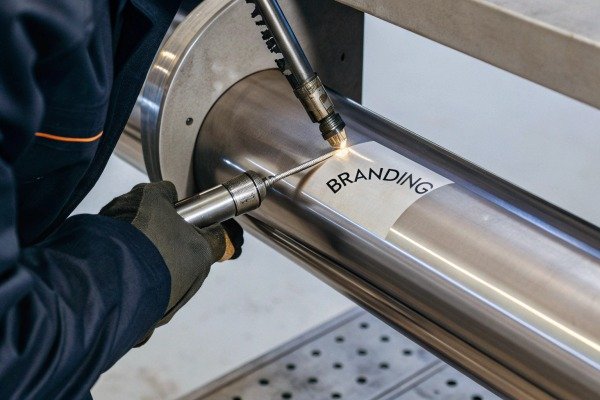
It is rare to get a simple "all-in" price without some upfront investment. In the world of custom manufacturing, "setup" covers the labor and materials required to get the machine ready before the first First Article Inspection 9 part is even touched.
The Fixturing Surcharge
This is the most common surprise for welding parts. Unlike a sheet of paper, welding parts are 3D objects. If you want a logo engraved on a curved tube or near a bulky weld seam, the part cannot just sit on the table. It might roll away or sit at an angle, causing the laser to lose focus.
To solve this, we must build a "jig" or fixture. This could be a 3D-printed cradle or a CNC-machined aluminum block that holds your part in the exact same spot every time.
- Standard Fixture: Free or low cost (using clamps they already own).
- Custom Jig: $100 – $500 one-time fee. This is necessary for complex geometries like the multi-tiered grid frame described in your product context.
- Rotary Attachment: If you are engraving around the circumference of a round tube, the machine needs a rotary axis. Suppliers often add a surcharge for this setup because it takes time to calibrate.
Sample Verification Fees
Before running 1,000 parts, you want to see one. However, stopping a production line to set up a machine for just one unit is expensive for the supplier. We often see "First Article Inspection" fees ranging from $50 to $150 just to engrave a single sample and send a photo for approval. This covers the technician's time to load the file, test the power settings, and adjust the focal length.
The "Waste Buffer" Calculation
Laser engraving is permanent. If a mistake is made, the part is often scrap. For high-value welding components, suppliers factor in a "risk premium." If your welding part costs $50 to manufacture and they are engraving it as the final step, a mistake costs them $50. Therefore, they might add a small percentage to the engraving cost to cover potential spoilage, especially if the material is tricky like reflective aluminum or copper. reflective aluminum or copper 10
Breakdown of Typical Non-Recurring Costs
| Cost Item | Typical Price Range | When Does It Apply? |
|---|---|---|
| Artwork Conversion | $30 – $100 | When you provide a JPG/PNG instead of a Vector file. |
| Machine Setup Fee | $45 – $80 | Per batch or per order. Covers file loading and alignment. |
| Custom Fixture/Jig | $100 – $500 | Irregular shapes, heavy weldments, or strict alignment needs. |
| Rotary Setup | $50 surcharge | Engraving on curved cylindrical tubing. |
| Sample/Proof Fee | $50 – $150 | Running a single unit for approval before mass production. |
By anticipating these costs, we can negotiate. For example, we often ask suppliers to amortize the fixture cost over the first 500 units, rather than paying it all upfront.
How much does logo engraving typically add to the final unit cost of my parts?
In our export operations, we constantly monitor the "fully landed cost" to ensure that branding efforts don't erode the competitive pricing we secure for our clients. A few cents here and there accumulate rapidly across a container load.
Logo engraving typically adds between $0.20 and $5.00 to the final unit cost, heavily dependent on volume and part handling requirements. For standard orders of flat parts, expect an increase of roughly 3-5%, whereas complex post-weld engraving can increase unit costs by 10-15%.
The final price tag is not just about the laser time; it is about the total throughput of the factory. If engraving slows down the packing line, the price goes up.
The Volume Discount Curve
Suppliers operate on economies of scale. The setup time is fixed. If it takes 30 minutes to set up the machine ($50 cost) and 1 minute to mark the part ($1 cost):
- For 1 part: Total cost is $51.00.
- For 10 parts: Total setup is spread out ($5/part) + $1 run time = $6.00/part.
- For 100 parts: Total setup is spread out ($0.50/part) + $1 run time = $1.50/part.
This is why we always push our clients to order in batches that maximize these break points. Typically, the price plateaus after 500 or 1,000 units, where the setup fee becomes negligible.
Material Hardness and Depth
The material of your welding part affects the laser speed.
- Anodized Aluminum: Very fast. The laser just bleaches the dye. Low cost.
- Stainless Steel: Slower. Requires annealing or deep etching to ensure the mark survives harsh environments. Medium cost.
- Raw Steel (to be painted): Deep engraving is required so the logo is visible after powder coating. This requires the laser to pass over the area 10-20 times to remove metal. This is the most expensive option, often adding $2.00+ per part.
Post-Processing Costs
For welding parts, engraving isn't always the last step.
- Passivation: If you laser mark stainless steel, you remove the protective oxide layer. It might rust. We must re-passivate (clean with acid) the part. This adds a chemical cleaning fee.
- Cleaning: Laser marking produces dust and residue. Someone has to wipe the part down.
Estimated Unit Cost Increases by Volume Tier
Based on a standard 2×2 inch logo on a stainless steel component.
| Order Quantity | Setup/Amortized Fee | Running Cost | Total Adder Per Unit |
|---|---|---|---|
| Sample (1-5 units) | High (charged as lot) | Élevé | $50.00+ (Lot charge) |
| Low Volume (50 units) | $1.00 | $1.50 | $2.50 |
| Mid Volume (500 units) | $0.10 | $0.80 | $0.90 |
| High Volume (5000 units) | $0.01 | $0.40 | $0.41 |
Ultimately, the best way to control these costs is to engrave early in the process (pre-weld) and keep the logo design optimized for vector marking. This approach ensures your brand is visible without eating into your profit margins.
Conclusion
Engraving pricing relies on preparation and volume. By choosing pre-weld marking, simplifying logo files to vectors, and ordering in optimal batches, you can secure professional branding for cents rather than dollars. Clear specs prevent hidden fees.
Notes de bas de page
1. Authoritative resource on cost breakdown analysis from the Chartered Institute of Procurement & Supply. ↩︎
2. International standards for safety and efficiency in industrial laser processing machines. ↩︎
3. TWI is a global authority on materials joining and engineering technologies. ↩︎
4. Official government guidelines on ergonomic material handling in industrial settings. ↩︎
5. General background on the history and development of the manufacturing sector. ↩︎
6. Documentation from a leading manufacturer of industrial laser marking systems. ↩︎
7. Industry standards for vector graphics formats used in technical manufacturing. ↩︎
8. Adobe is the industry standard authority for digital design file formats. ↩︎
9. Links to the official AS9102 aerospace standard defining First Article Inspection requirements. ↩︎
10. Scientific explanation of the reflective properties of metals during laser processing. ↩︎

 English
 Español de México
 Deutsch
 Français
 Русский
 العربية