
Every week, our project managers field calls from U.S. buyers frustrated by rising CNC costs, missed deliveries, and parts that fail inspection conformité ITAR 1. CNC machining services 2 The pain is real. And the search for a reliable, affordable machining partner feels endless.
Finding affordable CNC machining services requires a multi-step approach: compare quotes across online platforms, optimize part designs for manufacturability, choose cost-effective materials, specify only necessary tolerances, and vet suppliers through certifications and trial orders to balance price with quality.
The good news is that you have more options today than ever before. Online quoting platforms, global supplier networks, and smarter design tools have changed the game. Below, we break down the key strategies to cut your CNC costs without cutting corners.
How Can I Reduce the Overall Cost of My CNC Machining Projects?
Our engineering team reviews hundreds of part drawings each month, and we see the same costly mistakes over and over. Small design choices can inflate your machining bill by 30% or more.
To reduce CNC machining costs, simplify part geometries, select readily available materials, avoid over-specifying tolerances, increase order quantities for economies of scale, and minimize secondary operations. Each of these steps directly cuts machining time, setup time, and material waste.

Commencez par la conception pour la fabricabilité (DFM)
DFM is the single biggest lever you have. Conception pour la fabrication (DFM) 3 Before you even request a quote, look at your part design through the eyes of a machinist. Ask yourself: does this feature really need to be there? Can I use a standard tool radius instead of a custom one?
Here are common design changes that save money:
- Avoid deep pockets with small radii. They require specialty tooling and slow feed rates.
- Use standard hole sizes. Non-standard holes need custom drills or reamers.
- Reduce the number of setups. If your part needs to be flipped or repositioned multiple times, each setup adds cost.
- Add draft angles where possible. They make machining faster and reduce tool wear.
Many online platforms like Xometry and Protolabs now offer instant DFM feedback when you upload a CAD file. Use this. It is free, and it tells you exactly which features are driving up your price.
Leverage Economies of Scale
Fixed costs like programming, setup, and fixture building get spread across every part you order. Économies d'échelle 4 One part absorbs all that cost. A hundred parts split it a hundred ways.
| Quantité commandée | Estimated Setup Cost Per Part | Typical Per-Part Savings vs. Single Unit |
|---|---|---|
| 1 (prototype) | $150–$300 | Ligne de base |
| 10 | $15–$30 | 40–50% |
| 100 | $1.50–$3.00 | 60–70% |
| 1,000+ | $0.15–$0.30 | 75–85% |
If you know you will need recurring parts, consider blanket purchase orders. When we set up blanket orders for our clients, we lock in pricing and schedule production runs in advance. This gives the machine shop predictability, and they pass savings back to you.
Explore Lights-Out Manufacturing
Some suppliers run CNC machines unattended overnight. Lights-Out Manufacturing 5 This is called "lights-out" manufacturing. It works best for simpler parts with stable processes. Labor costs drop significantly because operators are not standing at the machine during those hours.
Ask your supplier if they offer this capability. Not every part qualifies, but when it works, it can cut your per-part cost by 15–25%.
Compare Multiple Platforms
Do not settle for the first quote you receive. Use at least three to five sources. Online platforms like Xometry, Hubs, Protolabs, RapidDirect, and PCBWay all offer instant quoting. Upload the same file to each one and compare.
Industry data shows that businesses using multiple quoting platforms save 20–50% compared to those who rely on a single traditional machine shop. The global competition among suppliers works in your favor.
What Factors Should I Look for When Choosing a Budget-Friendly CNC Machining Partner?
When we help U.S. clients source parts from Asia, the first thing we evaluate is not price. It is whether the supplier can actually deliver what they promise. A low quote means nothing if the parts arrive late or out of spec.
When choosing a budget-friendly CNC partner, evaluate their certifications (ISO 9001, ITAR), DFM support, communication responsiveness, lead time reliability, quality control processes, and payment flexibility. The cheapest quote is not always the best value if it leads to rework or delays.

Certifications Matter
Certifications are not just paperwork. They tell you whether a supplier has documented, repeatable processes. For most commercial parts, ISO 9001 6 is the baseline. For aerospace or defense work, you need AS9100 7 or ITAR compliance.
| Certification | Ce qu'il couvre | Who Needs It |
|---|---|---|
| ISO 9001 | General quality management systems | Toutes les industries |
| AS9100 | Management de la qualité aérospatiale | Aérospatiale, défense |
| ITAR | International Traffic in Arms Regulations | U.S. defense-related parts |
| ISO 13485 | Gestion de la qualité des dispositifs médicaux | Medical device manufacturers |
| PPAP | Processus d'approbation des pièces de production | Automotive, high-reliability parts |
If a supplier cannot show you a valid certificate, move on. At our company, we conduct supplier audits before onboarding any new factory. We check their equipment lists, inspection records, and operator training logs. This upfront work prevents problems later.
Communication et réactivité
This is where many overseas suppliers fall short. You send a drawing with 15 critical dimensions, and they quote it in two hours without asking a single question. That is a red flag.
A good partner reads your drawing carefully. They ask clarifying questions. They flag potential issues before production starts. Our team in Vietnam and China reviews every drawing with the factory before confirming a quote. We catch problems at the quoting stage, not at final inspection.
Look for suppliers who respond within 24 hours, provide detailed quotes that break down costs, and offer a dedicated project manager or point of contact.
Payment Terms and Cash Flow
For many small and mid-sized businesses, cash flow is tight. Paying 100% upfront to an overseas supplier ties up capital for weeks or months. Look for partners who offer flexible payment terms.
We offer open account terms of 60–90 days for qualified clients. This means you receive your parts, sell them or install them, and then pay us. It is a significant advantage for businesses managing multiple projects at once.
Local vs. Global Trade-Offs
U.S.-based shops offer faster shipping, easier communication, and no tariff risk. But they typically charge 20–40% more per part. Asian suppliers offer lower per-part costs, but you need to account for shipping time (7–14 days by air, 30–45 days by sea), potential tariff impacts, and quality oversight.
The sweet spot for many buyers is a hybrid approach. Use a local shop for urgent prototypes and rush jobs. Use an Asia-based partner with strong quality controls for production volumes. This is exactly the model we support for our clients.
How Do I Ensure I Am Not Sacrificing Part Quality for a Lower Price Point?
Our quality control team inspects thousands of parts every month. The most common issue we see is not bad machining. It is bad communication. The factory did not understand the drawing, or the buyer did not specify what mattered most.
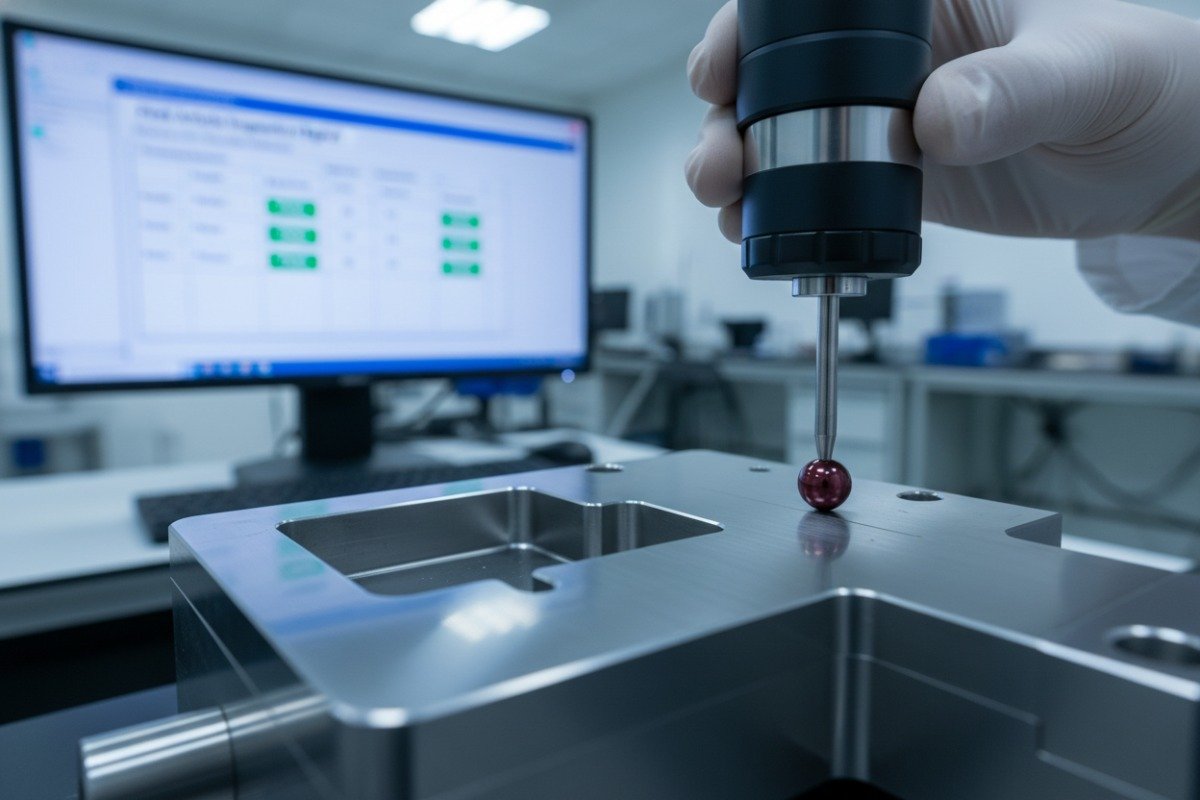
To maintain part quality at a lower price, request First Article Inspection (FAI) reports, define critical-to-quality (CTQ) dimensions clearly on your drawings, require PPAP documentation for production runs, and always test with a small trial order before committing to volume production.
Define What "Quality" Means for Your Part
Not every dimension on your drawing is equally important. Some are critical for function. Others are just reference dimensions. If you do not tell your supplier which ones matter most, they will treat them all the same — or worse, they will guess.
Utilisez GD&T (Cotation et Tolérancement Géométriques) 8 callouts on your drawings. Mark critical dimensions clearly. Provide a ballooned drawing with a corresponding inspection checklist. This removes ambiguity and gives the supplier a clear target.
Use First Article Inspection (FAI)
Before you approve a full production run, always request an FAI. This is a complete dimensional inspection of the first parts off the machine. It verifies that the process is capable of meeting your specifications.
A proper FAI report includes:
- Measured values for every dimension on the drawing
- Material certification (mill certs)
- Mesures de finition de surface
- Visual inspection results
- Any deviations or non-conformances noted
If the FAI passes, you have confidence that the rest of the run will be consistent. If it fails, you catch the problem before hundreds or thousands of bad parts are made.
Mettre en œuvre un processus PPAP
For production parts, especially in automotive or high-reliability applications, PPAP (Processus d'approbation des pièces de production) 9 is the gold standard. It documents the entire manufacturing process — from raw material to finished part — and proves that the process is stable and repeatable.
| PPAP Level | What Is Submitted | Cas d'utilisation typique |
|---|---|---|
| Level 1 | Part Submission Warrant (PSW) only | Low-risk commercial parts |
| Level 2 | PSW + limited supporting data | Standard production parts |
| Level 3 | PSW + full supporting data and samples | Automotive, aerospace, medical |
| Level 4 | PSW + full data (per customer requirements) | Exigences spécifiques au client |
| Level 5 | PSW + full data, available for review at supplier site | High-risk or safety-critical parts |
We manage PPAP documentation for our clients as part of our standard service. It adds a small amount of time upfront, but it prevents expensive quality failures downstream.
Trial Orders Are Non-Negotiable
Never commit to a large order with a new supplier without running a trial first. Order 10–50 pieces. Inspect them thoroughly. Check dimensions, surface finish, material hardness, and cosmetic appearance. Compare them against your requirements.
If the trial order meets your standards, scale up. If it does not, you have lost a small amount of money instead of a large amount. This simple step saves our clients from costly mistakes every year.
How Can I Optimize My Part Designs to Lower My Manufacturing Expenses?
When we co-develop parts with our clients, the design review stage is where the biggest savings happen. A 10-minute conversation about wall thickness or hole placement can save thousands of dollars over a production run.
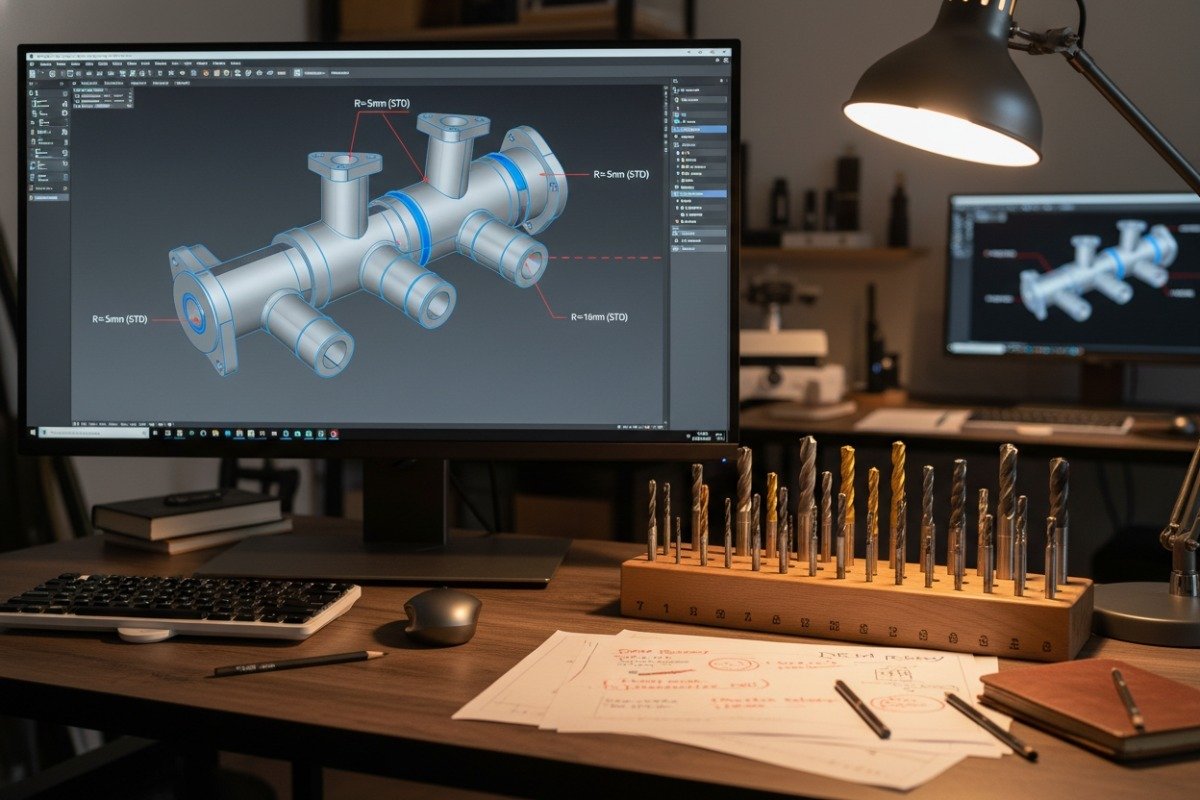
To optimize part designs for lower manufacturing costs, use standard tool sizes, avoid unnecessarily thin walls, limit tight tolerances to functional surfaces only, reduce the number of distinct features, and design parts that can be machined in the fewest setups possible.
Standard Tools Save Money
Every time a machinist needs a non-standard tool, it costs extra. Custom end mills, special reamers, and unusual drill sizes all add to your bill. Design your features around standard tool sizes whenever possible.
For example, use corner radii that match common end mill diameters: 1/8", 3/16", 1/4", 3/8", or 1/2". Avoid specifying a 0.173" radius when a 3/16" (0.1875") radius works just as well functionally.
Optimisation des tolérances
Tight tolerances require slower machining speeds, more inspection time, and sometimes secondary operations like grinding. Every decimal place you add to a tolerance specification increases cost.
Here is a general guideline:
| Plage de tolérance | Typical Cost Impact | Quand l'utiliser |
|---|---|---|
| ±0.010" (±0.25 mm) | Standard — no extra cost | General dimensions, non-critical features |
| ±0.005" (±0.13 mm) | Moderate — 10–20% premium | Surfaces d'accouplement, alésages de roulement |
| ±0.002" (±0.05 mm) | High — 30–50% premium | Ajustements de précision, surfaces d'étanchéité |
| ±0.001" (±0.025 mm) | Very high — 50–100%+ premium | Aerospace, medical, optical components |
| ±0.0005" (±0.013 mm) | Extreme — requires grinding/lapping | Ultra-precision applications only |
Review your drawing and ask: does this feature really need ±0.001"? Or will ±0.005" work? In our experience, about 60% of tight tolerances we see on client drawings are tighter than the application actually requires. Relaxing them where possible is free money.
Minimize Secondary Operations
Every operation beyond basic milling adds cost. Anodizing, plating, heat treating, grinding, polishing — each one requires additional handling, time, and often a separate vendor.
Before specifying a secondary operation, ask yourself:
- Is this surface finish required for function, or just cosmetics?
- Can I use a different material that does not need heat treatment?
- Can the CNC machine achieve the required finish directly, without post-processing?
For example, specifying a 32 Ra surface finish is achievable directly from CNC machining in most cases. But specifying 8 Ra or 4 Ra usually requires grinding or polishing, which adds significant cost.
Use AI-Driven Generative Design
A newer approach is generative design, where AI software creates optimized part geometries based on your functional requirements and constraints. Tools like Autodesk Fusion 360's generative design module can produce shapes that are lighter, stronger, and cheaper to machine than traditional human-designed parts.
These tools are especially useful for reducing material waste and simplifying complex assemblies into fewer parts. While not every project benefits from generative design, it is worth exploring for high-volume or performance-critical components.
Sélection des matériaux
Choosing the right material is just as important as choosing the right design. Common, readily available materials cost less because suppliers stock them in standard sizes, and machinists know how to cut them efficiently.
Aluminum 6061-T6 is the workhorse of CNC machining. It is cheap, easy to machine, lightweight, and corrosion-resistant. If your application allows it, default to 6061. For steel parts, 1018 or 4140 are widely available and well-understood. For plastics, Delrin (acetal) and HDPE machine beautifully and cost far less than PEEK or Ultem.
Exotic materials like Inconel, titanium, or Hastelloy are 5–10 times more expensive to machine than aluminum. They wear out tools faster, require slower speeds, and often need specialized equipment. Only use them when the application truly demands it.
Conclusion
Affordable CNC machining is not about finding the cheapest supplier. It is about smart design, clear communication, rigorous quality processes, and the right sourcing partner. Apply these strategies, and your costs will drop while your part quality stays high.
Notes de bas de page
1. Clarifies the International Traffic in Arms Regulations governing defense-related articles and services. ↩︎
2. Wikipedia offers a comprehensive and authoritative overview of CNC machining. ↩︎
3. Fictiv provides a comprehensive guide on Design for Manufacturability from a reputable manufacturing platform. ↩︎
4. Defines economies of scale and their impact on production costs and business profitability. ↩︎
5. Describes an automated production method that minimizes human intervention to lower costs. ↩︎
6. Details the international standard for quality management systems and its certification requirements. ↩︎
7. Explains the quality management system standard specifically for the aerospace industry. ↩︎
8. Wikipedia provides an authoritative and comprehensive explanation of Geometric Dimensioning and Tolerancing. ↩︎
9. Outlines the standardized process for approving production parts, especially in the automotive industry. ↩︎
10. Describes the crucial process for verifying initial production parts against design specifications. ↩︎

 English
 Español de México
 Deutsch
 Français
 Русский
 العربية