
Over the years, our team has helped dozens of U.S. buyers source precision parts from Asia. One lesson keeps repeating: the wrong manufacturing partner costs far more than the right one ISO 13485 for medical devices 1.
Choosing the best precision manufacturing services when sourcing requires evaluating a provider's technical capabilities, quality certifications, lead time reliability, and total cost of ownership. The goal is to find a partner who meets your tolerances, timelines, and budget without compromising precision or performance.
Precision machining errors cost manufacturers an estimated $1.2 trillion annually in rework and delays worldwide. Industry surveys show that 68% of sourcing failures trace back to mismatched capabilities. These are not small stakes. Whether you need aerospace parts held to 5–10 micron tolerances or medical components under 2 microns, picking the right partner is the single most important decision in your supply chain. Let's walk through the key factors step by step.
What Quality Certifications Should I Prioritize When Evaluating a Precision Manufacturing Partner?
When we audit suppliers across Vietnam and broader Asia, certifications are the first filter. A shop without the right paperwork is a risk no purchasing manager should take.
Prioritize ISO 9001:2015 as a baseline, then look for industry-specific certifications like AS9100 for aerospace, ISO 13485 for medical devices, IATF 16949 for automotive, and ITAR for defense. These certifications confirm documented quality management systems, annual audits, and defect rates below 1%.
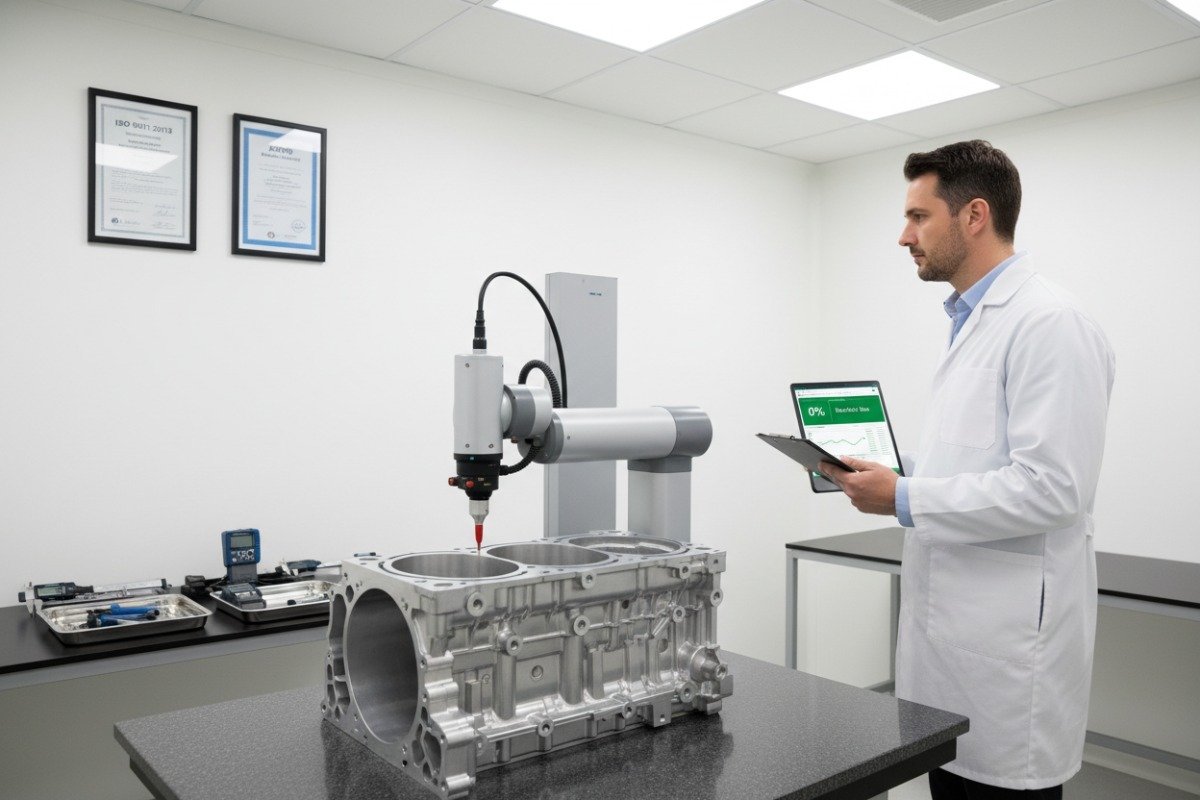
Certifications are not just wall decorations. They represent a structured approach to quality. Here is what each one means for your project and why it matters.
ISO 9001:2015 — The Universal Baseline
ISO 9001 is the minimum standard. It tells you the supplier has a documented système de management de la qualité 2 (QMS). They track processes. They record deviations. They run internal audits. If a supplier does not have ISO 9001, walk away. It signals they lack even basic process discipline.
Industry-Specific Certifications
Different industries demand different standards. Aerospace buyers need AS9100 because it adds requirements for traceability, risk management, and configuration control. AS9100 for aerospace 3 Medical device buyers need ISO 13485 because it covers biocompatibility documentation and sterilization validation. Defense buyers need ITAR compliance 4 to protect controlled technical data.
| Certification | Secteur d'activité | Exigences clés | Pourquoi c'est important |
|---|---|---|---|
| ISO 9001:2015 5 | Fabrication générale | Documented QMS, internal audits, corrective actions | Baseline quality assurance |
| AS9100 Rev D | Aérospatiale | Traceability, risk management, FAI per AS9102 | Meets FAA/EASA regulatory needs |
| ISO 13485 | Medical devices | Design controls, biocompatibility records, sterilization validation | FDA and EU MDR compliance |
| IATF 16949 | Automobile | PPAP, FMEA, SPC, control plans | OEM supplier approval |
| ITAR | Defense | Data security, export controls, U.S. person requirements | Protects controlled technical data |
Certifications Alone Are Not Enough
Here is a nuance many buyers miss. Some un-certified boutique shops do excellent work on niche, low-volume jobs. They use specialized handheld CMMs and have decades of craft experience. However, data shows that certified providers have 40% fewer defects in regulated industries. For high-stakes production, certifications are non-negotiable.
Our approach when auditing a new supplier is to verify the certification is current, check the scope of the certificate (it should cover the specific processes you need), and request recent audit reports. A certificate that covers "assembly" does not help you if you need "CNC machining of titanium."
Cybersecurity and IP Protection
One area gaining attention is cybersecurity. If your project involves defense or sensitive IP, look for CMMC (Cybersecurity Maturity Model Certification 6) readiness. IP theft reports have risen 20% in recent years. Ask your supplier about data encryption, file transfer protocols, and access controls. This is especially critical when sourcing from regions with weaker IP enforcement.
How Can I Ensure a Supplier's Technical Capabilities Match My Specific Design Requirements?
Our engineers spend significant time reviewing supplier equipment lists before we ever send a drawing. We have learned that assumptions about capability lead to rejected parts and wasted months.
To verify technical capabilities, request detailed equipment lists including CNC machine models and axis counts, review their material experience matrix, ask for sample inspection reports on parts with similar tolerances, and conduct a trial run or prototype order before committing to production volumes.
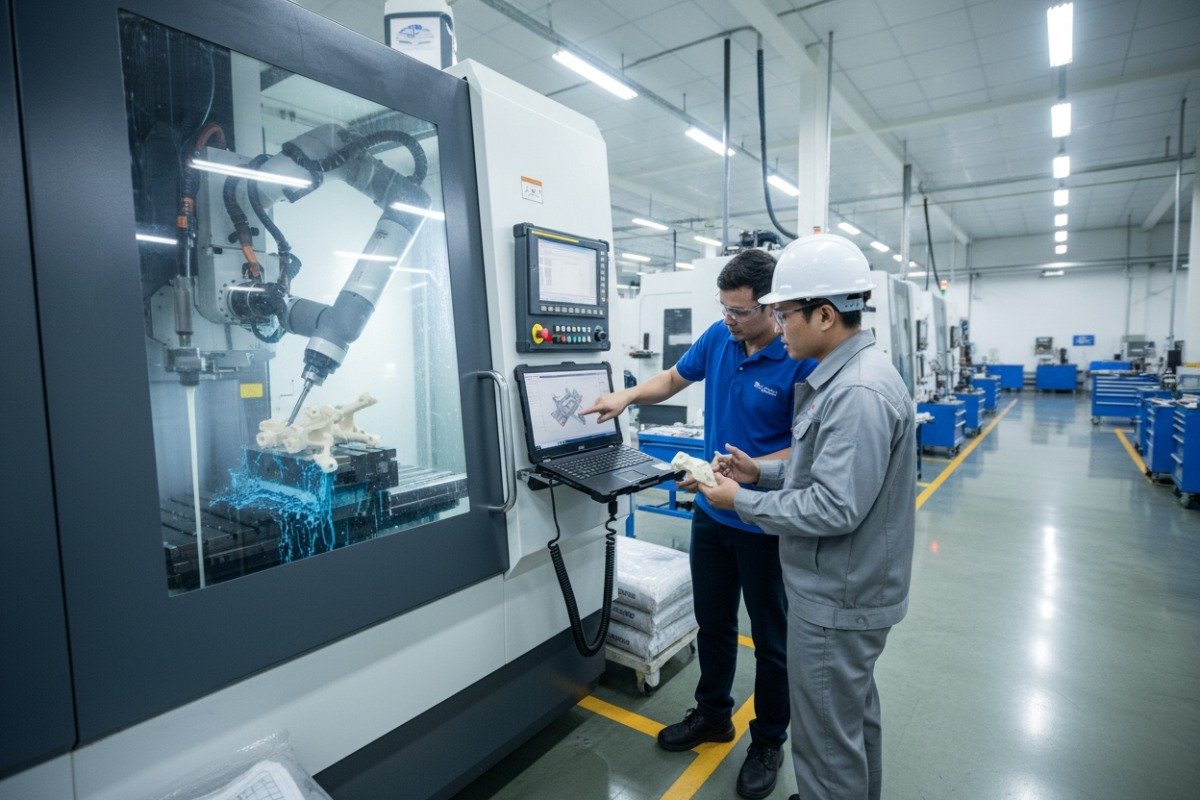
Matching a supplier's capabilities to your design is not guesswork. It requires a structured evaluation. Here is how we break it down.
Equipment and Technology Assessment
Start with the machines. Multi-axis CNC machines 7 (5-axis or more) handle complex geometries that 3-axis machines cannot. Wire EDM is essential for intricate cuts in hardened materials. Grinding machines deliver surface finishes that milling alone cannot achieve. Waterjet cutting works for heat-sensitive materials.
Ask for the specific make and model of their CNC machines. A shop running modern Mazak or DMG Mori 5-axis centers is fundamentally different from one using 20-year-old 3-axis mills. CNC adoption is rising 15% yearly, and shops investing in current technology deliver 30% higher productivity.
Material Expertise
Material knowledge separates good suppliers from great ones. Titanium warps if you do not manage thermal expansion. Aluminum galls if cutting parameters are wrong. Medical-grade plastics require specific feed rates to avoid surface defects. A supplier should demonstrate experience with your exact material, not just similar ones.
| Material Category | Common Challenges | What to Ask the Supplier |
|---|---|---|
| Alliages de titane | Tool wear, thermal distortion, warping | "What coolant strategy do you use for Ti-6Al-4V?" |
| Aerospace aluminum (7075) | Residual stress, thin-wall deflection | "How do you fixture thin-wall parts to prevent distortion?" |
| Stainless steel (316L) | Work hardening, burr formation | "What tool coatings do you use for 316L?" |
| Medical plastics (PEEK) | Heat sensitivity, surface finish control | "What spindle speeds and feed rates do you run for PEEK?" |
| Hardened tool steel (D2, H13) | Extreme tool wear, tight tolerance drift | "Do you have wire EDM or hard milling capability?" |
Vérification des tolérances
Do not just ask "Can you hold ±0.001 inches?" Ask for proof. Request Cpk data from similar jobs. Ask for CMM inspection reports. A capable supplier will have machines à mesurer tridimensionnelles 8 (CMMs) and optical comparators on the shop floor. Top providers achieve tolerances as tight as ±0.0001 inches, but only on specific features with specific setups.
In-House Secondary Processes
Every time a part leaves one shop and goes to another for heat treatment, plating, or grinding, you add risk and lead time. Suppliers with in-house secondary processes — heat treatment, anodizing, passivation, surface grinding — reduce handoffs. Fewer handoffs mean fewer errors and faster delivery.
Prototyping and Design for Manufacturability (DfM)
A strong supplier does not just make what you draw. They tell you how to make it better. DfM feedback from experienced engineers can eliminate features that drive up cost without adding function. Conception pour la fabricabilité 9 When we co-develop parts with clients, our engineering team reviews CAD files and flags potential issues before cutting metal. This "right first time" approach prevents the rework cycle that plagues so many sourcing relationships.
Rapid prototyping from CAD files should take days, not weeks. If a supplier cannot turn a prototype in under two weeks for a moderately complex part, their capacity or technology may be lacking.
What Steps Should I Take to Verify the Reliability and Lead Times of My Potential Manufacturer?
In our experience exporting to the U.S., delivery delays are the number one complaint we hear from buyers switching away from their previous suppliers. Late parts shut down production lines and cost real money.
To verify reliability and lead times, request on-time delivery records from existing clients, start with a small trial order to test actual performance, confirm production capacity and current machine utilization rates, and evaluate their supply chain for material availability and backup sourcing plans.
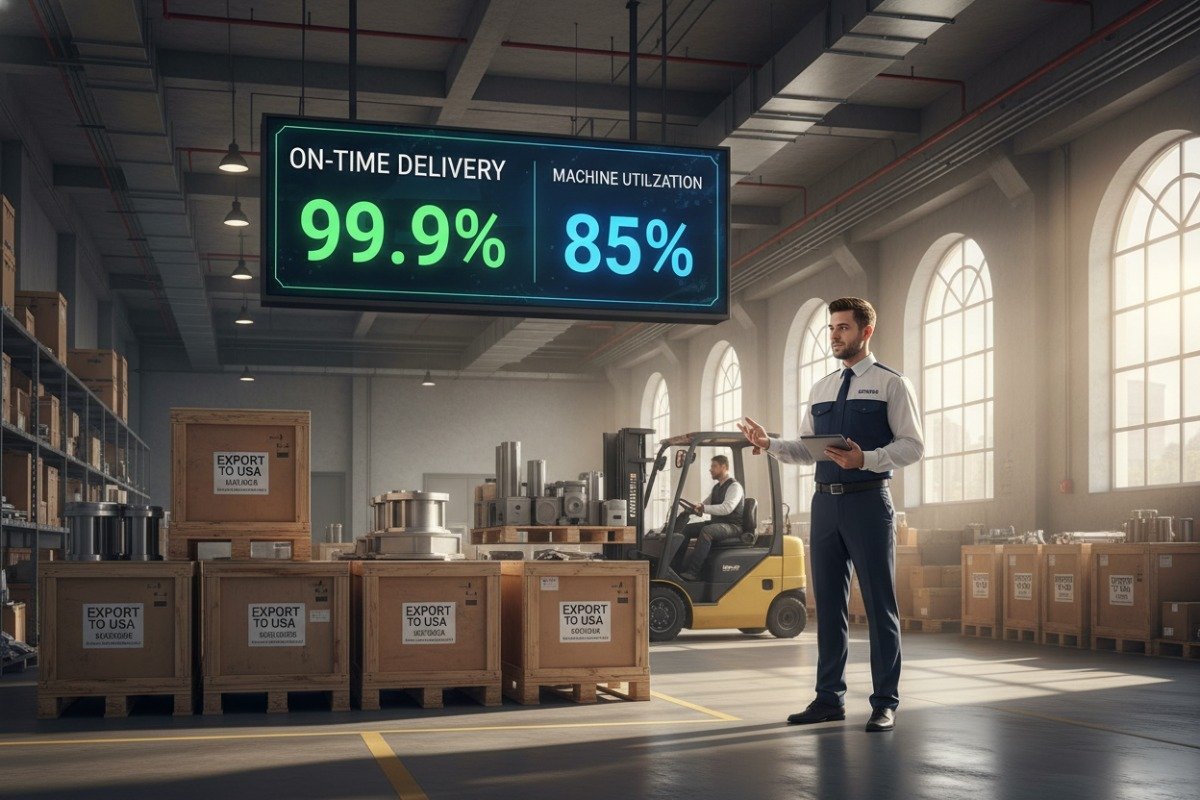
Reliability is not a feeling. It is measurable. Here is how to assess it before you commit.
Historique des livraisons dans les délais
Ask for data. What is their on-time delivery rate over the last 12 months? Top 20% of precision manufacturers achieve 99.9% on-time delivery. If a supplier cannot share this number, that is a red flag. They either do not track it or do not want you to see it.
Request references from current clients. Call them. Ask specifically: "Has this supplier ever missed a delivery date? How did they handle it?" The answer tells you everything about their reliability culture.
Capacity and Utilization
A shop running at 95% capacity cannot absorb your rush order. Ask about current utilization rates. A healthy shop runs at 70–80% capacity, leaving room for new orders and unexpected complications. Also ask how many shifts they run. A single-shift operation has limited flexibility compared to a two- or three-shift facility.
Lead Time Benchmarks
Lead times vary dramatically based on part complexity, material, and volume. Here are realistic benchmarks.
| Type de commande | Délai typique | Key Variables |
|---|---|---|
| Simple prototype (1–5 parts) | 3–7 business days | Material availability, complexity |
| Complex prototype (tight tolerances) | 1–3 weeks | Multi-axis setups, secondary processes |
| Low-volume production (50–500 parts) | 2–4 semaines | Fixturing, inspection requirements |
| High-volume production (1,000+ parts) | 4–8 semaines | Tooling, material procurement, capacity |
| Parts requiring special materials | Add 1–3 weeks | Exotic alloy lead times from mills |
Résilience de la chaîne d'approvisionnement
Post-2020 disruptions taught every buyer a hard lesson about supply chain fragility 10. Ask your supplier where they source raw materials. Do they have backup suppliers? How much safety stock do they carry? A supplier dependent on a single material source is a single point of failure in your supply chain.
Geopolitical factors matter too. Trade barriers, tariffs, and shipping disruptions can add 4–8 weeks to delivery from offshore sources. This is one reason nearshoring has gained momentum. U.S. and Southeast Asian shops now offer 15–25% faster delivery compared to traditional offshoring to distant regions, with the added benefit of tariff avoidance.
ERP and Communication Systems
Modern suppliers use ERP systems to manage scheduling, inventory, and order tracking. Ask if they can give you real-time visibility into your order status. Transparent scheduling prevents surprises. When we manage projects for our clients, we provide regular status updates and flag potential delays before they become problems. Proactive communication is the difference between a vendor and a partner.
The Trial Order Approach
Never commit a large production run to an unproven supplier. Start with a trial order. Send a moderately complex part. Evaluate their quoting speed, communication quality, dimensional accuracy, surface finish, packaging, and actual delivery date versus promised date. This small investment saves enormous headaches later.
How Do I Balance High-Precision Requirements with My Overall Project Budget?
When we quote custom parts for U.S. clients, the conversation almost always comes down to this: "Can you hit these tolerances without blowing the budget?" The answer is usually yes — but it requires smart decisions on both sides.
Balancing precision with budget means specifying only the tolerances that truly matter, leveraging Design for Manufacturability to simplify features, comparing total cost of ownership rather than unit price alone, and choosing suppliers whose efficient processes reduce rework and scrap rather than simply offering the lowest quote.

Cost and precision are not enemies. They just need to be managed together. Here is how experienced buyers do it.
Tolerance Optimization
The single biggest cost driver in precision machining is tolerance. Tightening a tolerance from ±0.005" to ±0.001" can double the machining time. Going to ±0.0005" can triple it. Yet many drawings specify tight tolerances on features that do not functionally require them.
Review every dimension on your drawing. Ask: "What happens if this feature is 0.002" off?" If the answer is "nothing," loosen that tolerance. Reserve tight tolerances for mating surfaces, sealing faces, and critical functional dimensions. This single step can reduce machining cost by 20–30% without affecting part performance.
Total Cost of Ownership vs. Unit Price
Cost-focused sourcing to low-cost regions promises 30–50% savings on unit price. But unit price is not total cost. Factor in shipping (4–8 weeks from distant suppliers), quality failures (rework, returns, line shutdowns), communication overhead (time zones, language barriers), and IP risk (reports of IP theft have risen 20%).
When we work with clients, we present a total cost comparison. A part that costs $8 from a distant low-cost source but arrives late, requires rework, and needs three rounds of communication actually costs more than a $12 part from a reliable regional partner that arrives on time and passes inspection first time.
Smart Process Selection
Different manufacturing processes have different cost profiles. CNC milling is versatile but expensive for high volumes. Casting or forging with CNC finishing can reduce per-part cost dramatically at scale. Additive manufacturing (3D printing) works for complex prototypes but rarely competes on cost for production volumes.
| Volume de production | Most Cost-Effective Process | Precision Trade-Off |
|---|---|---|
| 1–10 prototypes | CNC machining from billet | Full precision, highest per-part cost |
| 10–100 low volume | CNC machining, possible soft tooling | Full precision, moderate cost |
| 100–1,000 mid volume | Investment casting + CNC finishing | Near-net shape reduces machining time |
| 1,000–10,000 high volume | Die casting or forging + CNC finishing | Lowest per-part cost, requires tooling investment |
| Complex geometries, low volume | Hybrid additive + subtractive | Enables impossible geometries, premium cost |
The Value of DfM Collaboration
A collaborative supplier saves you money. When our engineering team reviews a client's design, we often identify features that are expensive to machine but easy to redesign. A sharp internal corner that requires EDM can become a radiused corner that a standard end mill handles. A deep narrow pocket that needs special tooling can be split into two simpler features. These changes save 15–25% on machining cost.
Joint R&D and co-development have been shown to cut development time by 35% in documented case studies. This is not about finding the cheapest shop. It is about finding a partner who thinks with you.
Long-Term Partnership Economics
The cheapest quote rarely delivers the lowest total cost. Suppliers who invest in advanced technology — AI-driven predictive maintenance, high-speed multi-axis CNCs, automated fixturing, digital twins — reduce downtime by up to 50%. They hold tighter tolerances more consistently. They deliver faster. Over a multi-year relationship, these efficiencies compound.
Our recommendation is always the same: get quotes from at least three suppliers. Compare them not on unit price alone, but on total value — quality consistency, communication responsiveness, lead time reliability, payment flexibility, and engineering support. The supplier who helps you avoid one round of rework has already paid for their premium.
Conclusion
Choosing the right precision manufacturing partner comes down to certifications, technical fit, proven reliability, and total value. Do your homework, start small, and invest in a partnership — not just a purchase order.
Notes de bas de page
1. Official standard for medical device quality management systems. ↩︎
2. Official definition and overview of quality management systems. ↩︎
3. Official standard for aerospace quality management systems. ↩︎
4. Official regulations for defense article exports and imports. ↩︎
5. Official standard for quality management systems. ↩︎
6. Official program for Department of Defense cybersecurity compliance. ↩︎
7. Wikipedia page providing a comprehensive overview of multi-axis machining. ↩︎
8. Comprehensive overview of CMM technology and uses in manufacturing. ↩︎
9. Explains the engineering practice of designing products for efficient manufacturing. ↩︎
10. Defines supply chain resilience and its importance in modern business. ↩︎

 English
 Español de México
 Deutsch
 Français
 Русский
 العربية