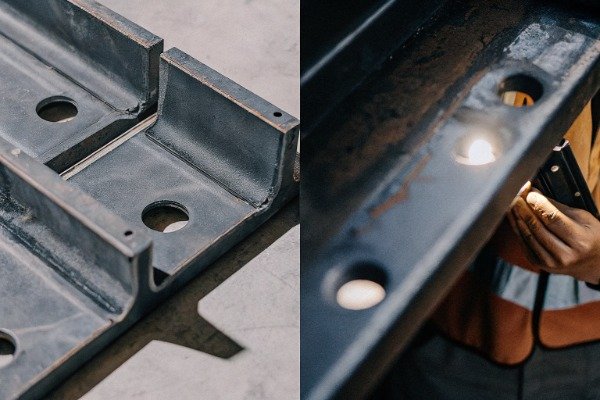
We often see US clients worry about welding quality when sourcing custom parts from Vietnam. Without proper verification, structural failures can ruin your project and damage your company's reputation.
structural failures 1
To confirm AWS compliance, verify the supplier's Welding Procedure Specifications (WPS) and Procedure Qualification Records (PQR) against AWS D1.1 codes. Ensure all welders hold valid performance qualifications (WPQ) and mandate independent audits by an AWS Certified Welding Inspector (CWI) before shipment.
Let's break down the specific steps to ensure your custom parts are safe and compliant.
Do their welders hold valid AWS qualification certificates?
We know that a certificate on paper doesn't always equal skill on the factory floor. Relying solely on scanned documents without verification can lead to disastrous weld failures in critical components.
Valid AWS qualification requires verifying that every welder has passed performance tests at an Accredited Testing Facility (ATF). You must check their Welder Performance Qualification (WPQ) records to ensure they are certified for the specific positions, processes, and thicknesses your project demands.

When sourcing from Vietnam, it is not enough to simply ask, "Are your welders certified?" The answer is almost always "Yes," but the reality can be complicated. In our experience managing supply chains in Southeast Asia, we have encountered suppliers who present expired certificates or certificates that do not match the specific welding process required for the project.
Understanding the WPQ Record
The Welder Performance Qualification (WPQ) is the most critical document for an individual welder. It proves that the person holding the torch has the manual skill to deposit sound weld metal. However, a WPQ is not a universal pass. It is limited by "essential variables."
For example, a welder qualified to weld flat fillets (1F position) on carbon steel using Stick welding (SMAW) is not qualified to weld vertical grooves (3G position) on stainless steel using TIG welding (GTAW). You must match the welder's WPQ variables to your specific product requirements.
The "Continuity" Requirement
One aspect many US buyers overlook is the continuity log. Under AWS D1.1, a welder's qualification remains valid indefinitely only if they have used the process without a gap of more than six months. If a welder stops welding for six months, their qualification expires.
We recommend requesting a continuity log or an "affidavit of usage" signed by the supplier's QA manager. This document tracks the welder's activity and ensures their skills are current.
Verification Checklist
To avoid fraud or misunderstandings, we use a strict verification process. You can use the table below to audit your Vietnamese supplier's welder qualifications.
Table 1: Welder Qualification Audit Checklist
| Document / Requirement | What to Check For | Why It Matters |
|---|---|---|
| WPQ (Welder Performance Qualification) | Check the expiration date and the specific welding process (e.g., GMAW, FCAW). | Ensures the welder is legally qualified for your specific job. |
| Position Qualification | Verify if they are qualified for Flat (1G), Horizontal (2G), Vertical (3G), or Overhead (4G). | A welder good at flat welding may fail at vertical welding. |
| Thickness Range | Ensure the qualified thickness covers your part's material thickness. | Welding thick structural steel requires different skills than thin sheet metal. |
| Continuity Log | Look for signatures every 6 months confirming the welder has used the process. | Prevents the use of expired certifications due to inactivity. |
| ATF Stamp | Look for the stamp of an AWS Accredited Testing Facility. | Validates that the test was witnessed by an independent third party. |
Can they perform non-destructive testing (NDT) according to AWS D1.1?
In our Vietnam facility, we find that visual inspection often misses internal cracks or lack of fusion. Skipping advanced testing risks hidden defects compromising your structural integrity once the parts reach the US.
Suppliers must demonstrate the capability to perform NDT methods like ultrasonic or radiographic testing aligned with AWS D1.1 standards. Verify that their technicians are certified to SNT-TC-1A levels and require detailed reports that document acceptance criteria for every critical weld joint.
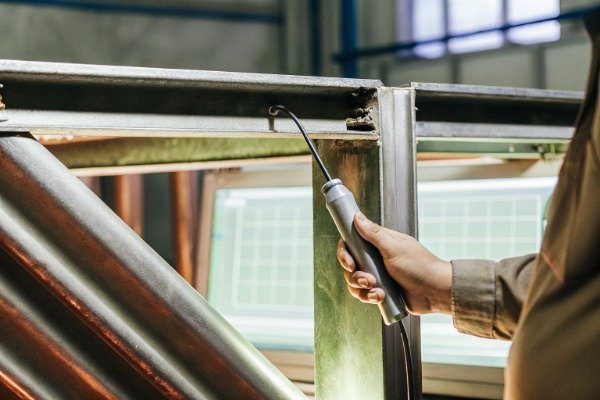
Non-Destructive Testing (NDT) is the safety net that catches defects invisible to the naked eye. For structural steel projects destined for the US, AWS D1.1 is the governing code. It specifies not just how to weld, but how to inspect.
Surface vs. Volumetric Testing
Many suppliers in Asia prefer Visual Inspection (VT), Dye Penetrant Testing (PT), or Magnetic Particle Testing (MT). These are excellent for finding surface cracks. However, they tell you nothing about the inside of the weld.
For critical load-bearing parts, we insist on volumetric testing. This includes Ultrasonic Testing (UT) or Radiographic Testing (RT/X-ray). These methods can detect "lack of fusion" or internal porosity that could cause a catastrophic failure under load.
Ultrasonic Testing (UT) 2
Technician Certification (SNT-TC-1A)
The equipment is only as good as the operator. In the US and Vietnam, NDT technicians are usually certified according to SNT-TC-1A.
- Level I: Can perform the test but cannot interpret results.
- Level II: Can perform the test and evaluate results (Accept/Reject).
- Level III: Can develop procedures and train others.
You must ensure that the person signing off on your NDT reports is at least a Level II technician. A Level I technician is not qualified to sign a final acceptance report.
Establishing Acceptance Criteria
Before production begins, you must define the "Acceptance Criteria." AWS D1.1 has different criteria for "Statically Loaded Structures" versus "Cyclically Loaded Structures" (structures subject to fatigue, like bridges or lifting equipment). Cyclically loaded criteria are much stricter.
If you do not specify this, the supplier might use the looser static criteria for a fatigue-critical part. We always clarify this in the purchase order to avoid disputes later.
Table 2: Common NDT Methods for AWS D1.1 Compliance
| NDT Method | Type | Best For Detecting | Cost/Speed |
|---|---|---|---|
| Visual Testing (VT) | Surface | Surface cracks, undercut, porosity, profile errors. | Low Cost / Fast |
| Dye Penetrant (PT) | Surface | Surface-breaking cracks in non-magnetic materials (e.g., Aluminum, Stainless). | Low Cost / Moderate |
| Magnetic Particle (MT) | Surface | Surface and near-surface cracks in ferromagnetic materials (Steel). | Moderate Cost / Fast |
| Ultrasonic Testing (UT) | Volumetric | Internal cracks, lack of fusion, inclusions. | High Cost / Slow |
| Radiographic (RT) | Volumetric | Internal porosity, slag inclusions, cracks. | High Cost / Slow |
Should I hire a Certified Welding Inspector (CWI) for the final audit?
We always recommend third-party eyes because internal QC teams can be biased toward shipping product. Relying only on the factory's word often results in non-conforming parts arriving in the US, leading to expensive rework.
Hiring an independent AWS Certified Welding Inspector (CWI) is crucial for validating compliance beyond basic paperwork. A CWI conducts physical audits of fit-up, joint preparation, and final weld quality, providing an unbiased guarantee that the fabrication meets strict AWS structural codes.

The cost of a recall or a field failure in the United States is astronomical compared to the cost of a CWI audit in Vietnam. A single day of inspection might cost $500 to $800, but it can save you tens of thousands of dollars in liability.
internal porosity 3
What Does a CWI Actually Do?
A CWI does not just look at the finished product. If they only inspect the final weld, they are missing 80% of the process. A proper CWI audit covers three phases:
- Pre-Weld: They check the "fit-up." Is the gap between the metal plates correct? Is the bevel angle right? If the fit-up is bad, the weld will be bad, no matter how skilled the welder is. They also check material storage—are low-hydrogen electrodes kept in ovens to prevent moisture?
- In-Process: They watch the welding parameters. Is the voltage and amperage consistent with the WPS? Is the welder cleaning the slag between passes?
- Post-Weld: They perform the final visual inspection and review the NDT reports.
The "Golden Sample" Protocol
For new suppliers, we implement a "Golden Sample" protocol. We select one random unit from the first production run and send it to an ISO 17025-accredited laboratory in the US for destructive testing. This is the ultimate truth-teller.
While the CWI checks the process in Vietnam, the US lab pulls the metal apart to see if it holds up. If the CWI report matches the US lab results, you have found a reliable supplier.
traceability 4
Remote Auditing Trends
Since 2020, remote auditing has become more common. Using high-definition cameras and real-time streaming, a US-based CWI can guide a local technician in Vietnam. While this is better than nothing, we still believe physical presence is superior for critical structural parts. However, for lower-risk items, remote witnessing of "hold points" (critical inspection stages) is a cost-effective alternative.
Table 3: Internal QC vs. Third-Party CWI Audit
| Feature | Factory Internal QC | Third-Party AWS CWI |
|---|---|---|
| Bias | High (Pressure to ship on time). | None (Works for the buyer). |
| Certification | Often internal or local standards only. | AWS Certified (Global Standard). |
| Scope | Usually final inspection only. | Pre-weld, In-process, and Post-weld. |
| Reporting | Basic pass/fail checklist. | Detailed report with photos and code references. |
| Cost | Included in part price. | Additional daily rate ($500-$1000/day). |
How do they document compliance with specific AWS codes?
We struggle when suppliers have messy paperwork that fails traceability audits during final review. Poor documentation makes it impossible to prove safety liability in legal disputes, leaving your company vulnerable.
Welding Procedure Specifications (WPS) 5
Proper documentation requires a complete package including the Welding Procedure Specification (WPS), Procedure Qualification Record (PQR), and Mill Test Reports (MTRs) for materials. Ensure the supplier links every batch of filler metal and base material to specific heat numbers for full traceability.
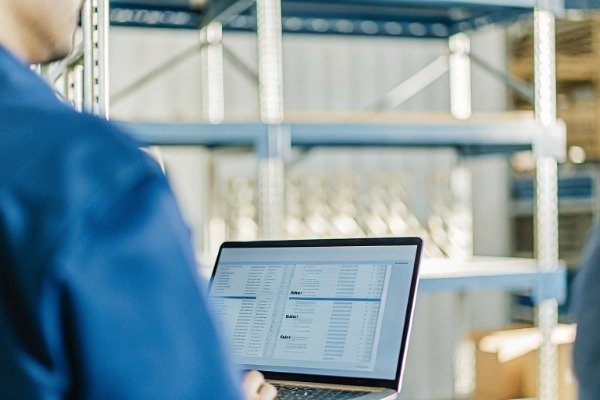
ISO 17025-accredited laboratory 6
In the world of AWS welding, if it isn't written down, it didn't happen. Documentation is your legal shield. When we audit suppliers for our clients, we look for the "Golden Triangle" of documents: the WPS, the PQR, and the MTR.
SNT-TC-1A 7
The WPS and PQR Relationship
This is the most common area of confusion.
- WPS (Welding Procedure Specification): This is the "recipe." It tells the welder what amperage, voltage, travel speed, and filler metal to use.
- PQR (Procedure Qualification Record): This is the "proof" that the recipe works. It is a record of a test weld that was subjected to destructive testing (tensile pull, bend test).
A supplier cannot just write a WPS; they must support it with a PQR. If a supplier sends you a WPS but cannot produce the supporting PQR, they are guessing, not engineering. You must demand both.
TIG welding (GTAW) 8
Material Traceability (MTRs)
AWS D1.1 requires that the base metal (the steel you are welding) meets specific chemical and mechanical properties. This is verified through a Mill Test Report (MTR).
In Vietnam, as in China, there is a risk of counterfeit material. We require suppliers to maintain a "Heat Map." This documents exactly which batch of steel (Heat Number) went into which specific part. If a bridge girder fails five years from now, you need to be able to trace that specific piece of steel back to the mill that produced it.
Stick welding (SMAW) 9
Digital Submission and Portals
Modern suppliers are moving toward digital documentation. AWS now allows for digital submission of forms. We encourage our suppliers to upload all QC documents to a shared cloud folder in real-time. This prevents the "Friday rush" where a supplier creates all the inspection reports at once right before shipping. Real-time documentation ensures the checks were done during production, not faked afterwards.
Critical Data Points to Verify
When you receive the documentation package, check these specific data points:
- PQR Date: Is it legible and signed?
- Code Year: Is the WPS based on a current version of AWS D1.1 (e.g., 2020 edition)?
- Filler Metal Class: Does the electrode match the steel grade? (e.g., E7018 for A36 steel).
- Gas Mixture: For MIG/TIG welding, is the gas blend correct? (e.g., 75% Argon / 25% CO2).
Conclusion
Confirming AWS standards in Vietnam requires verifying WPS/PQR documents, ensuring welder qualifications (WPQ) are valid, and utilizing third-party CWIs. Strict audits prevent costly failures and ensure safety.
AWS D1.1 codes 10
Notes de bas de page
1. Government agency overseeing structural safety and bridge integrity standards. ↩︎
2. Leading manufacturer explaining ultrasonic flaw detection technology. ↩︎
3. Educational resource explaining the physics of welding defects. ↩︎
4. Official US government institute defining measurement traceability standards. ↩︎
5. General overview of the required welding documentation. ↩︎
6. International standard for testing and calibration laboratories. ↩︎
7. The industry standard for qualification and certification of NDT personnel. ↩︎
8. Major welding equipment manufacturer guide on Gas Tungsten Arc Welding basics. ↩︎
9. Major manufacturer explaining the Shielded Metal Arc Welding process. ↩︎
10. Official standard body page for the specific structural welding code mentioned. ↩︎

 English
 Español de México
 Deutsch
 Français
 Русский
 العربية