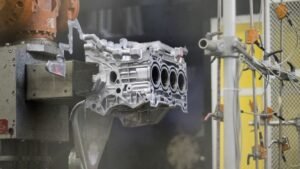
Die casting is a popular metal casting process that involves pressing molten metal into the mold cavity under high pressure. This is one of the fastest and most cost-effective methods for mass production of precision metal parts. However, there are other commonly used metal casting methods, each with its own advantages and disadvantages. The following is a comparison with some other widely used casting processes:
Casting Method | Casting Method | Casting Method |
Die-casting | 1. Produce parts with high dimensional accuracy and smooth surface finish. 2. It is possible to create shapes that are more complex than most other casting methods. 3. Fast production cycle. 4.Mass production and operation are more cost-effective. | 1. The upfront cost of mold or mold manufacturing is high 2. There may be porosity issues 3. Limited to non-ferrous metals such as zinc, aluminum, magnesium, and copper alloys. |
| Sand Casting | 1. Can be used for various metals, including ferrous metals and non-ferrous metal alloys. 2. The mold cost is lower. 3. Suitable for small and large parts. | 1. The surface is rougher and the dimensional tolerance accuracy is lower 2. The mold manufacturing process is slow and the delivery cycle is long. 3. More post casting mechanical processing and surface finishing may be required. |
| Investment Casting (Loss of wax process) | 1. Can generate complex geometric shapes. 2. Excellent surface smoothness and high dimensional accuracy. 3. It can cast both iron and non-iron materials. 4. Almost no mechanical processing is required after casting. | 1. More expensive than sand casting. 2. Mass production is less cost-effective than die casting. Compared with other casting methods, the process takes longer time. |
| Permanent Mold Castings (Gravity Die Casting) | 1. It has better surface finish and stricter tolerances. 2. Reusable molds can reduce the unit cost of high production operations. 3. Good mechanical performance. | 1. The cost of molds is higher than that of sand casting. 2. Limited to non-ferrous metals only. |
Whether you choose die casting or other metal casting processes, the goal is to achieve the best balance of quality, cost, and performance for your specific application. By evaluating the requirements and production scale of the required parts, you can choose a casting method that meets operational goals and quality standards.
Merci d'avoir lu notre article. Si vous avez besoin de produits connexes ou si vous avez des questions ou des suggestions concernant nos produits, n'hésitez pas à nous contacter en envoyant un e-mail, et nous vous répondrons dans les plus brefs délais.

 English
 Español de México
 Deutsch
 Français
 Русский
 العربية