
Every year, our project team reviews dozens of supplier qualification packages 1 from companies across Asia. The pattern is clear. Buyers who rush the selection process end up paying twice — once for the wrong parts, and again to fix the mess Contrôle Statistique des Processus 2.
Choosing the right custom parts manufacturer requires evaluating five core areas: quality certifications, production capacity, intellectual property protection, pricing transparency, and communication responsiveness. A systematic assessment across these factors prevents costly rework, delivery delays, and compromised part quality.
The following sections break down each critical factor. Whether you source from Vietnam, India, or other Asian markets, these guidelines will help you ask the right questions and spot red flags early. Let's walk through them one by one.
What Specific Quality Certifications Should I Prioritize for My Custom Parts?
Our quality team has rejected entire shipments because a supplier claimed "ISO certified" but could not produce a valid certificate. Certification confusion costs buyers time and money.
Prioritize ISO 9001 as the baseline quality management certification for any custom parts supplier. For aerospace, require AS9100; for automotive, IATF 16949; and for medical devices, ISO 13485. Always verify certificate validity directly with the issuing registrar before placing orders.

Quality certifications are not just wall decorations. They represent documented systems that a manufacturer follows every day. But not all certifications carry equal weight for every project. Understanding what each certification covers — and what it does not — helps you make smarter decisions.
ISO 9001: The Universal Baseline
ISO 9001 3 is the most widely recognized quality management system standard. It covers how a company documents processes, handles customer complaints, trains employees, and drives continuous improvement. If a supplier does not hold ISO 9001, that is a significant red flag. It means they have not invested in formalizing their quality processes.
However, ISO 9001 alone does not guarantee your parts will be perfect. It guarantees the company has a system. You still need to verify how well they execute that system.
Industry-Specific Certifications
Different industries demand different standards. Here is a quick reference:
| Secteur d'activité | Required Certification | Ce qu'il couvre |
|---|---|---|
| General Manufacturing | ISO 9001 | Système de management de la qualité 4 fundamentals |
| Aerospace & Defense | AS9100 / ITAR | Risk management, traceability, export controls |
| Automobile | IATF 16949 5 | Defect prevention, variation reduction, PPAP |
| Dispositifs médicaux | ISO 13485 6 | Design controls, sterility, biocompatibility tracking |
| Électronique | IPC Standards | Soldering quality, PCB fabrication standards |
When we audit suppliers in Vietnam for our U.S. clients, we always cross-check whether the certification scope matches the actual processes used for the buyer's parts. A supplier might hold ISO 9001 for their assembly line but not for their machining department. That gap matters.
Beyond Certifications: Practical Quality Indicators
Certifications tell you about systems. But you also need to look at execution. Ask for recent inspection reports. Request first-article inspection (FAI) data. Review their PPAP documentation if you are in the automotive space. Check whether they use Machines à mesurer tridimensionnelles 7 (CMMs) or Statistical Process Control (SPC) charts.
A supplier who can show you real SPC data from a recent production run is far more trustworthy than one who simply waves a certificate. In our experience managing contract manufacturing projects, the suppliers who resist sharing data are usually the ones with the most quality problems.
Comment vérifier les certifications
Do not take a PDF at face value. Go to the registrar's website and search for the supplier's name. Confirm the certificate number, scope, and expiration date. We have encountered forged certificates more than once. A five-minute check can save you months of headaches.
How Can I Evaluate if a Manufacturer's Production Capacity Matches My Project Timeline?
When we onboard a new supplier for a client, the first factory visit always focuses on one thing: can this facility actually deliver the volume we need, on time? Promises on paper mean nothing if the shop floor tells a different story.
Evaluate production capacity by reviewing the manufacturer's equipment list, current utilization rate, workforce size, and historical on-time delivery rate. Request references from clients with similar order volumes. A capable supplier should demonstrate at least 85% on-time delivery and have documented capacity planning processes.
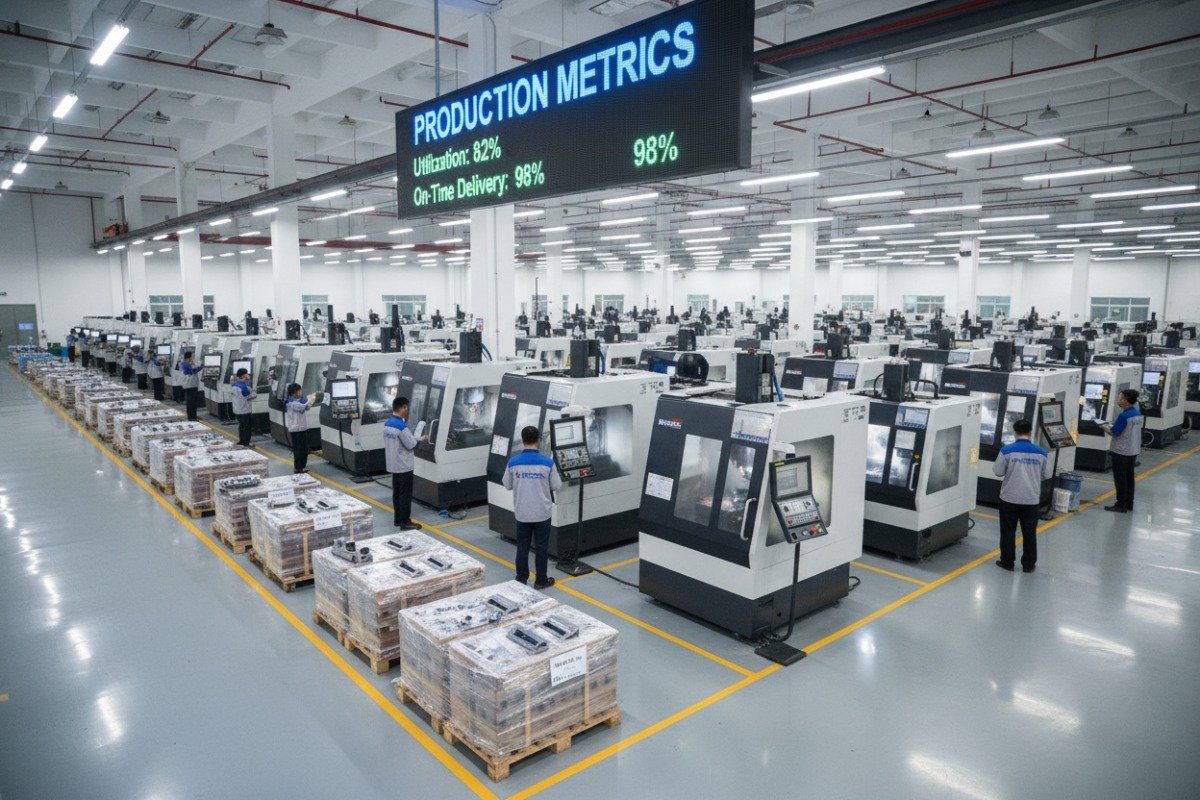
Production capacity is one of the most overlooked factors in supplier selection. Buyers often focus on price and quality but forget to ask: "Can you actually make this many parts in this timeframe?" The result is missed deadlines, partial shipments, and disrupted production schedules downstream.
Matching Volume to Capability
Not every shop handles every volume level well. A small CNC shop with three machines excels at prototype runs of 10–50 pieces. But ask them to produce 10,000 units, and they will either refuse or deliver late. Conversely, a large injection molding facility may not be interested in your 200-piece order because it is not worth their setup time.
| Volume de commande | Best-Fit Manufacturer Type | Délai typique |
|---|---|---|
| 1–50 units (Prototype) | Small CNC / 3D printing shops | 1–3 weeks |
| 50–500 units (Low volume) | Mid-size CNC or urethane casting shops | 3–6 semaines |
| 500–5,000 units (Mid volume) | Mid-to-large CNC or stamping facilities | 6–10 semaines |
| 5,000–50,000+ units (High volume) | Injection molding or die casting plants | 8–16 weeks (including tooling) |
Key Metrics to Request
When we conduct supplier audits, we ask for specific data points. You should too:
- Current utilization rate: If a factory runs at 95% capacity, your order will wait. Ideally, look for 70–85% utilization — busy enough to be stable, but with room for your project.
- Number of shifts: A single-shift operation has limited flexibility. Two or three shifts indicate the ability to absorb rush orders.
- Equipment age and maintenance records: Old machines break down. Frequent breakdowns cause delays. Ask when their CNC machines were last serviced.
- Workforce stability: High employee turnover means inconsistent quality and slower ramp-up times. Ask about average employee tenure.
The On-Time Delivery Question
Ask directly: "What is your on-time delivery rate for the past 12 months?" A good supplier tracks this metric and can share it. If they cannot answer, they probably do not track it — which is a problem.
In our work coordinating shipments from Asian suppliers to U.S. clients, we have learned that delivery reliability matters more than speed. A supplier who consistently delivers in six weeks is more valuable than one who promises four weeks but delivers in eight.
Capacity Planning and Scalability
Think beyond your current order. If your product succeeds, can this supplier scale with you? Ask about their expansion plans, additional equipment on order, and whether they subcontract overflow work. Subcontracting is not inherently bad, but you need to know about it. Uncontrolled subcontracting introduces quality risks because the sub-tier supplier may not follow the same standards.
What Steps Should I Take to Protect My Intellectual Property When Sharing My Designs?
Our engineering team handles confidential drawings from U.S. clients every week. We understand the anxiety that comes with sending proprietary designs overseas. The fear is real — but so are the solutions.
Protect your intellectual property by executing a Non-Disclosure Agreement (NDA) before sharing any designs, registering patents or trademarks in the manufacturing country, limiting access to only necessary design details, using watermarked or controlled-release drawings, and choosing suppliers in countries with enforceable IP laws.

Intellectual property theft 8 is a legitimate concern in international manufacturing. But avoiding outsourcing entirely is not practical for most companies. The key is to take deliberate, layered steps that reduce risk to an acceptable level.
Start with a Strong NDA
Before you share a single drawing, get a signed Non-Disclosure Agreement 9. This is non-negotiable. A proper NDA should specify:
- What information is considered confidential
- How long the confidentiality obligation lasts
- What happens if the agreement is breached
- Which country's laws govern the agreement
Make sure the NDA is enforceable in the supplier's jurisdiction. An NDA governed by U.S. law may be difficult to enforce against a factory in Southeast Asia. Work with a lawyer who understands cross-border IP issues.
Control What You Share
Not every supplier needs your complete design package. When we manage co-development projects, we use a tiered information release approach:
| Stade | What to Share | What to Withhold |
|---|---|---|
| Initial Quoting | General dimensions, material, quantity | Proprietary geometry, assembly context |
| Supplier Qualification | Detailed drawings with key tolerances | Full assembly drawings, end-use application |
| Production Release | Complete manufacturing drawings | Source code, proprietary formulas, customer identity |
This approach limits exposure. If a supplier only sees one component, they cannot replicate your full product.
Watermark and Track Your Documents
Add watermarks to every drawing you send. Include the supplier's name and the date on each document. This creates a trail. If a design leaks, you can trace it back to the source. Use PDF formats with restricted permissions — disable printing or copying where possible.
Our team uses document control systems that log every file sent to every supplier. This level of tracking may seem excessive, but it has proven valuable when disputes arise.
Choose Your Manufacturing Country Carefully
IP protection varies dramatically by country. Singapore, for example, has strong IP enforcement aligned with international standards. Vietnam has improved significantly in recent years but enforcement remains inconsistent in some regions. Research the legal framework before committing.
Register Your IP Locally
If your design is truly proprietary, register patents or design rights in the country where manufacturing occurs. This gives you legal standing to pursue action if infringement happens. Registration is relatively inexpensive compared to the cost of losing a proprietary design.
Build Trust Gradually
Start with a small, non-critical order. Evaluate the supplier's professionalism and integrity before sharing your most sensitive designs. A supplier who respects confidentiality on small projects will likely do the same on large ones. Trust is earned, not assumed.
How Do I Determine if a Supplier's Pricing Reflects the True Value of My Custom Components?
When we prepare quotations for clients, we break down every cost element. Transparency is not just good practice — it is how trust gets built. But we also see competitors submit suspiciously low quotes that fall apart once production starts.
Determine true pricing value by requesting detailed cost breakdowns covering material, labor, tooling, quality inspection, finishing, and logistics. Compare at least three qualified suppliers. The lowest quote often excludes hidden costs like rework, expedited shipping, or additional inspection — always evaluate total cost of ownership.

Price is what you pay. Value is what you get. This distinction matters enormously in custom parts manufacturing. A quote that looks cheap upfront can become the most expensive option when you factor in quality failures, delivery delays, and the cost of managing problems.
Understanding Cost Components
Every custom part price includes multiple cost layers. Here is what a transparent quote should break down:
- Raw material cost: Based on current market prices for the specified grade and quantity
- Machining or processing cost: Machine time, setup time, programming time
- Tooling cost: Molds, fixtures, jigs, or dies required for production
- Labor cost: Operator time, inspection time, packaging time
- Quality assurance cost: First-article inspection, in-process checks, final inspection, CMM measurement
- Surface treatment or finishing: Anodizing, plating, powder coating, painting
- Packaging and logistics: Crating, shipping, customs documentation
When a supplier gives you a single lump-sum number with no breakdown, ask for details. If they refuse or cannot provide one, that is a warning sign.
The Danger of Choosing the Lowest Price
We have seen this scenario play out many times. A buyer selects the cheapest supplier. The first shipment arrives late. Half the parts fail inspection. The buyer spends weeks negotiating replacements. Meanwhile, their production line sits idle. The "savings" from the low quote evaporate instantly.
Total Cost of Ownership Framework
Use this framework to compare suppliers fairly:
| Élément de coût | Supplier A (Low Quote) | Supplier B (Mid Quote) | Supplier C (High Quote) |
|---|---|---|---|
| Unit price | $4.50 | $6.20 | $7.00 |
| Tooling (amortized) | $0.80 | $0.60 | $0.50 |
| Rework rate (estimated) | 8% | 2% | 1% |
| Cost of rework per unit | $0.36 | $0.12 | $0.07 |
| Shipping per unit | $0.50 | $0.45 | $0.40 |
| Inspection cost per unit | $0.00 (none offered) | $0.15 | $0.20 |
| Total cost per unit | $6.16 | $7.52 | $8.17 |
At first glance, Supplier A looks cheapest. But once you add rework costs and the risk of no inspection, the gap narrows significantly. And this table does not even account for the cost of delayed deliveries or lost customer trust.
Red Flags in Pricing
Watch for these warning signs:
- No tooling charge on a new mold: Molds cost money. If a supplier absorbs this cost entirely, they are either cutting corners on mold quality or hiding the cost elsewhere.
- Pricing significantly below all competitors: If three suppliers quote $6–$8 and one quotes $3, something is wrong. They may be using inferior materials, skipping quality steps, or planning to raise prices after you are locked in.
- No mention of inspection or quality costs: Quality is not free. A supplier who does not charge for it probably does not do it.
- Vague payment terms: Clear payment terms — such as 30, 60, or 90 days net — indicate a professional operation. Vague or aggressive payment demands suggest financial instability.
Negotiating Fair Pricing
Fair pricing benefits both parties. When we negotiate with our supply chain partners, we focus on long-term relationships rather than squeezing every cent. A supplier who makes a reasonable margin will invest in better equipment, retain skilled workers, and prioritize your orders. A supplier operating on razor-thin margins will cut corners to survive.
Ask about volume discounts, blanket order pricing, and annual agreements. These structures give the supplier predictability, which often translates to better pricing for you.
Conclusion
Choosing the right custom parts manufacturer comes down to asking the right questions and verifying the answers. Prioritize certifications, capacity, IP protection, and true cost — not just price. A systematic approach today prevents expensive problems tomorrow.
Notes de bas de page
1. Explains the process and guidelines for supplier qualification. ↩︎
2. Defines Statistical Process Control and its application in manufacturing. ↩︎
3. The original URL returned an HTTP 404 error. The new URL is the official ISO 9001 page from the International Organization for Standardization, an authoritative source. ↩︎
4. Provides a definition and overview of a quality management system. ↩︎
5. Explains IATF 16949 as the automotive industry’s quality management standard. ↩︎
6. Describes ISO 13485 as a quality management system for medical devices. ↩︎
7. Explains how Coordinate Measuring Machines work and their principles. ↩︎
8. The original URL returned an HTTP 404 error. The new URL from Proofpoint, a cybersecurity company, provides a detailed definition and examples of intellectual property theft. ↩︎
9. Explains what a Non-Disclosure Agreement is and its purpose. ↩︎
10. Defines Total Cost of Ownership and its importance in manufacturing. ↩︎

 English
 Español de México
 Deutsch
 Français
 Русский
 العربية