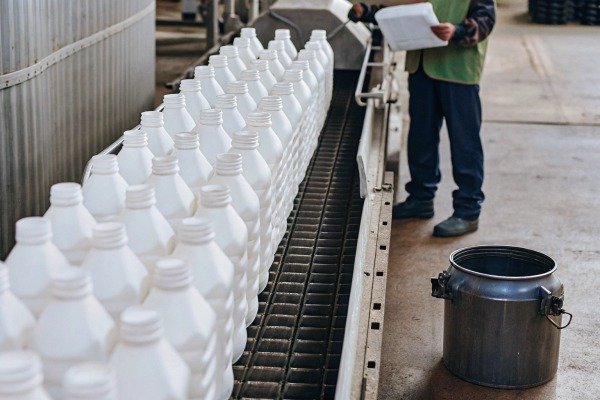
Sur notre chaîne de production, nous avons vu d'innombrables projets de moulage par soufflage personnalisés échouer à cause de fournisseurs qui prétendaient être conformes aux normes ASTM mais livraient des conteneurs qui fuyaient, se fissuraient ou cédaient sous la pression. ASTM D2463 pour la résistance aux chocs par chute 1. Le coût réel va au-delà des pièces défectueuses : il comprend les rappels, les réputations endommagées et la perte de clients.
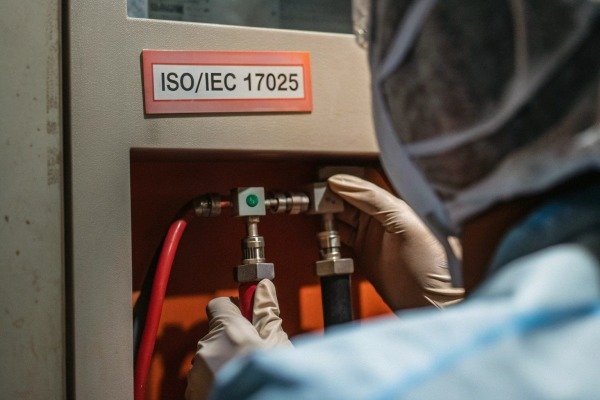
Pour vérifier la conformité du laboratoire des fournisseurs de moulage par soufflage en plastique aux normes ASTM, vous devez confirmer Accréditation de laboratoire ISO/CEI 17025 2, audit des enregistrements d'étalonnage des équipements de test, examen des procédures de test documentées correspondant à des méthodes ASTM spécifiques telles que D2463 et D2659, validation de la compétence du personnel par le biais des dossiers de formation, et mise en parallèle des rapports internes avec les résultats de tests indépendants de tiers.
Ce guide vous accompagne à travers chaque étape de vérification ASTM D2659 pour les propriétés de résistance à l'écrasement en colonne 3. Nous aborderons les normes ASTM les plus importantes, comment auditer l'équipement de laboratoire et le personnel, et comment garantir l'intégrité des données grâce à une validation par des tiers.
Quelles normes ASTM critiques dois-je spécifier pour mes projets de moulage par soufflage de plastique sur mesure ?
Lorsque notre équipe d'ingénierie examine les qualifications des fournisseurs, nous commençons toujours par les normes de test. ASTM D2561 pour la résistance à la fissuration sous contrainte environnementale 4. De nombreux fournisseurs mentionnent une "conformité ASTM" générique sans spécifier quels tests ils effectuent réellement. Cette imprécision crée un risque pour les acheteurs.
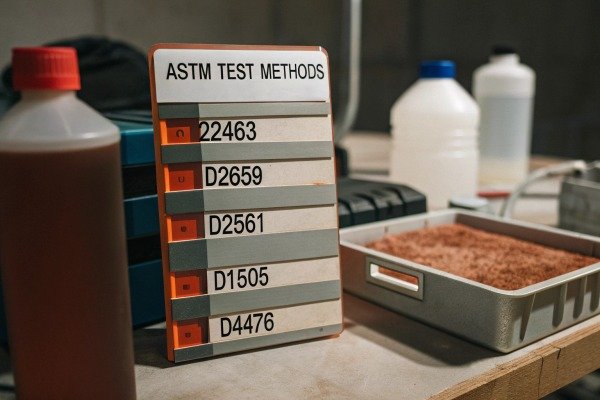
Pour les projets de moulage par soufflage de plastique personnalisés, spécifiez ASTM D2463 pour la résistance aux chocs par chute, D2659 pour les propriétés de compression en colonne, D2561 pour la résistance à la fissuration sous contrainte environnementale, D1505 pour la mesure de la densité et D4976 pour les spécifications des matériaux en polyéthylène, y compris l'indice de fluidité à chaud et les exigences de densité.
Comprendre chaque norme ASTM critique
Chaque norme sert un objectif spécifique dans la validation de la qualité des conteneurs moulés par soufflage. étalonnage de l'équipement de laboratoire 5. Laissez-moi vous expliquer ce que chaque test mesure et pourquoi il est important.
L'ASTM D2463 mesure la résistance aux chocs par chute à l'aide de conteneurs remplis d'eau. Le test nécessite un minimum de 20 spécimens avec bouchons. La procédure A utilise la méthode de l'escalier de Bruceton, où la hauteur de chute s'ajuste en fonction des résultats de réussite/échec. La procédure B utilise une hauteur fixe avec 20 chutes ou plus autour de la hauteur de défaillance moyenne. La défaillance se produit lorsque vous observez une rupture visible ou une fuite de liquide.
L'ASTM D2659 évalue les propriétés de résistance à l'écrasement en colonne sous compression constante. Ce test s'applique aux conteneurs soufflés en laboratoire et dans le commerce. Il vous indique quelle charge verticale votre conteneur peut supporter avant une défaillance structurelle.
La norme ASTM D2561 traite spécifiquement de la résistance à la fissuration sous contrainte environnementale des récipients en polyéthylène moulés par soufflage. Ce test prédit la durabilité à long terme lorsque les récipients entrent en contact avec divers produits chimiques ou détergents.
Tableau comparatif des principales normes ASTM
| Norme | Objectif du test | Exigences clés | Critères de défaillance |
|---|---|---|---|
| D2463 | Résistance aux chocs par chute | Min 20 spécimens remplis d'eau avec bouchons | Rupture visible ou fuite de liquide |
| D2659 | Propriétés de compression en colonne | Charge de compression constante | Effondrement structurel sous charge |
| D2561 | Résistance à la fissuration sous contrainte environnementale | Contenants en PE sous contrainte | Formation de fissures ou défaillance du matériau |
| D1505 | Mesure de densité | Technique de gradient | Lecture de densité hors spécifications |
| D4976 | Spécification du matériau PE | Indice de fluidité à chaud, densité, inflammabilité selon FMVSS 302 | Déviation des propriétés du matériau |
Considérations spécifiques au matériau
Le Norme ASTM D4976 6 couvre les plastiques polyéthylène pour le moulage et l'extrusion. Elle fait référence à D1505 pour les tests de densité et exige la mesure de l'indice de fluidité à chaud via un plastomètre d'extrusion. Pour les applications automobiles, elle inclut des tests d'inflammabilité selon FMVSS 302.
Lorsque votre projet utilise du PEHD recyclé, demandez aux fournisseurs la conformité à D5203. Cette norme concerne le contenu recyclé post-consommation provenant de bouteilles et de bidons de lait. Avec la réglementation croissante autour de la recyclabilité, la vérification des tests de contenu recyclé devient essentielle.
Le conditionnement préalable aux tests selon D618 garantit une préparation cohérente des échantillons. Sans conditionnement approprié, les résultats des tests varient considérablement. Confirmez toujours que votre fournisseur suit les protocoles D618 avant d'effectuer des tests mécaniques.
Les mises à jour récentes à surveiller incluent D2561-17(2023) et D2659-16(2023). Ces révisions sont alignées sur les normes ISO pour la conformité aux exportations mondiales. Assurez-vous que votre fournisseur référence les versions actuelles des normes, et non des éditions obsolètes.
Comment puis-je vérifier que l'équipement de laboratoire du fournisseur est correctement calibré et entretenu ?
Notre équipe qualité audite régulièrement les laboratoires des fournisseurs. Nous avons découvert que l'équipement non calibré est l'une des sources les plus courantes de données de test peu fiables. Une machine d'essai universelle qui dérive de 2% peut transformer des résultats positifs en échecs réels.
Vérifier l'étalonnage de l'équipement de laboratoire en demandant les certificats d'étalonnage actuels traçables aux normes nationales, en vérifiant les intervalles d'étalonnage par rapport aux recommandations du fabricant, en examinant les journaux de maintenance pour un entretien régulier, en confirmant l'adéquation du modèle d'équipement pour les tests ASTM spécifiés et en auditant les contrôles environnementaux tels que la température et l'humidité dans la zone de test.
Équipement essentiel pour les tests de moulage par soufflage
Différents tests ASTM nécessitent un équipement spécifique. Le laboratoire de votre fournisseur doit disposer d'instruments correctement calibrés pour chaque test qu'il prétend effectuer.
Pour les tests de chute D2463, le laboratoire a besoin d'une tour de chute calibrée avec une mesure de hauteur précise. Le mécanisme de réglage de la hauteur doit fournir des incréments précis pour la méthode de l'escalier. L'équipement de mesure de la température de l'eau garantit que les spécimens sont testés à la bonne température.
Les machines d'essai universelles effectuent les tests de compression D2659. Ces machines nécessitent une calibration de la cellule de charge à plusieurs points sur leur plage de fonctionnement. La calibration de la vitesse de la traverse garantit des taux de compression constants pendant les tests.
Liste de contrôle de vérification de la calibration de l'équipement
| Type d'équipement | Intervalle de calibration | Paramètres clés | Exigence de traçabilité |
|---|---|---|---|
| Machine d'essai universelle | Annuel | Précision de la cellule de charge, vitesse de la traverse | NIST ou laboratoire national équivalent |
| Tour de test de chute | Annuel | Mesure de la hauteur, mécanisme de libération | Normes de mesure certifiées |
| Contrôleurs de température | Semestriel | Précision de température ±1°C | Thermomètre de référence calibré |
| Thermocouples | Semestriel | Précision de lecture de température | Compensation de jonction froide |
| Colonne de gradient de densité | Annuel | Linéarité du gradient, température | Étalons de densité certifiés |
| Indice de fluidité à chaud | Annuel | Précision de la température, du poids | Institut national de métrologie |
Drapeaux rouges lors des audits d'équipement
Surveillez ces signes avant-coureurs lors des audits de laboratoire des fournisseurs. Un équipement dont les autocollants de calibration sont expirés indique une mauvaise gestion de la qualité. Des journaux de maintenance manquants suggèrent une maintenance réactive plutôt que préventive de l'équipement.
Les laboratoires qui utilisent un équipement en dehors de sa plage spécifiée produisent des résultats peu fiables. Une cellule de charge d'une capacité de 5000N ne devrait pas tester des spécimens nécessitant une force de 10000N. De même, tester à des températures en dehors de la plage nominale de l'équipement compromet la précision.
Les contrôles environnementaux sont très importants. La norme ASTM D618 spécifie les environnements de conditionnement à 23°C ± 2°C et 50% ± 10% d'humidité relative. Les laboratoires sans contrôle climatique ne peuvent pas produire de résultats reproductibles. Demandez à voir les enregistrements de surveillance environnementale lors de votre audit.
Exploiter la technologie pour la vérification
Les fournisseurs avancés utilisent désormais la technologie de jumeau numérique pour simuler les processus de moulage par soufflage. Cela leur permet de prédire le comportement des matériaux avant les tests physiques. Bien que ce ne soit pas un remplacement des tests ASTM réels, cela démontre une sophistication technique.
Certains laboratoires progressistes mettent en œuvre une surveillance des équipements en temps réel grâce à des capteurs IoT. Ces systèmes signalent immédiatement les dérives de calibration plutôt que d'attendre les vérifications annuelles. Cette approche réduit le risque de tests avec des équipements hors spécifications.
Technologie Blockchain 7 crée des enregistrements immuables des événements de calibration. Chaque certificat de calibration est horodaté et lié à des numéros de série d'équipement spécifiques. Cela empêche la rétrodatage ou la falsification des enregistrements de calibration.
Quelles mesures dois-je prendre pour valider la compétence technique du personnel de laboratoire effectuant les tests ?
Lors d'un audit de fournisseur, notre équipe a observé un technicien effectuer des tests de chute D2463. Il n'a utilisé que 12 spécimens au lieu des 20 requis. Lorsque nous lui avons demandé pourquoi, il a admis qu'il ne savait pas que la norme en exigeait plus. Un équipement compétent ne vaut rien sans opérateurs compétents.
Valider la compétence du personnel de laboratoire en examinant les dossiers de formation spécifiques à chaque méthode ASTM, en observant les procédures de test lors d'audits sur site, en vérifiant les certifications des techniciens délivrées par des organismes reconnus, en recherchant des évaluations de compétence documentées et en confirmant les dispositions de supervision pour le personnel moins expérimenté, conformément aux exigences de la norme ISO/IEC 17025.

Exigences de compétence de base
Le personnel de laboratoire doit comprendre la théorie et la pratique derrière chaque méthode ASTM. Pour les tests de chute D2463, les techniciens doivent expliquer la logique de la méthode de l'escalier de Bruceton. Ils doivent savoir pourquoi on commence 300 mm en dessous de la hauteur moyenne estimée de défaillance. Ils doivent reconnaître les critères de défaillance valides : rupture visible ou fuite de liquide.
La compétence en préparation des spécimens garantit des résultats cohérents. Pour le D2463, le personnel doit remplir correctement les récipients avec de l'eau, installer correctement les bouchons et conditionner les spécimens conformément aux exigences du D618. Une mauvaise préparation introduit une variabilité qui masque les véritables performances du produit.
Matrice d'évaluation des compétences du personnel
| Domaine de compétence | Méthode d'évaluation | Exigence minimale | Documentation nécessaire |
|---|---|---|---|
| Connaissance des méthodes ASTM | Examen écrit | 80% score de passage | Dossiers d'examen et clés de réponses |
| Fonctionnement de l'équipement | Démonstration pratique | Zéro erreur critique | Listes de contrôle d'observation |
| Préparation des spécimens | Pratique supervisée | 10 tests supervisés | Journaux de formation |
| Enregistrement des données | Examen des dossiers | 100% précision | Rapports de tests d'échantillons |
| Identification des défaillances | Test d'évaluation visuelle | Taux d'identification correct ≥95% | Dossiers de tests de compétence |
| Procédures de sécurité | Évaluation pratique | Conformité totale | Certificats de formation à la sécurité |
Importance de l'accréditation ISO/IEC 17025
L'accréditation ISO/IEC 17025 offre la plus forte garantie de compétence d'un laboratoire. Les laboratoires accrédités sont soumis à des audits externes réguliers. Ces audits vérifient la formation du personnel, la validation des méthodes et les systèmes de gestion de la qualité.
Lorsqu'un fournisseur prétend avoir l'accréditation ISO/IEC 17025, vérifiez la portée. L'accréditation s'applique à des méthodes d'essai spécifiques, pas à l'ensemble du laboratoire. Un laboratoire accrédité pour les essais de densité D1505 n'est pas nécessairement compétent pour les essais d'impact D2463. Demandez le certificat et vérifiez quelles méthodes ASTM sont incluses.
Protocoles d'observation sur site
Prévoyez d'observer les essais réels lors des audits de fournisseurs. Arrivez sans préavis si possible pour voir les opérations normales. Les visites annoncées présentent souvent les meilleurs techniciens plutôt que les performeurs typiques.
Soyez attentif aux écarts de procédure. Le technicien suit-il la procédure écrite étape par étape ? Enregistre-t-il les données immédiatement ou plus tard de mémoire ? Manipule-t-il correctement les échantillons pour éviter de les endommager ?
Posez des questions pendant l'observation. Un technicien compétent explique ce qu'il fait et pourquoi. Il se réfère à des exigences ASTM spécifiques sans consulter ses notes. Il reconnaît les résultats inhabituels et connaît le processus d'escalade.
La connaissance du contrôle statistique des processus indique une compétence avancée. Les techniciens doivent comprendre les cartes de contrôle et reconnaître quand les processus sortent des spécifications. La formation SPC permet la détection en temps réel des anomalies d'essai.
Comment puis-je faire référence croisée des rapports de laboratoire internes avec des tests tiers pour garantir l'intégrité des données ?
Nous avons tiré une leçon coûteuse il y a des années. Le laboratoire interne d'un fournisseur rapportait systématiquement des résultats de tests de chute satisfaisants. Mais lorsque les conteneurs arrivaient à l'entrepôt de notre client, les taux d'échec augmentaient. Des tests par des tiers ont révélé que le fournisseur testait à des températures non standard. Les rapports internes semblaient parfaits mais ne signifiaient rien.
Assurez l'intégrité des données en sélectionnant des laboratoires tiers accrédités ISO/IEC 17025 tels qu'Infinita Lab, en échantillonnant aléatoirement les lots de production pour des tests indépendants, en comparant statistiquement les résultats aux données du fournisseur, en exigeant la divulgation complète des données brutes, y compris les tests échoués, et en établissant des critères d'acceptation pour la variance permissible entre les résultats internes et externes.

Mise en place d'un programme de tests par des tiers
Créez un plan d'échantillonnage systématique pour la vérification par des tiers. Testez un minimum de 5% des lots de production par des laboratoires indépendants. Pour les applications critiques ou les nouveaux fournisseurs, augmentez ce chiffre à 10% initialement.
Sélectionnez des laboratoires tiers accrédités selon des méthodes ASTM spécifiques. La proximité géographique de votre fournisseur réduit les variables d'expédition. Cependant, n'utilisez jamais un laboratoire recommandé par le fournisseur, cela crée des conflits d'intérêts potentiels.
Échantillon du calendrier de test par des tiers
| Phase de production | Taux d'échantillonnage | Tests requis | Sélection du laboratoire tiers |
|---|---|---|---|
| Premier article | 100% des échantillons PPAP | Toutes les normes ASTM applicables | Laboratoire spécifié par l'acheteur |
| Production initiale (3 premiers mois) | 10% des lots | D2463, D2659, D2561 | Rotation entre 2 laboratoires |
| Production stable | 5% de lots | D2463, D2659 | Laboratoire d'accréditation principal |
| Après changement de processus | 20% de lots sur 30 jours | Toutes les normes applicables | Vérification indépendante |
| Requalification annuelle | 3 lots représentatifs | Suite complète de tests ASTM | Laboratoire spécifié par l'acheteur |
Méthodes de comparaison statistique
La comparaison brute des résultats de réussite/échec n'offre qu'un aperçu limité. Comparez plutôt les valeurs mesurées réelles. Pour D2463, comparez les hauteurs de défaillance calculées entre les tests internes et ceux de tiers. Une variance supérieure à 15% justifie une enquête.
Demandez les données brutes complètes aux fournisseurs, pas seulement des rapports de synthèse. Cela comprend les résultats des spécimens individuels, les conditions environnementales pendant les tests et toute anomalie observée. Les fournisseurs qui résistent à la fourniture de données brutes peuvent cacher des résultats problématiques.
L'analyse des tendances au fil du temps révèle des biais systématiques. Si les résultats des fournisseurs dépassent systématiquement les résultats des tiers, leurs tests peuvent être non conservateurs. Ce schéma suggère des problèmes d'étalonnage de l'équipement ou des déviations procédurales.
Résolution des écarts
Établissez des protocoles clairs avant que les écarts ne surviennent. Définissez les limites de variance acceptables dans votre accord fournisseur. Spécifiez qui paie pour les nouveaux tests lorsque les résultats entrent en conflit.
L'analyse des causes profondes doit suivre les écarts importants. Les causes courantes incluent des temps de conditionnement des échantillons différents, des différences de contrôle environnemental ou une dérive de l'étalonnage de l'équipement. La résolution nécessite une vérification des actions correctives.
Certains acheteurs mettent en œuvre la traçabilité basée sur la blockchain pour les enregistrements de tests. Cela crée une documentation inviolable reliant des lots de production spécifiques aux résultats de tests internes et tiers. Bien que la mise en œuvre nécessite un investissement, elle élimine les litiges concernant l'authenticité des données.
Équilibrer le coût et l'assurance
Les tests par des tiers ajoutent des coûts et du temps. Équilibrez cela avec le risque. Les conteneurs de produits de base à grand volume peuvent justifier des taux d'échantillonnage plus faibles après avoir établi la fiabilité du fournisseur. Les conteneurs personnalisés pour des applications critiques justifient une vérification intensive continue.
Envisagez un statut de fournisseur à plusieurs niveaux. Les fournisseurs dont la corrélation entre les résultats internes et tiers est constante sur 12 mois peuvent bénéficier de taux de test tiers réduits. Cela incite les fournisseurs à investir dans la qualité tout en maintenant la surveillance.
Conclusion
La vérification de la conformité des laboratoires des fournisseurs de moulage par soufflage de plastique nécessite une attention systématique aux normes ASTM, à l'étalonnage des équipements, à la compétence du personnel et à l'intégrité des données par le biais d'une validation par des tiers. Collaborez avec des fournisseurs qui acceptent la surveillance et investissent dans une infrastructure de qualité.
Notes de bas de page
1. Fournit la norme officielle pour l'évaluation de la résistance aux chocs par chute des conteneurs thermoplastiques moulés par soufflage. ↩︎
2. Explique la norme internationale sur la compétence des laboratoires d'essais et d'étalonnage. ↩︎
3. Page mise à jour d'ASTM International pour la norme D2659. ↩︎
4. Page mise à jour d'ASTM International pour la norme D2561. ↩︎
5. Souligne l'importance critique d'un étalonnage précis pour des résultats de tests de laboratoire fiables et l'intégrité des données. ↩︎
6. Page mise à jour d'ASTM International pour la norme D4976. ↩︎
7. Explique la blockchain comme un système de registre décentralisé et immuable pour une tenue de registres sécurisée et transparente. ↩︎

 English
 Español de México
 Deutsch
 Français
 Русский