At our Singapore facility, we see clients struggle with undefined sample requirements, leading to costly delays. You need clarity to ensure your custom parts fit perfectly before mass production begins.
You should request prototype samples for design validation, pre-production samples to verify tooling stability, and First Article Inspection (FAI) samples for dimensional accuracy. Additionally, ask for material certification samples to confirm alloy properties and boundary samples to establish acceptable visual defect limits for mass production.
To help you navigate this complex process, we have broken down the essential sample types and evaluation strategies you need to secure your supply chain.
supply chain 1
How Do I Distinguish Between Prototype Samples and PPAP Production Samples?
When we co-develop parts with US clients, confusion between prototypes and production samples often causes friction. Understanding the difference saves you time and budget during the critical sourcing phase.
Prototype samples validate design concepts using soft tooling or laser cutting, prioritizing speed over process consistency. In contrast, PPAP production samples are manufactured using final hard tooling and actual mass-production machinery, verifying that the manufacturing process is stable, repeatable, and capable of meeting strict quality standards.

Understanding the distinction between these two sample types is fundamental to a successful procurement strategy. In our daily operations, we often encounter buyers who assume a prototype is simply an "early version" of the final product. However, from a manufacturing perspective, they are fundamentally different beasts, created through entirely different processes.
The Role of Prototype Samples
Prototype samples are primarily about design verification. When we produce these for a client, we are not trying to prove our mass production capability yet. Instead, we are helping you verify if the part fits into your assembly and functions as intended.
To keep costs low and speed high, we typically use "soft tooling" or alternative methods like laser cutting, turret punching, or press brakes. These methods do not require the expensive, custom-hardened steel dies used in mass production.
- Pros: Fast delivery (often 1-2 weeks), low upfront cost, easy to modify.
- Cons: The surface finish, edge condition (e.g., laser burn marks), and tolerances might not perfectly match the final stamped part.
The Role of PPAP Production Samples
Production Part Approval Process (PPAP) samples are about process verification. These are the "real deal." They must be run off the final, permanent hard tooling (progressive dies or transfer dies) at the actual production speed.
When we submit PPAP samples, we are telling you: "This is exactly what you will get for the next 50,000 units." These samples prove that the tool is stable and that the dimensions are consistent across a run, not just on a single hand-picked part.
Key Differences at a Glance
To help you visualize the differences, we have compiled this comparison based on our export projects:
| Feature | Prototype Samples | PPAP Production Samples |
|---|---|---|
| Primary Goal | Validate design fit and function. | Validate manufacturing process and tooling stability. |
| Tooling Used | Soft tooling, laser cutting, or temporary dies. | Final hard tooling (Progressive/Transfer dies). |
| Cost | Low tooling cost, high per-unit cost. | High tooling investment, low per-unit cost. |
| Lead Time | Short (1–3 weeks). | Long (Tooling fabrication takes 4–8 weeks). |
| Edge Condition | May show laser marks or nibble marks. | Clean sheared/fractured edges typical of stamping. |
| Scalabilité | Not scalable for volume. | Highly scalable for millions of parts. |
Why You Cannot Skip PPAP
A common mistake we see is clients approving a laser-cut prototype and then immediately ordering 10,000 stamped parts without a PPAP phase. This is risky. Stamping introduces physical phenomena that laser cutting does not, such as springback (metal trying to return to its original shape) and work hardening. A stamped part might have slightly different internal stresses than a laser-cut prototype. Always insist on production samples to verify the hard tool before flipping the switch on volume production.
What Specific Criteria Should I Use to Evaluate Metal Stamping Samples?
Our engineers often find that buyers focus solely on dimensions, overlooking material behavior. A comprehensive evaluation strategy prevents structural failures and ensures longevity in your final assembly.
Evaluate stamping samples by verifying critical dimensions against blueprints, testing material properties like tensile strength and hardness, and inspecting surface finishes for plating adhesion. You must also perform functional tests to simulate real-world stress and check for defects such as burrs, cracks, or thinning in high-stress areas.
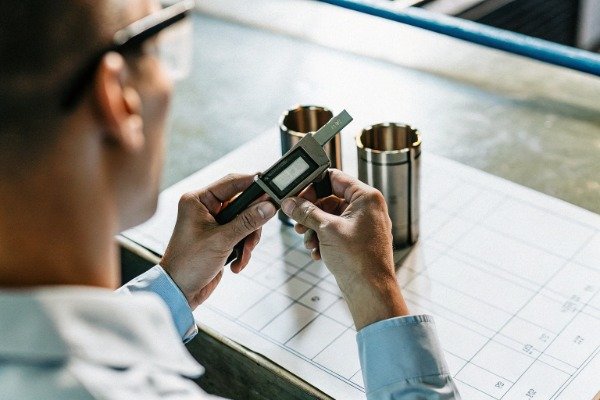
Once the samples arrive at your facility, the real work begins. It is not enough to just "look" at the parts; you need a systematic approach to evaluation. Based on our experience supplying custom parts to the US and Europe, we recommend a three-tiered evaluation process: Dimensional, Material, and Functional.
1. Dimensional Verification
This is the most obvious step, but it requires precision. You should not just measure the length and width. Stamping involves complex geometries.
- Hole Locations: Check position tolerances relative to the datums.
- Bend Radii: Ensure the internal radius matches the drawing. If the radius is too sharp, it may crack; if it is too large, it may interfere with mating parts.
- Burr Height: Every stamped part has a burr. The question is, is it within the allowable limit (usually < 10% of material thickness)?
2. Material and Cosmetic Inspection
You must confirm that the metal we used is actually what you ordered. While we always provide Mill Test Reports (MTR), you should spot-check.
- Surface Finish: Look for "orange peel" effects on bent areas, which indicate the material grain structure might be too coarse for the severity of the bend.
- Thinning: In deep-drawn parts, the material stretches and thins. You need to measure the wall thickness at the most critical points to ensure it hasn't dropped below your safety margin.
Material-Specific Evaluation Focus
Different alloys behave differently under the press. Here is what you should specifically look for based on the material type:
8D (Eight Disciplines) 2
| Material Type | Critical Defect to Look For | Recommended Test |
|---|---|---|
| Stainless Steel (300/400 Series) | Springback & Galling. Stainless is hard and likes to bounce back after bending. Check angles carefully. | Salt spray test for corrosion resistance after passivation. |
| Aluminum (5052, 6061) | Cracking. Aluminum is less ductile than steel. Check the outer radius of bends for micro-cracks. | Bend test (90° or 180°) to verify formability. |
| Copper / Brass | Surface Oxidation. These metals tarnish easily. Check for proper packaging and surface protection. | Conductivity test if used for electrical contacts. |
| High-Carbon Steel | Brittleness. If heat-treated, ensure the part isn't too brittle. | Hardness testing (Rockwell C) to verify heat treat specs. |
3. Functional Performance Tests
Dimensions on a drawing are theoretical; performance is reality. We strongly advise our clients to perform "stack-up" tests. Assemble the stamped sample with its mating components.
- Does it fit without forcing?
- Do the bolt holes align naturally?
- The "Shake" Test: If it's an enclosure, put the electronics inside and shake it. Does the stamping rattle?
The Importance of Boundary Samples
Sometimes, "good" and "bad" are subjective, especially regarding visual defects like scratches or tool marks. We recommend establishing Boundary Samples (also known as Limit Samples).
- Green Sample: Perfect part.
- Yellow Sample: Acceptable deviation (e.g., a minor scratch on a non-visible side).
- Red Sample: Unacceptable defect.
Having these signed physical samples prevents arguments later. If a shipment arrives with minor marks, we can compare it to the "Yellow Sample" to decide if it passes or fails, rather than relying on vague emails.
Should I Expect to Pay for Tooling and Sample Production Before Bulk Manufacturing?
In our negotiations, payment terms for tooling often become a sticking point. Knowing industry standards helps you budget effectively and build trust with your manufacturing partner.
asset tag 3
Yes, you should generally expect to pay upfront for custom hard tooling and initial sample production. Manufacturers require this investment to cover significant setup costs and verify commitment. However, some suppliers may amortize tooling costs into the unit price for high-volume orders or offer refunds after reaching specific quantity milestones.

This is one of the most common questions we receive from new Purchasing Managers. The short answer is that custom manufacturing is not like buying off-the-shelf goods on Amazon. The tooling (the die) is a custom asset built specifically for your project, and it carries significant cost and risk.
internal stresses 5
The Economics of Tooling
When we quote a project, the "Non-Recurring Engineering" (NRE) costs usually include:
- Design time: Creating the strip layout and die design.
- Material costs: High-grade tool steel and carbide components.
- Machining time: CNC machining and wire EDM cutting of the die components.
- Trial runs: Setting up the press to produce the initial samples.
Because these costs are incurred before a single production part is sold, manufacturers cannot absorb them without risk. If a client cancels the project after we build the tool, we are left with a heavy block of steel that is useless to anyone else. Therefore, standard industry practice is 50% deposit on tooling to start, and 50% upon sample approval.
work hardening 6
Sample Costs vs. Tooling Costs
Usually, the cost of the Initial Sample Run (typically 5–20 pieces) is included in the tooling price. You are not paying for the "parts" per se; you are paying for the validation of the tool.
However, if you need a large batch of pre-production samples (e.g., 500 units) for a pilot run, you should expect to pay the unit price for those parts.
Amortization and Refunds
For our long-term partners or high-volume projects, we sometimes offer amortization. This means we do not charge the full tooling cost upfront. Instead, we add a small surcharge to the piece price until the tool is paid off.
| Cost Model | Pros | Cons | Idéal pour |
|---|---|---|---|
| Upfront Payment | Lowest piece price immediately. You own the tool. | High initial cash outflow. | Established projects with verified designs. |
| Amortization | Low initial investment. Better cash flow. | Higher piece price. Risk if volume targets aren't met. | High-volume projects (100k+ units/year). |
| Tooling Refund | Tooling fee refunded after X units sold. | Incentivizes long-term partnership. | Growing product lines. |
Ownership of the Tool
It is crucial to clarify ownership. If you pay for the tooling, you own it. At DEWIN, we mark the tool with the client's asset tag. If you ever decide to move production to another supplier (though we work hard to ensure you won't want to!), you have the right to move that tool. Be wary of suppliers who offer "dirt cheap" tooling but refuse to acknowledge your ownership rights.
What Steps Should I Take If the Initial Stamping Samples Fail to Meet Specifications?
We know the frustration when a sample arrives out of spec. Instead of panicking, a systematic technical response ensures the next batch meets your requirements perfectly.
progressive dies 7
If samples fail, immediately request a detailed root cause analysis and a corrective action plan from the supplier. Do not approve production until you receive new, compliant samples. Clearly document every deviation using photos and measurement reports, and determine if the issue stems from tooling errors or unclear design drawings.

Production Part Approval Process (PPAP) 8
Receiving a "Not OK" (NOK) sample is not the end of the road; it is a normal part of the engineering refinement process. Stamping dies are complex, and the first hit off the press is rarely perfect. How you react to a failed sample determines the success of the project.
laser cutting 9
Step 1: Document Everything
Do not just email us saying "It doesn't fit." That gives our engineers nothing to work with. You need to provide data.
- Marked-up Drawing: Circle the dimensions that are out of spec on the PDF.
- Photos: Send clear photos of the defect. If it is a visual issue, use a red arrow to point it out.
- Measurement Report: If you have a CMM, send the raw data.
Step 2: Root Cause Analysis (The 8D Approach)
Ask your supplier for a formal investigation. We typically use the 8D (Eight Disciplines) format or a simplified "5 Whys" analysis. We need to determine:
- Is it a Tooling Issue? Did we cut the die wrong? (Supplier responsibility -> We fix it for free).
- Is it a Design Issue? Is the bend radius physically impossible for this material thickness? (Design responsibility -> You may need to modify the drawing).
- Is it a Material Issue? Did the steel batch have inconsistent hardness?
Step 3: Review the "Golden Master"
Sometimes, a sample fails the print but works perfectly in the application.
- Scenario: The drawing says the hole should be 5.0mm. The sample is 5.1mm. But the bolt is 4.8mm, so it fits fine.
- Action: In this case, do not force the supplier to rework the tool (which risks damaging it). Instead, update the drawing to match the functional reality. This is often faster and cheaper.
Step 4: The T1, T2, T3 Cycle
In the tooling world, we refer to sample rounds as T-levels.
- T0/T1: First shots off the tool. Often have minor issues.
- T2: Tooling is adjusted (ground down, shims added) based on T1 feedback.
- T3: Final approval.
Do not authorize mass production until you have a T-level sample that meets all critical specs. "Fixing it during production" is a myth that leads to disaster.
Handling Communication
We appreciate clients who are firm but collaborative. If a sample fails, ask us: "What is your plan to correct this, and when can we expect the T2 samples?" This puts the onus on us to provide a schedule. If the supplier cannot explain why it failed, that is a major red flag regarding their technical competence.
Conclusion
Requesting the right samples secures your supply chain. By validating prototypes, enforcing strict criteria, and managing non-conformance, you ensure quality custom parts every time.
soft tooling 10
Notes de bas de page
1. Defines the broader logistics network mentioned in the introduction. ↩︎
2. Authoritative source on the problem-solving methodology mentioned. ↩︎
3. Refers to the method of identifying client-owned tooling. ↩︎
4. Explains the document certifying material chemical and physical properties. ↩︎
5. Describes the residual forces remaining in stamped parts. ↩︎
6. Explains the material strengthening phenomenon during stamping. ↩︎
7. Details the high-volume tooling method mentioned. ↩︎
8. Describes the industry standard process for part approval. ↩︎
9. Provides technical details on the alternative cutting method. ↩︎
10. Explains the temporary tooling method used for prototypes. ↩︎

 English
 Español de México
 Deutsch
 Français
 Русский
 العربية