
We have helped dozens of U.S. clients source custom CNC prototypes from Asia, and one pattern keeps repeating: the cheapest quote almost always becomes the most expensive project 5-axis milling 1.
Selecting the right prototype CNC machining partner means evaluating technical capability, quality systems, DfM feedback, and scalability—not just price. A structured vetting process that includes trial orders and first article inspections prevents costly delays and rework that cheap quotes often hide.
The sections below walk you through a practical framework CMMs 2. We will cover technical capabilities, lead time and budget alignment, quality verification, and design feedback—each with concrete steps you can act on today.
What Key Technical Capabilities Should I Prioritize When Evaluating a Prototype CNC Machining Vendor?
Our engineering team reviews vendor capabilities for every new project we take on, and we have learned that the wrong machine for the job causes more failures than the wrong price first article inspection (FAI) reports 3.
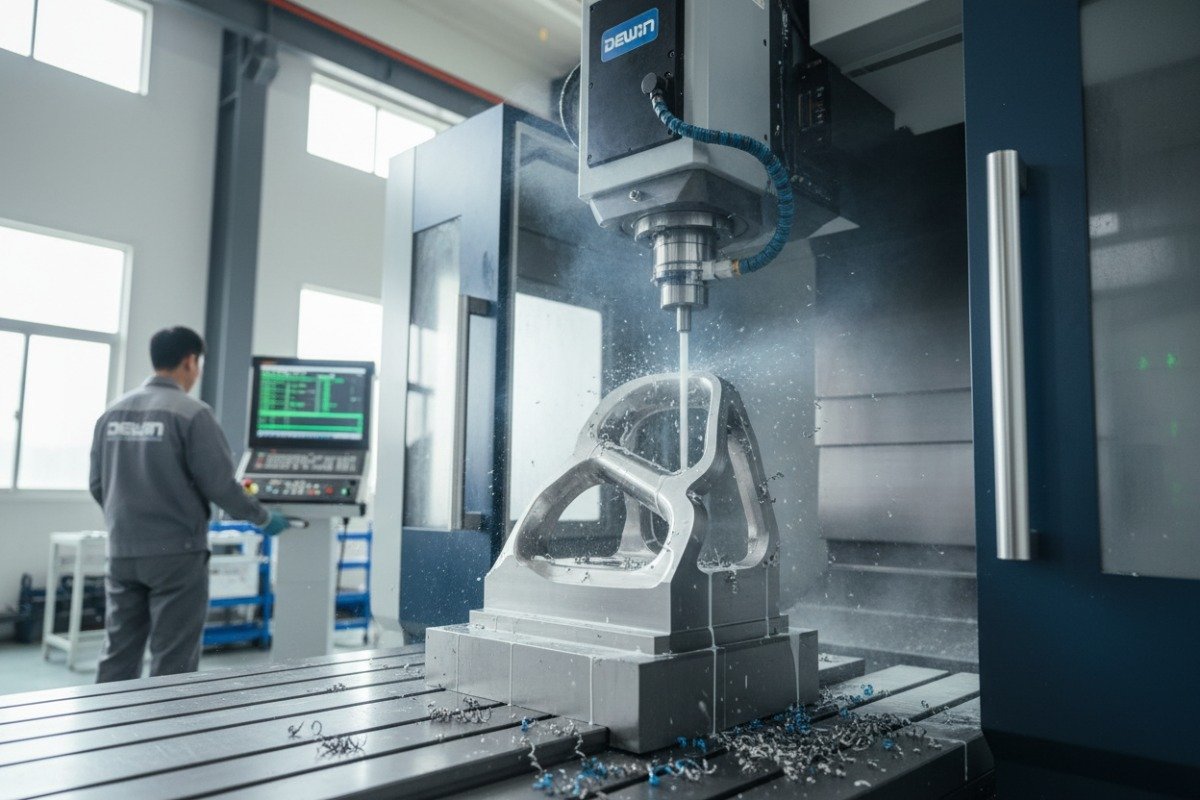
Prioritize 5-axis milling for complex geometries, multi-material experience (metals and engineering plastics), tight tolerance capability down to ±0.001", and advanced inspection equipment like CMMs. These four factors determine whether a vendor can actually make your part—not just quote it.
Why Machine Type Matters More Than Machine Count
A shop with twenty 3-axis mills cannot do what one 5-axis machine can Design for Manufacturability (DfM) report 4. If your prototype has undercuts, compound angles, or thin walls, you need simultaneous multi-axis machining. Asking "how many machines do you have?" is the wrong question. Ask "what is the most complex geometry you have cut in the last 90 days?"
Simple parts—flat brackets, spacers, basic housings—can run on 3-axis mills just fine. But the moment your design includes freeform surfaces or features at compound angles, you need a vendor with real 5-axis experience. Not just the machine. The programming knowledge and fixturing strategy matter equally.
Material Range and Experience
Your vendor should have documented experience with your specific material. Cutting 6061 aluminum is very different from cutting titanium Ti-6Al-4V 5 or PEEK plastic. Each material has unique feeds, speeds, tool wear patterns, and thermal behavior. A shop that mostly cuts mild steel will struggle with aerospace alloys.
Ask for a material list. Better yet, ask for photos or case studies of parts they have made in your exact material.
| Capability Area | Bandera verde | Señal de Alerta |
|---|---|---|
| Machine type | 5-axis CNC with live tooling | Only 3-axis mills, no turning centers |
| Tolerance range | ±0.001" or tighter, documented | Vague answers like "we can hold tight tolerances" |
| Material experience | Proven work in your specific alloy or plastic | "We can try it" with no track record |
| Equipo de inspección | In-house CMM, optical comparator | Relies on hand tools only (calipers, micrometers) |
| Programación | CAM software with simulation (e.g., Mastercam, NX) | Manual programming or outdated software |
Inspection Equipment Is Non-Negotiable
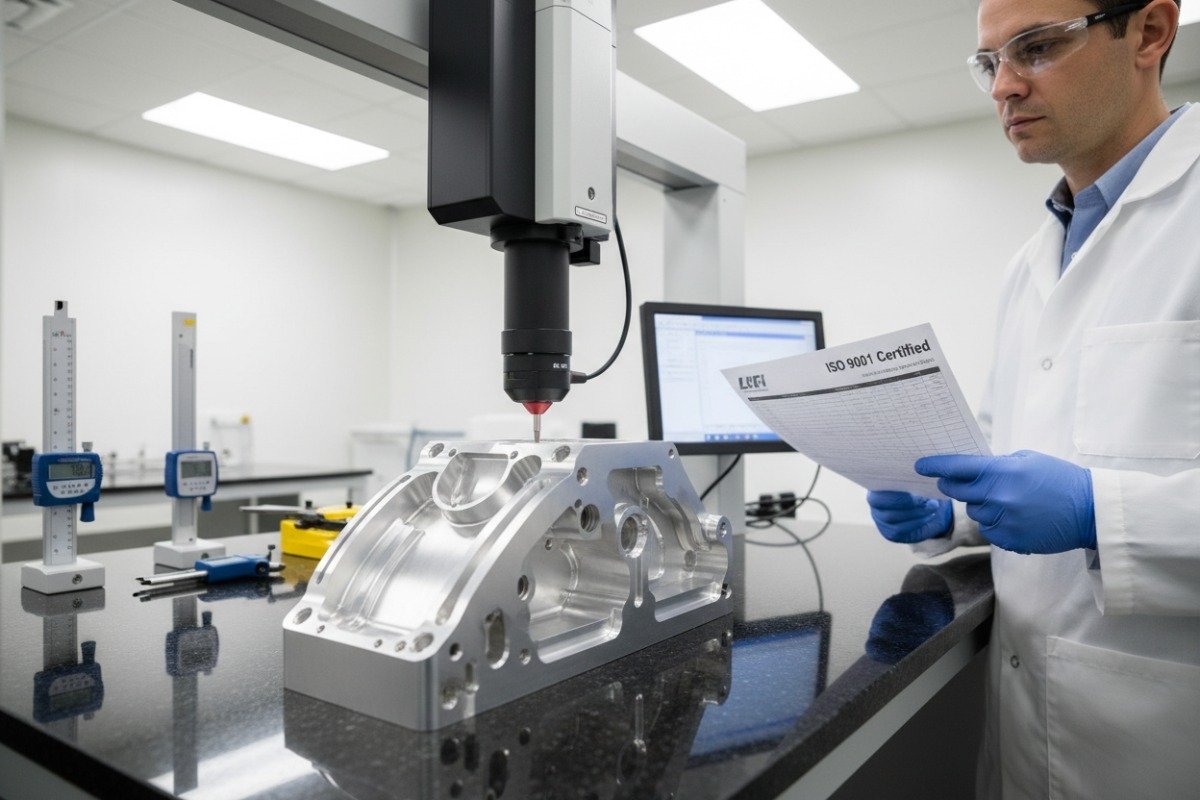
A vendor without a coordinate measuring machine (CMM) cannot verify GD&T callouts reliably. Period. If your drawing has true position, profile, or runout tolerances per ASME Y14.5 6, you need CMM data—not a caliper reading.
High-precision shops achieve first-pass yields of 98% with CMM inspection. Unverified suppliers typically land between 75% and 85%. That gap means rework, delays, and cost overruns on your end.
Capacity for Your Volume Tier
Prototype runs of 1–10 parts need different scheduling than low-volume production of 50–5,000 pieces. Some shops are set up for high-volume only and treat prototypes as interruptions. Others specialize in quick-turn prototypes but cannot scale. The best partners handle both under one roof.
Ask directly: "If this prototype succeeds, can you produce 500 pieces per month on the same equipment and process?" If the answer involves subcontracting or "partner networks," that is a red flag for quality drift.
How Can I Ensure My Chosen Partner Will Meet My Project's Specific Lead Time and Budget Requirements?
When we quote prototype projects for our clients, we break down every cost driver and timeline milestone upfront—because surprises at week six kill projects faster than a high quote at week one.
Ensure lead time and budget alignment by requesting a detailed quote breakdown showing setup costs, per-unit pricing at different volumes, and a milestone-based production schedule. Compare at least three vendors, and weight on-time delivery track record more heavily than lowest price.

Understanding Prototype Pricing Structure
Prototype CNC parts cost more per unit than production parts. That is normal. The setup time, programming, fixturing, and first article inspection are amortized over just a few pieces. A part that costs $150 each for 5 prototypes might cost $35 each at 500 pieces.
The key is understanding where the money goes. Ask your vendor to itemize:
- Programming and CAM setup
- Fixture design and fabrication
- Costo de materia prima
- Machine time per part
- Inspection and documentation
- Envío
This breakdown tells you which costs are fixed (setup) and which scale with quantity (material, machine time). It also reveals padding. If a vendor cannot break down their quote, they are either hiding margin or they do not track their own costs—both are problems.
| Volume Tier | Typical Per-Unit Cost Impact | Setup Cost Amortization | Lead Time Range |
|---|---|---|---|
| Prototype (1–5 parts) | Highest per-unit cost | $5–$15/part for setup alone | 1–2 weeks (quick-turn) |
| Low-volume (10–100 parts) | 15–30% lower than prototype | Setup spread across more units | 2–4 semanas |
| Production (100–5,000 parts) | 30–50% lower than prototype | Fixture investment yields 20% efficiency gains | 4–8 semanas |
Lead Time: What Is Realistic?
Quick-turn prototype services typically deliver in 1–2 weeks for simple to moderate parts. Complex parts with exotic materials or tight tolerances may need 3–4 weeks. Any vendor promising 3-day turnaround on a 5-axis titanium part with ±0.001" tolerances is either lying or cutting corners on inspection.
Get the schedule in writing. A good partner will provide milestone dates: order confirmation, material procurement, machining start, first article inspection, shipping. This is not bureaucracy. It is project management.
The Hidden Cost of Cheap Quotes
We have seen this pattern repeatedly with our clients. A vendor quotes 40–60% below market rate. The client awards the order. Then the problems start: missed delivery dates, parts that do not match the drawing, no inspection report, and radio silence when you email questions.
Poor partner selection delays projects by 4–8 weeks on average. About 35% of prototypes fail scalability tests because the prototype vendor used different methods than what production requires. That rework costs far more than the savings from the cheap quote.
Ask every vendor: "What is your on-time delivery rate for the last 12 months?" Top partners hit 95–99%. The industry average sits around 92%. If a vendor cannot answer this question with data, move on.
What Steps Should I Take to Verify the Quality and Precision of a CNC Machine Shop's Previous Work?
Our quality team runs supplier audits across Vietnam and China every month, and we have developed a straightforward verification process that catches problems before they reach our clients.
Verify a CNC shop's quality by requesting first article inspection (FAI) reports from previous jobs, checking ISO 9001 or AS9100 certification status, ordering a paid trial run of 5–10 parts, and comparing CMM measurement data against your drawing's GD&T callouts.
Start with Certifications—But Do Not Stop There
Certificación ISO 9001 7 is now table stakes. It means the shop has a documented quality management system. But certification alone does not guarantee good parts. Some shops maintain the certificate but do not follow the procedures daily.
For aerospace prototypes, look for AS9100. Certificación AS9100 8 For defense-related work, ITAR registration is mandatory. Medical device prototypes may require ISO 13485 compliance 9. These certifications signal that the shop understands industry-specific requirements beyond basic quality management.
The Trial Order Method
The most reliable way to verify quality is a paid trial order. Send 5–10 parts with your tightest tolerances and most complex features. This is not free sampling—pay fair market price so the vendor treats it like a real job.
When the parts arrive, measure them. Compare actual dimensions to your drawing. Look at these specific indicators:
- Centered tolerances: If your drawing calls for 25.00 mm ±0.05 mm, the measured value should be close to 25.00 mm—not consistently at 24.96 mm or 25.04 mm. Centered results indicate a controlled process. Results clustered near one tolerance limit suggest the vendor is barely passing.
- Surface finish consistency: Measure Ra values at multiple locations. Variation across the part surface indicates inconsistent tool paths or worn tooling.
- Edge quality: Burr-free edges, clean thread entries, and sharp corners (where specified) show attention to detail.
Reading an FAI Report
A proper first article inspection report follows a standard format. Each dimension on your drawing gets a balloon number, and the FAI report lists the measured value for each balloon. Here is what to look for:
| FAI Report Element | Lo que le dice | Señal de Advertencia |
|---|---|---|
| Dimensional results vs. nominal | Process accuracy | Multiple dimensions near tolerance limits |
| GD&T results (true position, profile) | Fixturing and setup quality | Missing GD&T measurements entirely |
| Material certification (mill cert) | Correct alloy and heat treatment | No traceability to raw material source |
| Surface finish readings | Machining process control | No Ra measurements documented |
| Inspector signature and date | Accountability | Unsigned or undated reports |
Ask for References and Case Studies
Request contact information for 2–3 current customers. Call them. Ask specific questions: "Did the parts meet print on the first shipment?" "How does the vendor handle non-conformances?" "Have you scaled from prototype to production with them?"
Medical and aerospace companies report 15% lower defect rates when working with ISO-certified partners who provide FAI documentation on trial orders. That data point alone justifies the effort of a proper vetting process.
On-Site or Virtual Audit
If the order value justifies it, visit the shop. If travel is not practical, request a virtual tour via video call. Walk the shop floor. Look at machine condition, organization (5S practices), and how they handle work-in-process. A clean, organized shop almost always produces better parts than a cluttered one.
During the audit, ask to see their inspection room. Is it temperature-controlled? Is the CMM calibrated (check the calibration sticker)? Do they have dedicated quality personnel, or does the machinist inspect their own work? Self-inspection is a red flag for critical tolerance parts.
How Do I Determine If a Machining Partner Can Provide the Design Feedback I Need for My Prototype?
When we co-develop prototypes with our clients' engineering teams, the DfM review stage consistently saves more money than any negotiation on unit price ever could.
Determine a partner's design feedback capability by submitting your 3D model and asking for a formal Design for Manufacturability (DfM) report. A capable partner will identify 2–5 manufacturability issues per design, suggest specific changes, and quantify the cost and lead time impact of each recommendation.

What a Good DfM Report Looks Like
A proper DfM report is not a generic email saying "looks good" or "we can make this." It is a structured document that flags specific features on your 3D model and explains why each one creates a manufacturing challenge. It then proposes alternatives with clear trade-offs.
For example, a DfM report might flag an internal corner radius of 0.5 mm and recommend increasing it to 1.5 mm. Why? Because 0.5 mm requires a 1 mm end mill, which is fragile, slow, and expensive. A 1.5 mm radius allows a 3 mm end mill—standard tooling that cuts faster and costs less. That single change might reduce machining time by 30% and eliminate a tool breakage risk.
Good DfM reports identify issues like:
- Wall thickness too thin for the material (risk of deflection during machining)
- Hole depth-to-diameter ratios that require special tooling
- Tolerance callouts tighter than the feature's function requires
- Surface finish specifications that add unnecessary grinding or polishing steps
- Features that force additional setups, increasing cost and tolerance stack-up
How to Test a Vendor's DfM Capability Before Committing
Send your STEP or IGES file 10 along with your 2D drawing (GD&T per ASME Y14.5) to three vendors simultaneously. Ask each one for a DfM report within 48 hours. Compare the responses.
A vendor who returns a quote with no design comments is either not reviewing your model carefully or lacks the engineering depth to spot issues. A vendor who returns a detailed DfM report with annotated screenshots, alternative feature suggestions, and cost impact estimates is demonstrating real capability.
RFQ response times for vetted partners average 24–48 hours. DfM reports from strong partners typically identify 2–5 manufacturability issues per design and can cut production costs by 25–40% when recommendations are implemented.
The Scalability Question
Design feedback is not just about making the prototype work. It is about making the prototype in a way that scales to production. This is where many vendors fall short.
A prototype machined from a solid billet with manual deburring might look perfect. But if your production plan calls for 500 parts per month, that process will not scale. A good partner thinks ahead: "This feature works for 5 parts, but at 500 parts, we should consider a different fixturing approach or a slight design change to enable automated deburring."
Ask your vendor: "If we move to production volumes, what would you change about this design or process?" The answer reveals whether they think like a manufacturing partner or just a job shop filling orders.
Communication Style and Responsiveness
DfM capability means nothing if the vendor cannot communicate clearly. Pay attention to how they interact during the quoting phase. Do they ask clarifying questions about your drawing? Do they respond within 24 hours? Do they provide written summaries of phone conversations?
The best partners are proactive. They do not wait for you to ask about a potential problem. They flag it, explain it, and propose a solution—all before you place the order. This kind of communication prevents the "surprise" non-conformances that plague projects with less engaged vendors.
One practical test: after receiving their DfM report, ask a follow-up technical question by email. Measure how long it takes to get a substantive response. If it takes more than 48 hours during the quoting phase, imagine how slow they will be once they have your purchase order.
Conclusión
Selecting a prototype CNC machining partner is a risk management decision, not a price comparison exercise. Vet technical capability, verify quality with trial orders, demand DfM feedback, and prioritize partners who think beyond the prototype to production scalability.
Notas al pie
1. Found a comprehensive guide on 5-axis CNC machining from an authoritative source. ↩︎
2. Identified an essential guide to Coordinate Measuring Machines (CMMs) from a reputable metrology company. ↩︎
3. Located a detailed explanation of First Article Inspection (FAI) from an authoritative source, which includes information on FAI reports. ↩︎
4. Strategies to ensure products are designed for efficient and cost-effective manufacturing. ↩︎
5. Details the properties and applications of the specific titanium alloy mentioned. ↩︎
6. Establishes rules, symbols, and practices for geometric dimensioning and tolerancing. ↩︎
7. Defines requirements for a quality management system to enhance customer satisfaction. ↩︎
8. Specifies quality management system requirements for the aerospace industry. ↩︎
9. Outlines quality management system requirements specific to medical devices. ↩︎
10. Describes vendor-neutral file formats for exchanging 2D and 3D CAD data. ↩︎

 English
 Español de México
 Deutsch
 Français
 Русский
 العربية