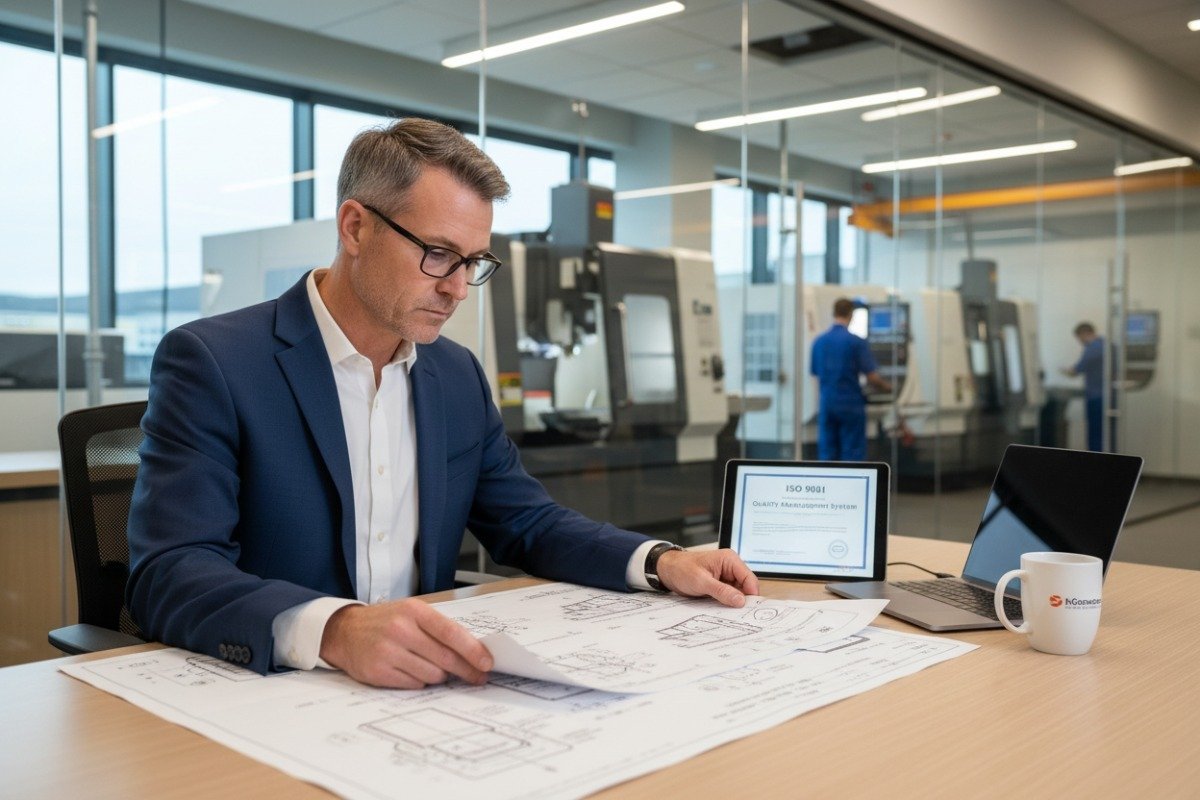
Every week, our project team reviews inquiries from buyers who just got burned by the wrong supplier ISO 9001 or AS9100 1. Wrong tolerances, late shipments, parts that fail inspection — the stories repeat themselves.
Choosing a reliable precision parts manufacturer requires evaluating certifications like ISO 9001 or AS9100, inspecting equipment capabilities such as multi-axis CNC machines, verifying quality control processes including CMM and SPC, checking references from past clients, and assessing communication responsiveness and scalability for your production volumes.
El global precision machining market 2 is projected to exceed $20 billion by 2030 multi-axis CNC machines 3. The stakes are high, and picking the wrong partner can derail up to 30% of projects. Below, we break down exactly what to look for — and what to avoid — when vetting a new precision parts manufacturer EDM (Electrical Discharge Machining) 4.
How Do I Evaluate the Technical Capabilities of a Potential Precision Parts Manufacturer?
Our engineers spend hours reviewing supplier equipment lists before we even send a drawing ISO 13485 para dispositivos médicos 5. The reason is simple: if the machines can't do the job, nothing else matters.
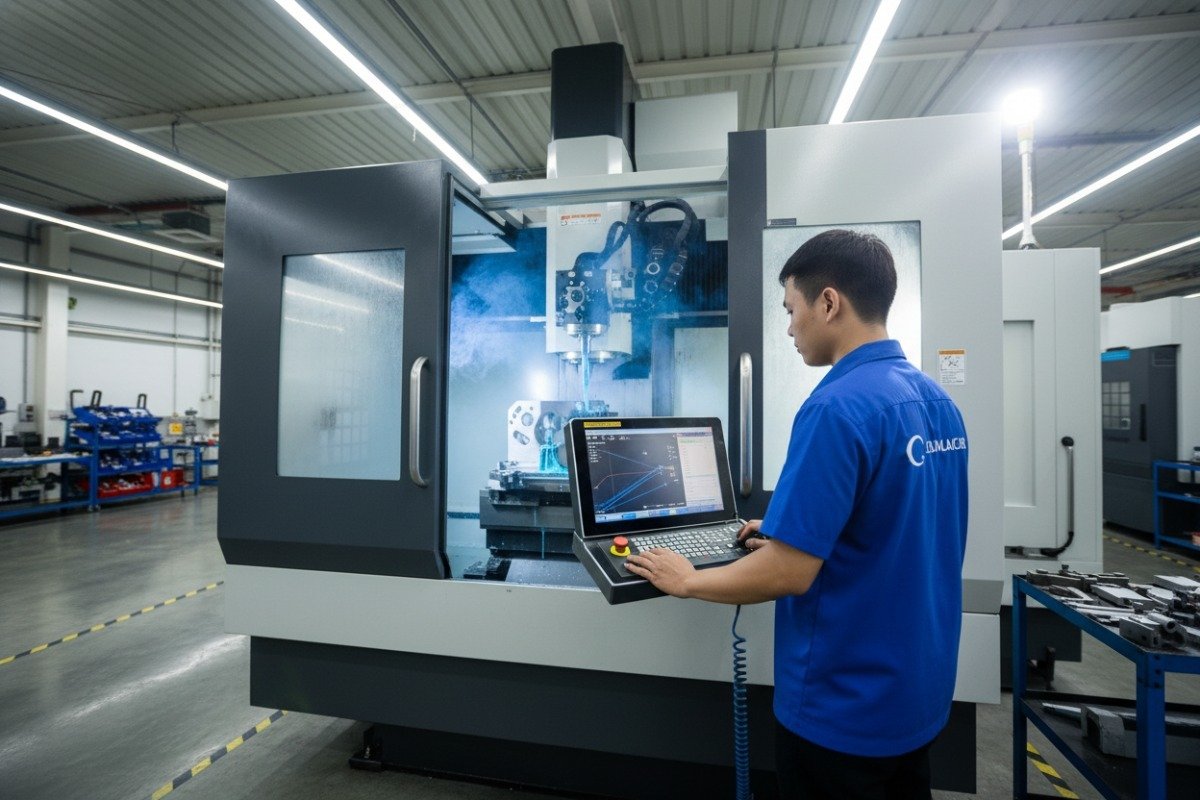
To evaluate technical capabilities, review the manufacturer's equipment inventory for multi-axis CNC machines, EDM, and precision grinding. Request sample parts or test cuts, ask about tolerances they routinely hold, and confirm they have in-house metrology labs with CMM and optical measurement tools.
Why Equipment Matters More Than Promises
A manufacturer can claim they handle tight tolerances all day long IATF 16949 for automotive 6. But without the right machines, those claims are empty. When we audit factories across Vietnam and other Asian countries, the first thing we check is the shop floor First Article Inspection Reports (FAIR) 7.
Here is what to look for:
- Multi-axis CNC machines. 5-axis CNC centers can handle complex geometries in fewer setups Cpk and Process Capability 8. Fewer setups mean less error accumulation.
- EDM (Electrical Discharge Machining). Essential for hardened materials and intricate internal features.
- Precision grinding. Surface finish requirements below Ra 0.8 micrometers often demand dedicated grinding equipment.
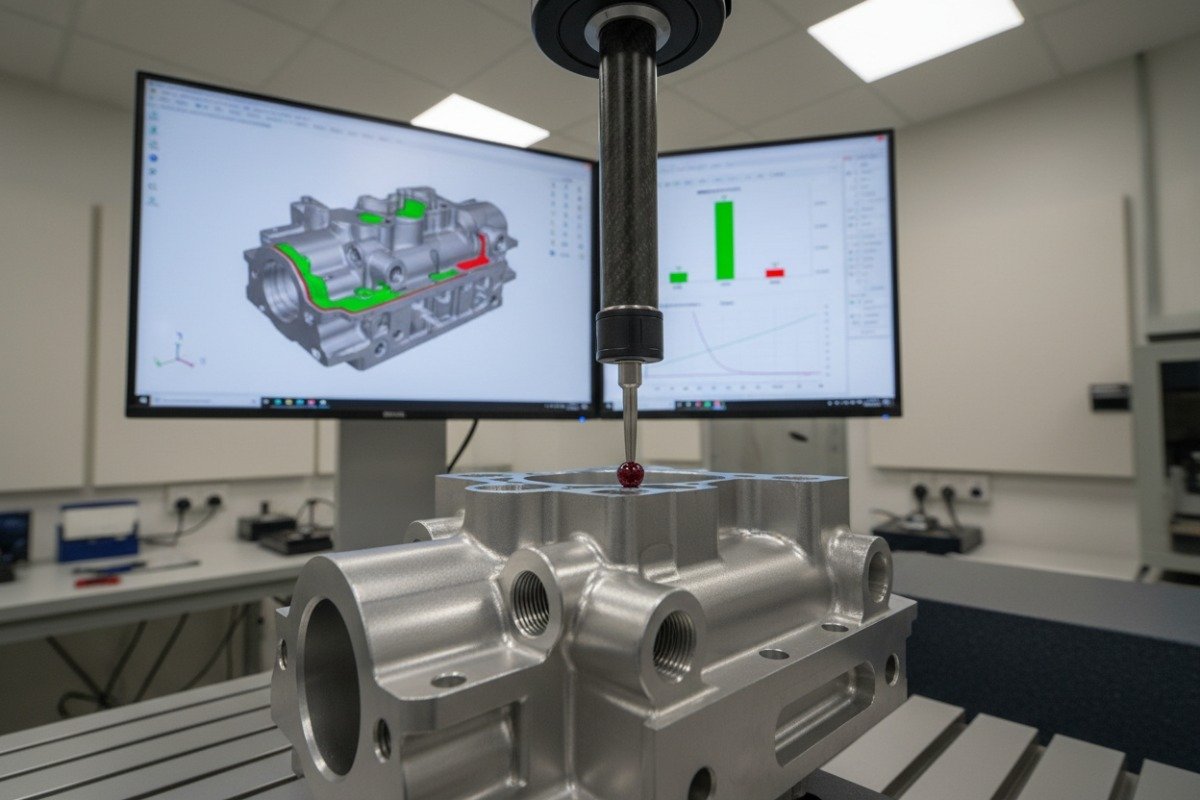
- In-house metrology lab. A MMC (Máquina de Medición por Coordenadas) 9 is non-negotiable for micron-level verification.
Equipment Capability Comparison Table
| Tipo de equipo | Rango de tolerancia típico | Lo mejor para | Watch Out For |
|---|---|---|---|
| Fresadora CNC de 3 ejes | ±0.005" | General parts, flat features | Cannot handle undercuts or complex angles |
| 5-axis CNC mill | ±0.0005" – ±0.001" | Aerospace, medical, complex geometry | Higher cost per hour; requires skilled operators |
| Electroerosión por Hilo | ±0.0001" | Hardened steel, intricate profiles | Slow material removal rate |
| CNC turning center | ±0.001" | Cylindrical parts, shafts, bushings | Limited to rotational symmetry |
| Precision surface grinder | Ra < 0.4 µm | Tight surface finish specs | Only for flat or cylindrical surfaces |
Don't Ignore the Human Factor
Even the best 5-axis CNC system needs an experienced operator. Automation handles repetitive tasks well. But for complex, non-standard parts — the kind our clients often need — skilled machinists make the difference. Ask how long their operators have been running those machines. Ask about their training programs. A shop with 15-year veterans on the floor is very different from one staffed entirely by recent hires.
How to Verify Capabilities Remotely
If you can't visit the factory in person, request a virtual tour. We do this regularly for our U.S. clients. A good manufacturer will walk you through the shop floor on video, show you the machines running, and let you see the metrology lab. If they refuse or make excuses, that tells you something.
Also, request sample parts. A test cut on your actual material, to your actual drawing, is worth more than any brochure. We often run a small pilot batch before committing to full production. This costs a little upfront but saves enormous headaches later.
Data from PMPA shows that top-quartile machine shops achieve 99.9% yield rates. That level of performance comes from combining good equipment with skilled people and disciplined processes.
What Specific Quality Certifications Should I Look for During My Sourcing Process?
When we onboard a new supplier in Vietnam or elsewhere in Asia, the certification audit is the very first gate. No certifications, no further discussion — it is that straightforward.
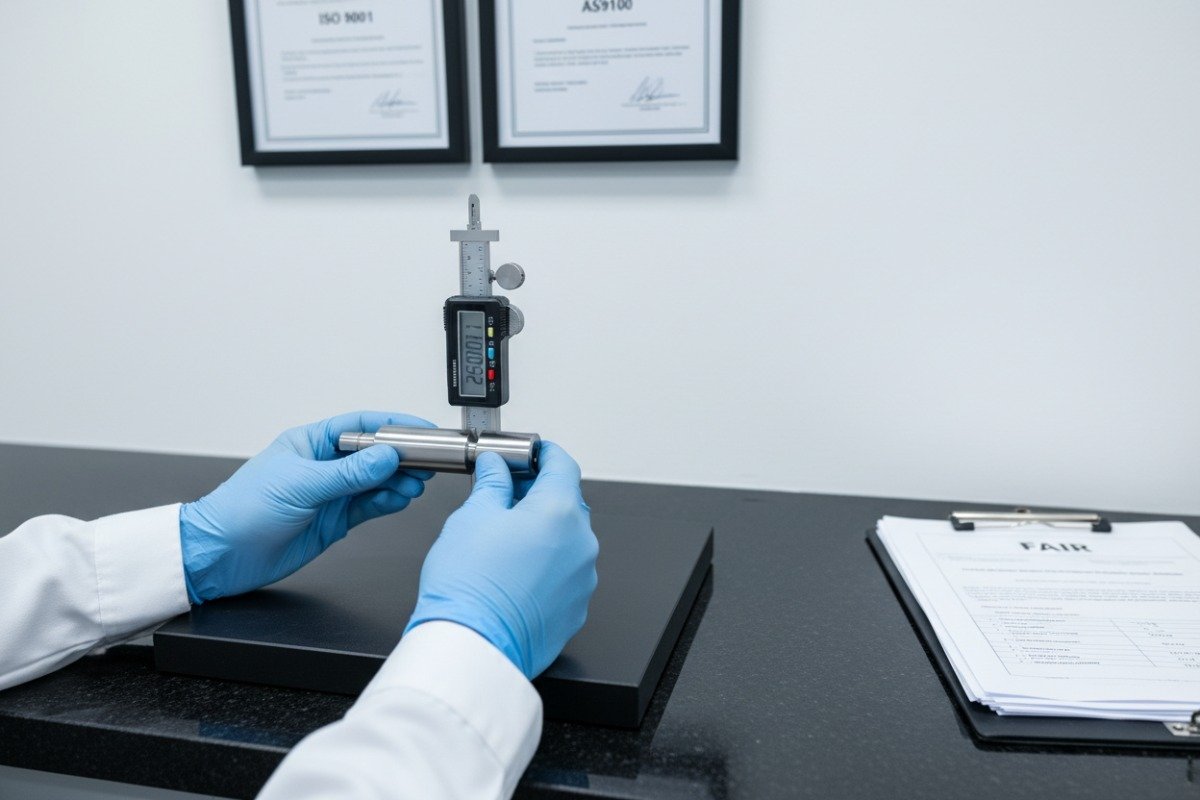
Key certifications to look for include ISO 9001:2015 for general quality management, AS9100 for aerospace, ISO 13485 for medical devices, IATF 16949 for automotive, and ITAR registration for U.S. defense-related work. Always request current certificates and verify them with the issuing body.
What Each Certification Actually Means
Certifications are not just wall decorations. Each one tells you something specific about how a manufacturer controls quality. Here is a quick breakdown:
| Certificación | Enfoque de la industria | Lo que demuestra |
|---|---|---|
| ISO 9001:2015 10 | Fabricación General | Documented quality management system in place |
| AS9100 Rev D | Aerospace & defense | Meets strict aerospace traceability and risk management standards |
| ISO 13485 | Dispositivos médicos | Controls for biocompatibility, sterilization, and regulatory compliance |
| IATF 16949 | Automotriz | Defect prevention, variation reduction, waste reduction in supply chain |
| ITAR registration | U.S. defense | Authorized to handle controlled technical data and defense articles |
| NADCAP | Aerospace special processes | Accredited for processes like heat treating, welding, or NDT |
Certifications Are Necessary but Not Sufficient
Here is where many buyers make a mistake. They see ISO 9001 on a supplier's website and assume quality is guaranteed. It is not. ISO 9001 means the manufacturer has a quality management system. It does not mean they execute it perfectly every time.
Studies show that certified manufacturers reduce defect rates by up to 40%. ISO-compliant firms deliver on-time at roughly 95%, compared to about 70% for non-certified ones. Those numbers are real. But they are averages.
We have seen ISO-certified factories with sloppy shop floors and outdated calibration records. The certificate was current, but the discipline was not. That is why we always go beyond the certificate. We check calibration logs. We review corrective action reports. We ask for recent inspection data on parts similar to ours.
Cómo verificar certificaciones
Do not just accept a PDF. Go to the certification body's website and search for the manufacturer. Most registrars — like BSI, TÜV, or SGS — have online directories. If the certificate is not listed, ask questions.
Also, check the scope of the certification. A company might be ISO 9001 certified for assembly work but not for machining. The scope matters. Make sure it covers the processes you actually need.
For U.S. defense work, ITAR compliance is critical. If your parts have any defense application, your supplier must be ITAR registered. This is not optional. Violations carry severe penalties.
Smaller Shops Can Still Deliver
One counterpoint worth noting: some smaller machine shops excel in niche precision work despite lacking big-name certifications. They may hold tight tolerances consistently and have excellent track records. If a small shop has strong references, verified case studies, and a clear quality process — even without AS9100 — they might be the right fit for certain projects. The key is to verify performance through data, not just badges.
How Can I Verify if a Manufacturer Can Meet My Tight Tolerances and Complex Design Requirements?
Our quality team has a saying: "Trust the data, not the sales pitch." When a supplier says they can hold ±0.0005", we ask them to prove it — with numbers, not words.
Verify tolerance capability by requesting first article inspection reports (FAIR), reviewing Cpk data from statistical process control, asking for sample parts machined to your exact specifications, and checking if they use CMM with calibrated probes. A Cpk value above 1.33 indicates the process is capable and stable.
Start with a Clear Drawing
Before you can verify anything, your drawing must be clear. Ambiguous GD&T callouts lead to misinterpretation. We have seen projects fail not because the manufacturer lacked capability, but because the drawing was unclear about datum references or tolerance zones.
Make sure your drawing includes:
- Complete GD&T per ASME Y14.5
- Material specification with grade and condition
- Surface finish requirements (Ra values)
- Critical dimensions clearly flagged
- Any special processing notes (heat treatment, plating, etc.)
The First Article Inspection Report (FAIR)
A FAIR is your best friend. It is a complete dimensional report on the first production part. Every dimension on the drawing gets measured and recorded. If a manufacturer cannot produce a clean FAIR, they cannot produce your part.
We require a FAIR on every new part number. No exceptions. This catches problems before they become expensive.
Understanding Cpk and Process Capability
Cpk measures how well a process stays centered within tolerance limits. Here is a quick reference:
| Cpk Value | Qué significa | Acción requerida |
|---|---|---|
| < 1.00 | Process is not capable | Reject — too many parts will be out of spec |
| 1.00 – 1.33 | Marginally capable | Proceed with caution; 100% inspection may be needed |
| 1.33 – 1.67 | Capable and stable | Acceptable for most precision applications |
| > 1.67 | Highly capable | Excellent; suitable for aerospace and medical |
| > 2.00 | Six Sigma level | World-class process control |
Ask your potential supplier for Cpk data on critical dimensions. If they don't know what Cpk is, that is a red flag.
Tolerance Hierarchies Across Industries
Not every part needs aerospace-level precision. Understanding where your part falls helps you set realistic expectations and avoid overpaying.
- Aeroespacial: ±0.0001" to ±0.001" — parts failing by just 0.001" can trigger rework costs exceeding $1 million per incident.
- Dispositivos médicos: ±0.0005" to ±0.002" — biocompatibility and sterilization add complexity.
- Automotive: ±0.001" to ±0.005" — high volume demands consistency across thousands of parts.
- General industrial: ±0.005" to ±0.010" — less critical but still requires process discipline.
Run a Pilot Batch
We always recommend running a pilot batch of 10–50 pieces before committing to full production. Measure every piece. Calculate Cpk. Check surface finish with a profilometer. This small investment reveals whether the manufacturer can truly deliver — or whether they just got lucky on the sample.
In aerospace, surface finish Ra values under 0.8 micrometers are often required. A manufacturer might hit that on one part. But can they hit it on 500 parts? The pilot batch answers that question.
Design for Manufacturability Feedback
A capable manufacturer will not just accept your drawing silently. They will come back with DFM feedback. They might suggest a slightly larger radius to improve tool life, or recommend a different material grade that machines more consistently. This kind of proactive input is a sign of real expertise. When we work with our clients on co-development projects, DFM review is a standard step. It saves time, reduces cost, and improves first-pass yield.
What Are the Red Flags I Should Watch Out for When Vetting a New Production Partner?
Over the years, our sourcing team has walked away from dozens of potential suppliers. Sometimes the warning signs are obvious. Sometimes they are subtle. But they are always there if you know where to look.
Red flags include poor communication responsiveness, reluctance to share references or inspection data, vague answers about capacity and lead times, lack of documented quality processes, unwillingness to sign NDAs, no clear corrective action procedures, and pricing that seems too good to be true compared to market rates.

Communication Is a Make-or-Break Factor
This is the number one predictor of supplier performance, in our experience. If a supplier takes five days to reply to your email during the quoting phase — when they are trying to win your business — imagine how they will respond after they have your purchase order.
Good manufacturers provide transparent updates. They assign a dedicated project manager. They use portals or shared trackers so you can see status in real time. They flag problems early instead of hiding them.
We have seen projects go sideways not because of technical failure, but because the supplier did not communicate a material delay until two weeks after the original ship date. That kind of surprise destroys trust and disrupts your entire supply chain.
The "Too Cheap" Trap
Some buyers chase the lowest price. We understand the pressure to reduce costs. But in precision manufacturing, unusually low pricing almost always means corners are being cut somewhere.
Here is what low-cost suppliers often sacrifice:
- Incoming material inspection — they skip verifying raw material certs.
- In-process checks — they measure the first piece and assume the rest are fine.
- Inspección final — they do a visual check instead of full dimensional verification.
- Packaging and shipping — parts arrive damaged because of poor protection.
Studies show that poor supplier choices contribute to 25% of manufacturing delays industry-wide. The cost of rework, returns, and lost time almost always exceeds the savings from a cheaper quote.
Intellectual Property Risks
If your parts involve proprietary designs, IP protection is critical. Ask about:
- Secure data handling and restricted access to drawings
- Willingness to sign NDAs before receiving technical data
- Clear policies on client-provided tooling ownership
- Whether they manufacture for your competitors
A supplier who hesitates to sign an NDA is a supplier you should avoid.
Scalability Questions That Reveal the Truth
Ask your potential partner: "If I need to go from 100 pieces to 10,000 pieces in three months, can you do it?" Listen carefully to the answer. A good manufacturer will explain their capacity, their shift structure, their ability to add equipment or staff. A bad one will just say "yes" without details.
We have helped clients scale from prototype to 10,000-unit production runs. It requires planning, flexible staffing, and sometimes multi-site operations. A supplier who cannot explain their scalability plan probably does not have one.
Red Flag Checklist
Here is a quick reference you can use during supplier evaluation:
| Señal de Alerta | Por qué importa | What to Do |
|---|---|---|
| Slow email responses (>48 hours) | Predicts poor communication during production | Move on to another supplier |
| No references provided | May indicate lack of satisfied customers | Request at least 3 client references |
| No documented QC process | High risk of inconsistent quality | Ask for QC procedure documents |
| Refuses to sign NDA | IP protection concern | Do not share proprietary drawings |
| Price 30%+ below market | Likely cutting corners on quality | Request detailed cost breakdown |
| No FAIR or inspection reports available | Cannot verify dimensional accuracy | Require FAIR before production |
| Vague lead time commitments | Risk of delivery delays | Get written lead time with penalties |
| No hay sistema de acción correctiva | Problems will repeat | Ask for CAPA examples |
Total Landed Cost: The Real Number
Do not compare unit prices alone. Calculate the total landed cost, which includes:
- Precio unitario
- Tooling and setup charges
- Shipping and freight
- Import duties and tariffs
- Inspection and testing costs
- Cost of potential rework or returns
A supplier quoting $2.00 per part with a 15% reject rate is more expensive than one quoting $2.50 with a 0.5% reject rate. We help our clients run this analysis before making sourcing decisions. It changes the picture every time.
Domestic vs. Overseas Sourcing
There is a real tension between cost and control. U.S. or EU manufacturers offer faster turnaround (2–4 weeks typical) and easier ITAR compliance, but at 15–30% higher cost. Asian manufacturers excel in volume pricing but demand rigorous audits to ensure consistency.
Our approach is to bridge that gap. With our local team in Vietnam and our quality processes, we give U.S. clients the cost advantage of Asian sourcing with the quality assurance they expect. But regardless of where you source, the vetting process described above applies.
Conclusión
Choosing the right precision parts manufacturer comes down to data, not gut feeling. Verify certifications, test capabilities with pilot batches, watch for red flags, and always calculate total landed cost.
Notas al pie
1. Explains AS9100, based on ISO 9001, for aerospace industry. ↩︎
2. Provides market size and growth projections for the precision machining industry. ↩︎
3. Details the advantages of multi-axis CNC machines for precision and efficiency. ↩︎
4. Explains the principles, types, and applications of Electrical Discharge Machining. ↩︎
5. Describes ISO 13485, the quality management system standard for medical devices. ↩︎
6. Provides information on IATF 16949, the quality management standard for the automotive sector. ↩︎
7. Defines FAIRs and their importance in verifying product conformity to specifications. ↩︎
8. Explains Cpk as a statistical measure for process capability and consistency. ↩︎
9. Defines CMMs and their use in measuring physical objects with high accuracy. ↩︎
10. Replaced HTTP 404 with authoritative main page. ↩︎

 English
 Español de México
 Deutsch
 Français
 Русский
 العربية