
Every week, our project engineers review new custom part requests that standard catalogs simply cannot fulfill Control Estadístico de Procesos 1. The gap between what off-the-shelf components offer and what your design actually needs can stall an entire product launch.
The best non-standard parts manufacturer combines proven CNC machining, injection molding, or additive manufacturing capabilities with strict quality control processes like PPAP, strong DFM collaboration, transparent communication, and reliable on-time delivery to ensure your custom components meet exact specifications the first time.
Choosing the right partner for custom components is not just about price. It is about finding a team that understands your drawings, catches critical details early, and delivers parts that fit without rework. Below, we break down the key questions you should ask before committing to any manufacturer.
What Quality Control Measures Should I Expect From My Custom Parts Supplier?
When our team onboards a new custom project, the very first thing we build is a quality control plan — before any metal is cut or any mold is opened. Without a clear QC framework, non-standard parts become a gamble.
You should expect your custom parts supplier to implement incoming material inspection, in-process dimensional checks, Statistical Process Control (SPC), final inspection with documented reports, and a full Production Part Approval Process (PPAP) to guarantee conformance to your drawings and specifications.
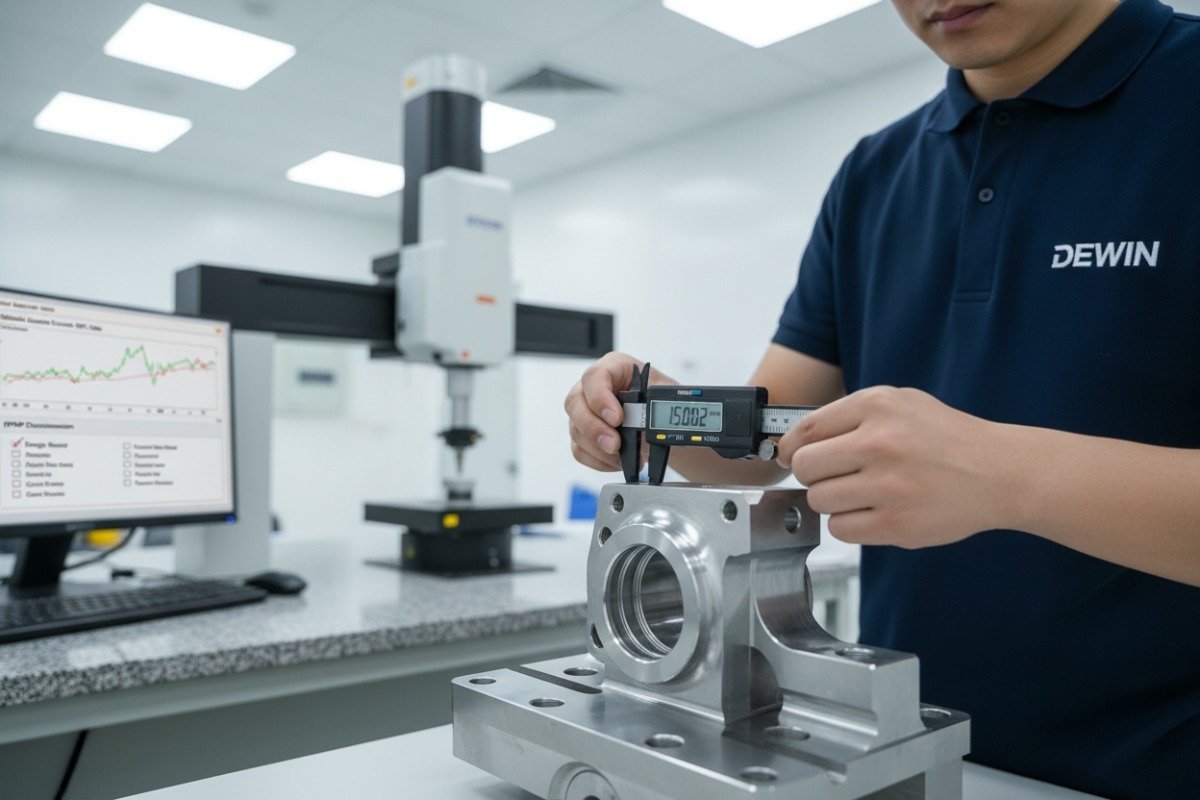
Quality control for non-standard parts is fundamentally different from quality control for catalog items. Standard parts have established tolerances, known material properties, and years of production data behind them. Custom parts have none of that history. Every new part is essentially a first run. That is why the QC framework must be built from scratch for each project.
Why PPAP Matters for Custom Components
PPAP — Proceso de Aprobación de Piezas de Producción 2 — is the gold standard in custom manufacturing. It originated in the automotive industry, but it applies to any sector where parts must meet exact specifications. A proper PPAP submission includes:
- Dimensional results for every critical feature
- Material certifications
- Process flow diagrams
- Control plans
- Measurement System Analysis (MSA)
When we run PPAP for our clients, we catch problems before mass production begins. This saves thousands of dollars in rework and returns.
The Inspection Stages You Should Demand
| Etapa de Inspección | Qué Cubre | Por qué importa |
|---|---|---|
| Incoming Material Inspection | Raw material certs, hardness tests, chemical composition | Prevents defective material from entering production |
| Inspección del primer artículo (FAI) | Full dimensional check of the first produced part | Confirms tooling and setup are correct |
| In-Process Inspection | SPC data, visual checks, gauge measurements during production | Catches drift before it becomes a batch-wide problem |
| Inspección Final | AQL sampling or 100% inspection per drawing requirements | Ensures every shipped part meets your specifications |
| Inspección Pre-Envío | Packaging, labeling, quantity verification | Prevents shipping errors and damage in transit |
Common QC Failures and How to Avoid Them
One of the biggest pain points we hear from U.S. purchasing managers is this: "My supplier missed a critical note on the drawing." This happens more often than you think. A callout for surface finish, a geometric tolerance, or a specific heat treatment gets overlooked. The parts arrive, they look fine visually, but they fail in assembly or testing.
The fix is simple but requires discipline. Your manufacturer should conduct a thorough drawing review with you before production. Every note, every tolerance, every special requirement should be discussed and documented. If your supplier skips this step, that is a red flag.
Another common failure is the lack of traceability. If a defect appears six months after delivery, can your supplier trace it back to the specific batch of raw material, the machine that produced it, and the operator who ran it? Good manufacturers can. They keep records. They use lot numbers. They maintain inspection data for years.
Our quality team in Vietnam and China follows a standardized checklist for every project. It is not glamorous work, but it is the difference between getting it right the first time and dealing with costly returns.
How Can I Optimize My Design to Lower Production Costs With a Non-Standard Parts Manufacturer?
Our engineers spend a significant portion of their time not just making parts — but helping clients redesign them for manufacturability. A small change in a radius or a wall thickness can cut tooling costs by 30% or more.
To lower production costs, collaborate with your manufacturer early on Design for Manufacturability (DFM) reviews, simplify geometries where possible, standardize tolerances to avoid unnecessary precision, select cost-effective materials, and consolidate multiple components into single parts to reduce assembly steps.

Cost optimization for custom parts does not mean cutting corners. It means making smart design choices that reduce manufacturing complexity without sacrificing function. The best time to do this is before tooling begins — not after.
The DFM Review: Your Biggest Cost-Saving Opportunity
Diseño para la Fabricación 3 is a collaborative process between your engineering team and your manufacturer's team. The goal is to identify features in your design that are difficult, expensive, or impossible to produce — and find alternatives.
For example, a deep narrow pocket in a CNC-machined part requires a long, thin end mill. That tool deflects easily, breaks often, and slows the cycle time. If the pocket can be widened slightly or made shallower, the machining becomes faster and cheaper.
Similarly, in moldeo por inyección 4, uniform wall thickness prevents sink marks and warping. If your design has thick sections next to thin sections, the mold needs extra cooling channels, the cycle time increases, and the reject rate goes up.
Tolerance Optimization
Not every dimension on your part needs to be held to ±0.01 mm. Tight tolerances cost money. They require slower machining speeds, more frequent tool changes, and additional inspection steps.
| Tolerance Level | Aplicación Típica | Relative Cost Impact |
|---|---|---|
| ±0.5 mm | Non-critical dimensions, cosmetic features | Low — standard machining |
| ±0.1 mm | Functional fits, assembly interfaces | Moderate — requires careful setup |
| ±0.05 mm | Precision fits, sealing surfaces | High — slower speeds, more inspection |
| ±0.01 mm or tighter | Aerospace, medical, semiconductor | Very High — specialized equipment, 100% inspection |
The key is to apply tight tolerances only where they are functionally necessary. Our team reviews every drawing and flags dimensions where a looser tolerance would save cost without affecting performance. This conversation alone has saved some of our clients 15–20% on unit costs.
Material Selection and Its Cost Impact
Material choice drives cost in two ways: the raw material price and the machinability. Stainless steel 316L, for instance, is more expensive than carbon steel and also harder to machine. If your application does not require the corrosion resistance of 316L, switching to a lower-grade stainless or a coated carbon steel can reduce both material and machining costs.
For injection-molded parts, the resin selection affects mold design, cycle time, and part quality. Engineering-grade resins like PEEK or PPS are expensive but necessary for high-temperature or chemical-resistant applications. For less demanding environments, nylon or ABS may perform just as well at a fraction of the cost.
Part Consolidation
If your assembly uses five separate machined parts that bolt together, ask your manufacturer if they can be combined into one or two parts. Fewer parts means fewer setups, fewer fixtures, fewer inspection steps, and less assembly labor. This is especially effective with 3D printing, where complex geometries that would require multiple machined components can be produced as a single piece.
We recently helped a client consolidate a three-piece bracket assembly into a single investment casting. The unit cost dropped by 40%, and the assembly time was eliminated entirely.
What Are the Key Factors I Should Consider When Evaluating a Manufacturer's Capabilities for My Unique Components?
When we visit potential sub-suppliers for our clients, we carry a detailed audit checklist that goes far beyond looking at machines on the shop floor. Equipment is only part of the picture. The people, processes, and systems behind those machines matter just as much.
When evaluating a non-standard parts manufacturer, assess their equipment range and capacity, engineering team expertise, quality management certifications (ISO 9001, IATF 16949), material sourcing traceability, prototyping capabilities, communication responsiveness, on-time delivery track record, and willingness to support PPAP and DFM collaboration.
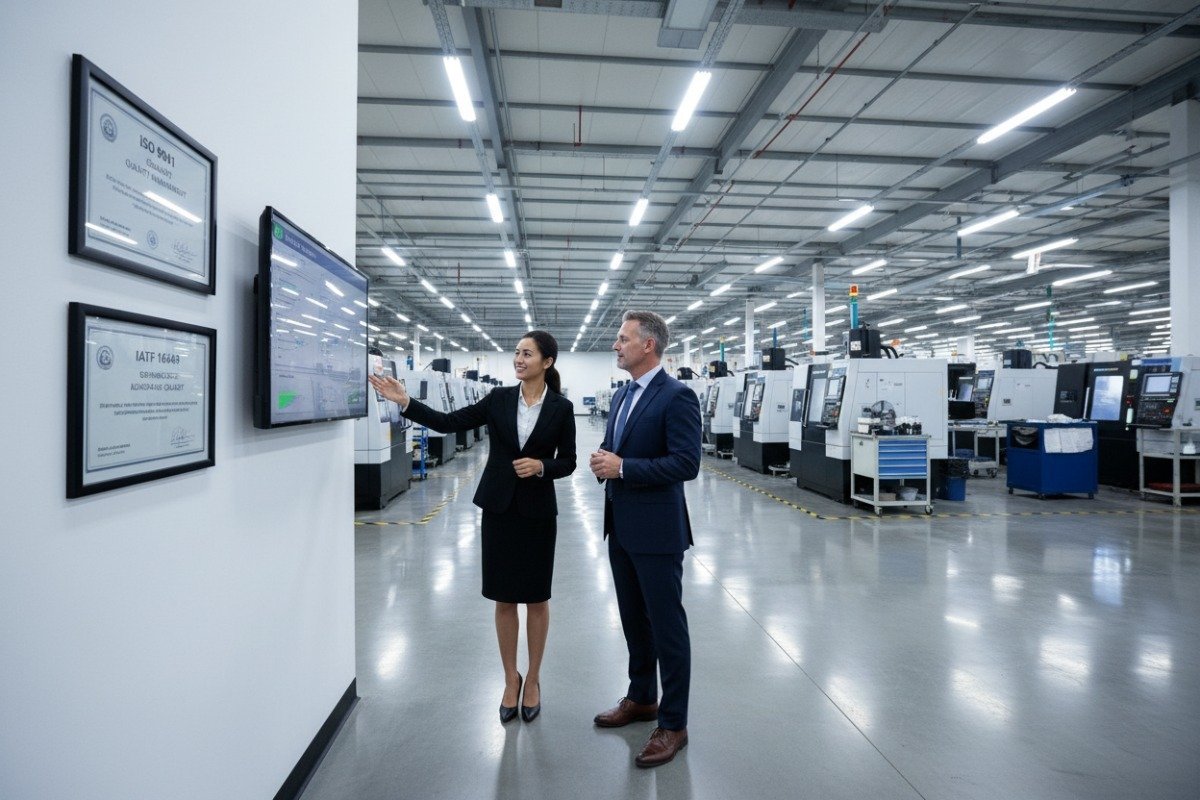
Choosing a manufacturer for custom components is a high-stakes decision. A wrong choice does not just cost money — it costs time, delays your product launch, and damages your reputation with your own customers. Here is how to evaluate a manufacturer systematically.
Equipo y Tecnología
The first question is straightforward: does this manufacturer have the right machines for your parts? Mecanizado CNC 5 centers, injection molding presses, wire EDM, surface grinders, CMM inspection equipment — the specific requirements depend on your part.
But do not stop at the equipment list. Ask about capacity. A shop with two CNC machines may produce excellent parts, but if your order requires 10,000 pieces per month, they may not be able to keep up. Ask about their current utilization rate. Ask what happens if your order volume increases by 50%.
Also look at technology adoption. Manufacturers investing in Industry 4.0 technologies 6 — IoT-connected machines, real-time production monitoring, digital twins for virtual testing — are better positioned to deliver consistent quality and shorter lead times.
Engineering and Communication
This is where many sourcing relationships fail. Your manufacturer's engineering team needs to understand your drawings, ask the right questions, and flag potential issues before production. If they simply say "yes" to everything without discussion, that is a warning sign.
Good communication means proactive updates. It means your manufacturer tells you about a potential delay before it becomes a crisis. It means they send you photos of first articles without being asked. It means they respond to emails within 24 hours.
Our teams in Vietnam and China are trained to communicate in this proactive style because we know how frustrating it is for U.S. purchasing managers to chase suppliers for updates across time zones.
Certifications and Systems
| Certificación | What It Indicates | Relevance to Custom Parts |
|---|---|---|
| ISO 9001 7 | Basic quality management system | Minimum requirement for any serious manufacturer |
| IATF 16949 8 | Automotive-grade quality management | Essential for automotive custom parts |
| ISO 13485 | Medical device quality management | Required for medical component manufacturing |
| ISO 14001 | Environmental management system | Important for sustainability-focused buyers |
| NADCAP | Special process accreditation (heat treat, NDT, etc.) | Critical for aerospace and defense parts |
Certifications are not just badges. They represent documented systems for controlling processes, training employees, handling non-conformances, and driving continuous improvement. A manufacturer without ISO 9001 in 2025 is not a manufacturer you should trust with custom work.
Prototyping and Iteration Speed
Non-standard parts often require multiple rounds of prototyping before the design is finalized. Your manufacturer should be able to produce prototypes quickly — ideally within one to two weeks for machined parts, and within days for 3D-printed parts.
Ask about their prototyping process. Do they have dedicated prototype machines, or do prototypes compete with production jobs for machine time? A dedicated prototyping capability means faster turnaround and less disruption to your timeline.
Financial Stability and Payment Terms
This factor is often overlooked. A manufacturer that is financially unstable may cut corners on materials, delay investments in maintenance, or even shut down mid-project. Ask for references. Check their business registration. If possible, visit the facility.
Payment terms also matter. Many Asian suppliers demand 100% prepayment or a large deposit. This puts all the financial risk on the buyer. A manufacturer that offers open account terms — net 60 or net 90 — demonstrates confidence in their delivery and financial stability. We offer these terms to our U.S. clients specifically to reduce their cash flow pressure and build long-term trust.
Historial de entregas a tiempo
Ask for data. What is their on-time delivery rate over the past 12 months? Anything below 90% should raise concerns. Delivery delays cascade through your supply chain. They cause production stoppages, missed customer commitments, and expedited shipping costs that eat into your margins.
A good manufacturer tracks delivery performance systematically and shares it with you transparently. They have root cause analysis processes for any late deliveries and corrective actions to prevent recurrence.
Conclusión
Selecting the right non-standard parts manufacturer requires evaluating quality systems, DFM collaboration, communication, and delivery reliability — not just price. Choose a partner who gets it right the first time.
Notas al pie
1. Defines Statistical Process Control (SPC) and its application in manufacturing. ↩︎
2. Details the Production Part Approval Process (PPAP) in manufacturing and its importance. ↩︎
3. Wikipedia offers a detailed and authoritative explanation of Design for Manufacturability (DFM). ↩︎
4. Provides a comprehensive definition, types, and materials used in injection molding. ↩︎
5. Wikipedia provides a comprehensive and authoritative overview of CNC machining. ↩︎
6. Describes Industry 4.0 technologies and their impact on manufacturing and efficiency. ↩︎
7. Provides an overview of the ISO 9001 standard for quality management systems. ↩︎
8. Wikipedia offers an authoritative overview of IATF 16949. ↩︎

 English
 Español de México
 Deutsch
 Français
 Русский
 العربية