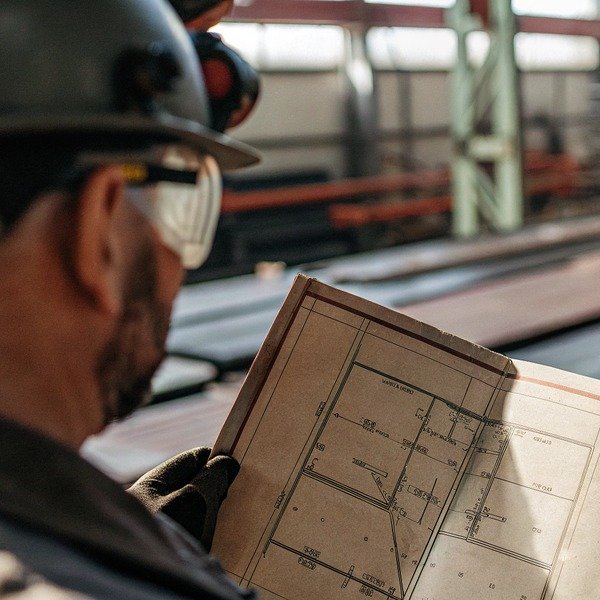
When we receive incomplete drawing packages at our facility, the quoting process stalls instantly. It forces our engineers to guess your intent regarding critical features, which inevitably leads to higher cost estimates and longer lead times for your project. longer lead times 1
To ensure an accurate quote, you must provide a comprehensive package containing 2D technical drawings with full dimensions and tolerances, 3D CAD files for volume calculation, standardized welding symbols, specific material grades, and clear surface finish requirements.
Let’s look at the exact details required to streamline your procurement process and avoid costly misunderstandings. procurement process 2
Is it better to submit 2D drawings or 3D CAD files for custom welding projects?
We often see clients submit only a 3D model, expecting it to be enough for production. Unfortunately, this missing data causes delays on our shop floor in Vietnam as we pause to request critical tolerance information.
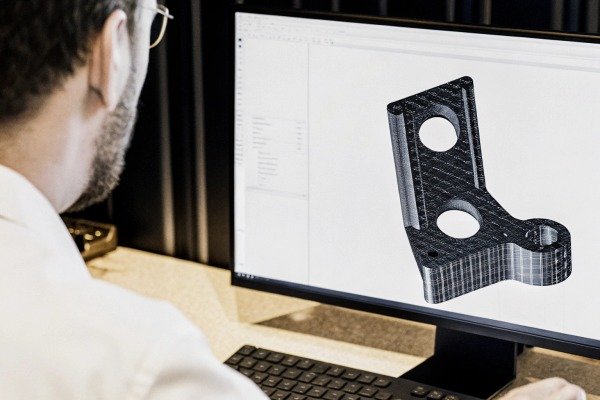
The most effective approach is submitting both formats simultaneously. While 3D CAD files allow our engineers to calculate material volume and visualize complex geometry, 2D drawings are legally binding documents necessary for specifying critical tolerances, thread details, and finish requirements.

The Critical Role of File Redundancy
In modern manufacturing, relying on a single file format is a recipe for error. When we analyze a request for quotation (RFQ), our engineering team uses 3D and 2D files for completely different purposes. The 3D model (typically STEP or IGES format) is essential for our CAM (Computer-Aided Manufacturing) software. STEP or IGES 3 It allows us to simulate bending operations, design welding fixtures, and calculate the exact volume of aluminum aluminum or steel 4 or steel required. For example, with the silver-colored aluminum frame structure mentioned in your product context, a 3D model helps us visualize how the rectangular tubing intersects and where potential clashes might occur during assembly.
However, a 3D model is mathematically perfect. It does not tell us how much deviation is acceptable. If a hole in your model measures 10mm, the computer sees exactly 10.000mm. It does not know if a 10.05mm hole is acceptable or if a 9.95mm hole will cause assembly failure. This is where the 2D drawing becomes the "source of truth." It contains the manufacturing logic that the 3D geometry lacks. Without the 2D drawing, we must assume standard tolerances, which might be too loose for your application or unnecessarily tight, driving up the cost. standard tolerances 5
Essential File Formats for Quoting
To get the fastest and most accurate quote from us, your submission package should include a specific set of files. Providing these upfront prevents the back-and-forth emails that typically delay projects by days or weeks.
| File Type | Preferred Format | Primary Function for the Supplier |
|---|---|---|
| 3D Model | STEP (.stp) or IGES (.igs) | Used for weight calculation, CAM programming, and designing welding jigs. |
| 2D Drawing | The legal contract. Defines tolerances, threads, material specs, and surface finishes. | |
| Flat Pattern | DXF or DWG | Essential for laser cutting sheet metal components before bending and welding. |
| Assembly View | Shows how multiple welded components fit together, including BOM and hardware lists. |
Why DXF Files Matter for Costing
For welded assemblies that include laser-cut plates or brackets, providing a clean DXF file allows us to nest parts efficiently. Nesting is the process of arranging shapes on a sheet of raw material to minimize waste. If you only provide a PDF, our engineers must manually redraw the part in CAD to calculate material usage. This adds engineering hours to your quote. By providing the DXF, you allow us to run an instant nesting simulation, ensuring you only pay for the material you actually use. This is particularly important for complex geometries where material utilization rates can significantly impact the final unit price.
What specific weld symbols and tolerance standards should I include in my RFQ?
Ambiguous welding instructions are the leading cause of quote revisions in our daily operations. Without clear symbols, we cannot accurately estimate labor hours or consumable usage, leading to budget overruns or structural risks.
You should strictly utilize ISO 2553 or AWS A2.4 standard welding symbols to define weld type, size, length, and location. Additionally, clearly specify linear and geometric tolerances (GD&T) to prevent us from applying expensive, high-precision standards to non-critical areas.
The Language of Welding
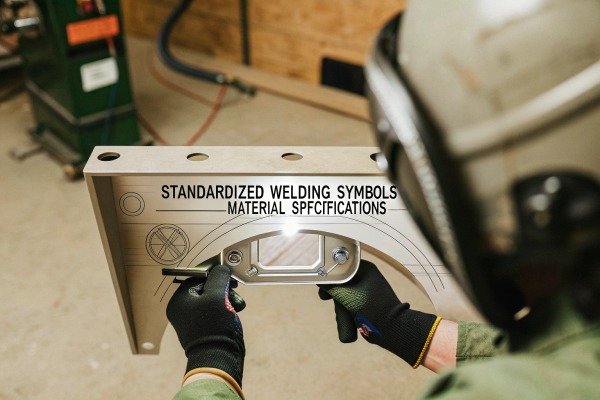
Welding is expensive. It consumes electricity, gas, filler material, and highly skilled labor. When a drawing simply points to a joint and says "Weld Here," we have to guess the requirements. If we guess conservatively, we might over-weld, which increases heat distortion and cost. If we guess aggressively to lower the price, the part might fail structurally. Standardized welding symbols eliminate this guesswork. Standardized welding symbols 6 They tell our welders exactly what to do without needing a conversation.
For your aluminum frame structure, specifying the correct symbol is vital. A continuous fillet weld along the entire length of a rectangular tube provides maximum strength but introduces significant heat, which can warp the frame. An intermittent (stitch) weld might provide sufficient strength with less distortion and lower cost. By using the correct symbol to specify an intermittent weld (e.g., 50-100, meaning 50mm weld length every 100mm pitch), you directly influence the quoted price.
Common Welding Symbols and Their Impact
Understanding how different symbols affect production time is key to controlling costs. Here is a breakdown of how specific symbols translate to our shop floor reality:
| Symbol / Feature | Meaning | Cost Implication |
|---|---|---|
| Fillet Weld | Triangular weld joining two surfaces at an angle. | Standard Cost. The most common and easiest weld to execute. |
| Groove/Butt Weld | Weld joining two flat pieces; requires edge preparation (beveling). | High Cost. Requires extra machining steps to bevel edges before welding. |
| Intermittent Weld | Short welds spaced out (stitch welding). | Lower Cost. Uses less material and time; reduces heat distortion. |
| All-Around Symbol | Circle at the arrow junction; weld extends around the entire joint. | Higher Cost. Often unnecessary; frequently used by mistake on square tubing. |
| Grind Flush | A flat line over the weld symbol; requires grinding the bead flat. | Added Cost. Requires manual labor to grind and polish after welding. |
Balancing Tolerances and Cost
Tolerance specifications are the biggest lever you have to control price. In welding, heat causes metal to expand and contract, leading to distortion. Maintaining tight tolerances (e.g., +/- 0.5mm) on a large welded frame requires us to build expensive, custom fixtures to hold the parts rigid during cooling. It may also require post-weld machining or straightening operations.
If you apply a general tolerance block (e.g., ISO 2768-m) to the entire drawing, you might be accidentally asking for precision on features that don't matter. We recommend using Geometric Dimensioning and Tolerancing (GD&T) to pinpoint exactly where precision is needed Geometric Dimensioning and Tolerancing (GD&T) 7—such as the mounting points on the upright section of your frame—while leaving the rest of the structure with looser tolerances. This approach allows us to quote a lower price without sacrificing the functionality of the part.
How detailed should my material specifications and welding process requirements be?
When we source raw materials for US clients, generic terms like “aluminum” create massive risks. Specificity prevents us from purchasing the wrong grade that might crack during welding or fail under load.
Specifications must be precise, listing exact material grades like Aluminum 6061-T6 or Stainless Steel 304L, rather than generic categories. You should also define the required welding process, such as TIG for aesthetics or MIG for speed, to control production costs.

Material Grades Determine Weldability
Simply stating "Aluminum" on a drawing is dangerous. There are many alloys of aluminum, and some are not weldable. For example, Aluminum 7075 is incredibly strong but highly prone to cracking when welded. Aluminum 6061 is the industry standard for structural frames, but it loses strength in the heat-affected zone and often requires artificial aging (heat treatment) to restore its properties.
For your specific project—a silver-colored frame made of rectangular tubing—we need to know if you require 6061-T6 for structural rigidity or 6063-T5 for a better surface finish. 6063 extrudes with a smoother surface, making it ideal for cosmetic parts that will be anodized, but it is not as strong as 6061. If you don't specify, a supplier might choose the cheaper option, which could compromise your product. Always include the standard (e.g., ASTM B221) and the temper ASTM B221 8 (e.g., T6) to ensure we source the exact material you need.
Selecting the Right Welding Process
The welding process you request dictates the appearance and the cost of the final part. Since your product is a visible structure with no branding, the visual quality of the welds is likely a key aesthetic feature.
- MIG Welding (GMAW): This is fast and cheaper. It uses a spool of wire fed through a gun. It is great for structural steel but can leave "spatter" (small droplets of metal) and a heavier, less uniform weld bead.
- TIG Welding (GTAW): This is slower and requires more skill, making it more expensive. However, it produces the beautiful, "stack-of-dimes" look often seen on high-end bicycle frames or architectural furniture.
For a silver-colored aluminum frame, TIG welding is usually the preferred choice because it is cleaner and produces no spatter. If cost is the primary driver and the welds are hidden, MIG might be acceptable. You must specify this on the drawing (e.g., "Process: TIG Weld" or "AWS D1.2 Class A") AWS D1.2 9 so we can calculate the labor hours correctly.
Post-Fabrication Processing
Welding is rarely the final step. The "silver color" you mentioned implies a finish. Aluminum naturally oxidizes, so it needs protection.
- Clear Anodizing: This creates a hard, protective silver layer that maintains the metallic look. It requires the base metal to be free of scratches.
- Chromate Conversion: A conductive coating that offers corrosion protection but is less durable than anodizing.
- Powder Coating: A paint-like finish. If you want a specific silver metallic color (e.g., RAL 9006), this is the most consistent option.
| Material Spec | Gängige Anwendung | Weldability | Notes for Quote |
|---|---|---|---|
| Alu 6061-T6 | Structural frames, heavy-duty parts | Gut | Most common. Strength decreases near welds. |
| Alu 6063-T5 | Architectural trim, visual frames | Ausgezeichnet | Better finish for anodizing than 6061. |
| Alu 5052-H32 | Sheet metal enclosures | Gut | cannot be heat treated; good corrosion resistance. |
| Alu 7075-T6 | Aerospace components | Schlecht | Do not specify for welding; use for machined parts only. |
Should I specify non-destructive testing (NDT) methods when requesting a quote?
Many buyers overlook testing until the first batch arrives with hidden defects. We encourage defining inspection protocols upfront to ensure our Vietnam team budgets for the necessary quality checks and equipment.
Yes, specifying NDT methods is crucial because testing costs are often excluded from standard quotes. You must explicitly state if the project requires visual inspection, dye penetrant Dye Penetrant (PT) 10 testing, ultrasonic testing, or X-ray verification to ensure these service costs are included.
Why NDT Cannot Be an Afterthought
Quality Control (QC) is not free. It requires certified inspectors, specialized equipment, and time. If your drawing says "Inspect Welds" without detail, we will typically quote for a standard Visual Inspection (VT). This means a qualified inspector looks at the weld to check for visible cracks, porosity, or undercut.
However, for a complex geometric frame that might support weight, visual inspection might not be enough. Internal defects like lack of fusion or internal porosity can exist inside a weld that looks perfect on the outside. If you decide later that you need X-ray (RT) or Ultrasonic (UT) testing, the price will increase significantly, potentially disrupting your budget. By specifying the NDT Level (e.g., "NDT: Dye Penetrant Check on 10% of welds") in the RFQ, you ensure that the quote includes the cost of these critical quality assurance steps.
Choosing the Right Test for Your Budget
Not every part needs aerospace-grade inspection. Over-specifying NDT can kill a project's viability. For an aluminum frame structure, we typically recommend a tiered approach.
- Visual Testing (VT): 100% of parts. Checks for surface consistency and obvious flaws.
- Dye Penetrant (PT): This is excellent for non-magnetic materials like aluminum. We spray a red dye on the weld, wipe it off, and use a developer to draw the dye out of microscopic surface cracks. It is affordable and effective.
- Radiographic (RT) / X-Ray: Very expensive and slow. Only use this for critical safety joints where failure could result in injury.
NDT Method Comparison
The table below helps you decide which method to request based on your part's function and your budget.
| Testing Method | Detects | Cost Level | Am besten für |
|---|---|---|---|
| Visual (VT) | Surface cracks, undercut, spatter, size | Low (Standard) | All welded parts. Basic requirement. |
| Dye Penetrant (PT) | Surface-breaking cracks, porosity | Medium | Aluminum/Stainless steel frames. |
| Magnetic Particle (MT) | Surface and near-surface defects | Medium | Ferrous metals only (Steel). Not for Aluminum. |
| Ultrasonic (UT) | Deep internal defects, lack of fusion | Hoch | Thick plates (>8mm) and critical structures. |
| Radiographic (RT) | All internal volumetric defects | Sehr hoch | Pressure vessels, aerospace, critical safety loads. |
By clarifying these requirements upfront, you allow us to plan our production flow. If Dye Penetrant testing is required, we cannot ship immediately after welding; the parts must go to the QC holding area, undergo testing, be cleaned, and then move to finishing. This impacts the lead time we quote you.
Fazit
Accurate quotes start with complete data. By providing clear drawings, distinct symbols, and defined standards, you help us deliver precise pricing and high-quality parts on time. When you remove ambiguity from your documentation, you empower our team to build your product right the first time.
Footnotes
1. Definition and impact of lead times in manufacturing. ↩︎
2. Official government guidance on procurement and purchasing. ↩︎
3. ISO standard for the exchange of product model data. ↩︎
4. Official data on aluminum and steel mineral resources. ↩︎
5. ISO standard for general tolerances in manufacturing. ↩︎
6. Links to the official ISO 2553 standard for welding symbols mentioned in the context. ↩︎
7. References the authoritative ASME Y14.5 standard for GD&T. ↩︎
8. Direct link to the official ASTM specification for aluminum extruded bars and profiles. ↩︎
9. Links to the official Structural Welding Code for Aluminum by the American Welding Society. ↩︎
10. Provides authoritative information on this testing method from the American Society for Nondestructive Testing. ↩︎

 English
 Español de México
 Deutsch
 Français
 Русский
 العربية