
Over the years, our team has helped dozens of U.S. buyers source custom sheet metal stampings 1 from Asia. The biggest frustration we hear? Parts arrive late, out of spec, or both — and the rework costs eat into every margin.
To source custom sheet metal stamping reliably, evaluate manufacturers on industry experience, quality certifications like ISO 9001, precision capabilities, in-house tooling, and their willingness to collaborate on design. A true manufacturing partner — not just a supplier — delivers on price, quality, and on-time performance consistently.
Finding the right stamping partner is not just about getting the lowest quote IATF 16949 2. It is about building a relationship that protects your production schedule and your reputation. Below, we break down the key questions you should ask and the steps you should take before placing your first order first article inspections (FAI) 3.
How Do I Identify the Best Sheet Metal Stamping Partner for My Specific Industry Needs?
When we first started helping clients source stampings for medical and automotive applications, we quickly learned that not every shop can handle every job coordinate measuring machines (CMMs) 4. The wrong partner costs you months, not just money.
The best sheet metal stamping partner for your industry has proven experience in your specific sector, relevant certifications, a strong track record of on-time delivery, and the engineering depth to collaborate on complex designs. Look for manufacturers who serve industries with similar tolerance and compliance demands.
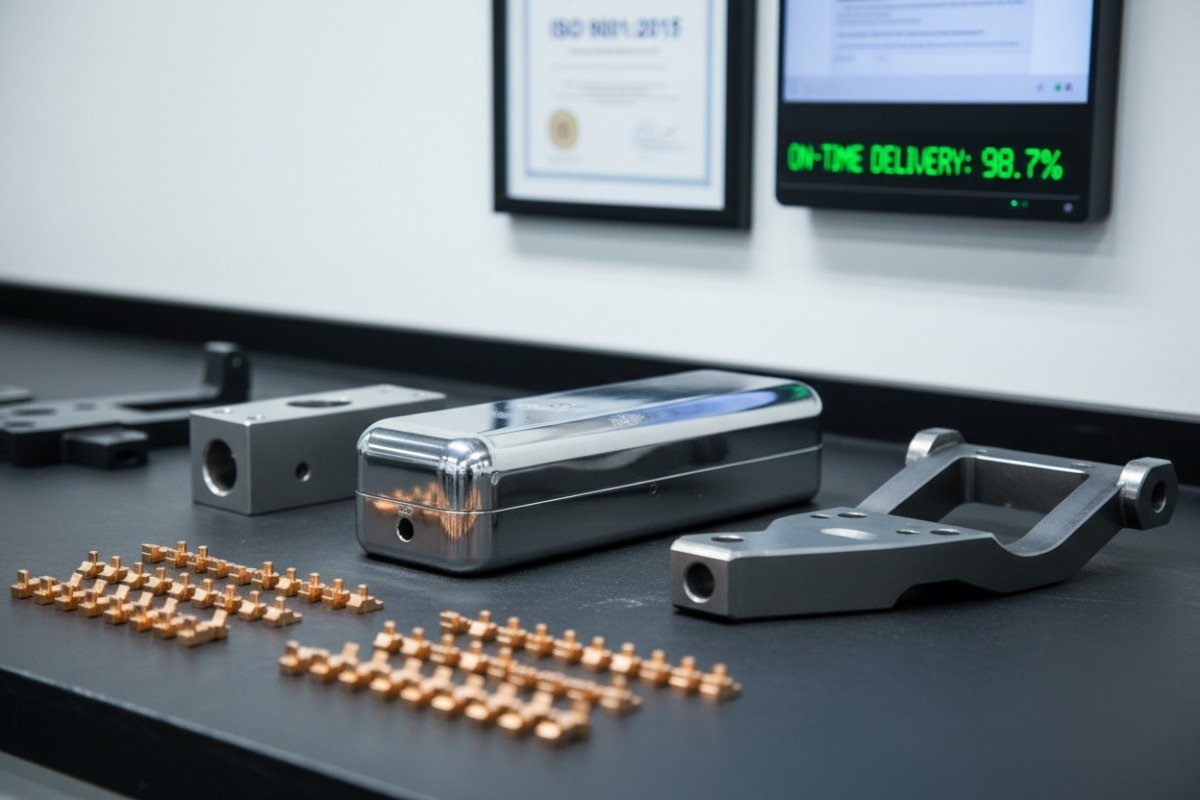
Choosing a stamping partner is one of the most consequential decisions a purchasing manager can make. A poor choice leads to missed deadlines, rejected parts, and strained relationships with your own customers. Let us walk through how to get it right.
Why Industry Experience Matters
A manufacturer who has stamped parts for aerospace 5 understands tight tolerances, traceability, and documentation at a level that a general-purpose shop simply does not. Experience in your specific industry means the manufacturer already knows the common pitfalls. They know which materials behave unpredictably. They know which geometries cause tooling wear. They have solved problems similar to yours before.
In our experience exporting stamped parts to the U.S. market, we have seen buyers waste six months qualifying a supplier who looked great on paper but had zero experience with their application. That is six months of samples, revisions, and frustration.
Key Criteria for Partner Evaluation
Here is a simple framework we use when helping clients shortlist stamping manufacturers:
| Bewertungskriterien | Worauf zu achten ist | Warnsignal |
|---|---|---|
| Industry experience | 5+ years serving your sector | No references in your industry |
| Zertifizierungen | ISO 9001 6, IATF 16949, AS9100 (as applicable) | No third-party quality certifications |
| Technischer Support | Dedicated DFM review and design collaboration | "Just send us the drawing" attitude |
| Tooling capability | In-house die design and fabrication | Outsources all tooling |
| Kommunikation | Proactive updates, English-speaking project manager | Slow replies, language barriers |
| Zahlungsbedingungen | Willingness to offer 60–90 day terms | Demands 100% upfront payment |
Supplier vs. Partner: The Critical Difference
A supplier fills your purchase order. A partner challenges your assumptions, flags potential issues before production, and invests in understanding your end-use requirements. When our engineers review a client's stamping drawing, we do not just quote it. We ask questions: What is the function of this feature? Can we simplify this bend to reduce tooling cost? Is this tolerance truly necessary on a non-critical surface?
This collaborative approach is what separates a transactional relationship from a strategic one. Manufacturers who have served multiple industries — automotive, electronics, medical, industrial — bring cross-sector insights that can improve your design and lower your costs.
Check Their Supply Chain Network
Established manufacturers have built relationships with reliable material suppliers over many years. supply chain network 7 This matters when you need specific alloys, tempers, or coatings. Ask your potential partner where they source their raw materials and whether they have backup suppliers. Supply chain resilience is not optional anymore — it is essential.
What Key Quality Control Processes Should I Expect from My Custom Stamping Supplier?
Quality failures in stamped parts have cost some of our clients tens of thousands of dollars in rework, air freight, and lost production time. We have seen it happen, and it is almost always preventable.
Expect your custom stamping supplier to maintain ISO 9001 certification at minimum, use statistical process control (SPC), perform first article inspections (FAI), employ coordinate measuring machines (CMMs), and conduct in-process and final inspections. A robust quality system catches defects before they reach your dock.

Quality control is not a department. It is a culture. And you can tell a lot about a manufacturer's culture by how they describe their QC processes. If the answer is vague — "we check everything before shipping" — that is a warning sign. Here is what a professional quality system actually looks like.
The Quality Control Lifecycle
Quality starts before the first blank is cut. It begins with incoming material inspection and continues through every stage of production. Here is a breakdown of what each phase should include:
| QC-Phase | Activities | Verwendete Werkzeuge |
|---|---|---|
| Wareneingangskontrolle | Verify material certificates, check thickness, hardness, surface condition | Calipers, micrometers, hardness testers |
| Erststückprüfung (FAI) | Measure first production parts against drawing specs | CMM, optical comparators, vision systems |
| Inprozesskontrolle | Monitor critical dimensions at set intervals during production | SPC software, go/no-go gauges |
| Endkontrolle | 100% visual inspection + AQL sampling for dimensions | CMM, surface roughness testers, pin gauges |
| Pre-shipment inspection | Verify packaging, labeling, quantity, and documentation | Checklists, photographic records |
Statistische Prozesskontrolle (SPC)
SPC is not just a buzzword. It is a mathematical approach to monitoring production consistency. When we run stamping jobs for our clients, our QC team tracks critical dimensions on control charts in real time. If a measurement trend starts drifting toward the tolerance limit — even if every part is still in spec — we stop and adjust. This prevents defects before they happen.
Ask your supplier: Do you use SPC? Can you share control charts from a recent production run? If they cannot, their process control is likely reactive, not proactive.
PPAP and Documentation
For automotive and other regulated industries, Produktionsprozess zur Teilefreigabe (PPAP) 8 documentation is standard. But even outside automotive, PPAP elements like control plans, process flow diagrams, and measurement system analysis (MSA) are valuable. They prove that the manufacturer has thought through every step and has a plan to maintain consistency.
Our team prepares full PPAP packages for clients who require them. This includes dimensional reports, material certifications, capability studies (Cpk), and process flow documentation. It takes effort, but it is the foundation of "right first time" manufacturing.
Why "Right First Time" Matters
Every time a part needs rework, you pay twice — once for the labor and once for the delay. When we calibrate our inspection processes, we aim for zero escapes. That means no non-conforming parts leave the facility. This is not a marketing claim. It is a business necessity. Your production line cannot wait for replacement parts to arrive by air freight from Asia.
How Can I Optimize My Part Design to Lower My Overall Sheet Metal Stamping Costs?
When we review new stamping projects, we often find that small design changes can cut tooling costs by 20% or more. Most buyers do not realize how much influence they have over cost — before a single die is built.
To lower sheet metal stamping costs, simplify part geometry, minimize tight tolerances on non-critical features, choose standard material thicknesses, reduce secondary operations by designing features in-die, and collaborate with your manufacturer on Design for Manufacturability (DFM) reviews early in the process.
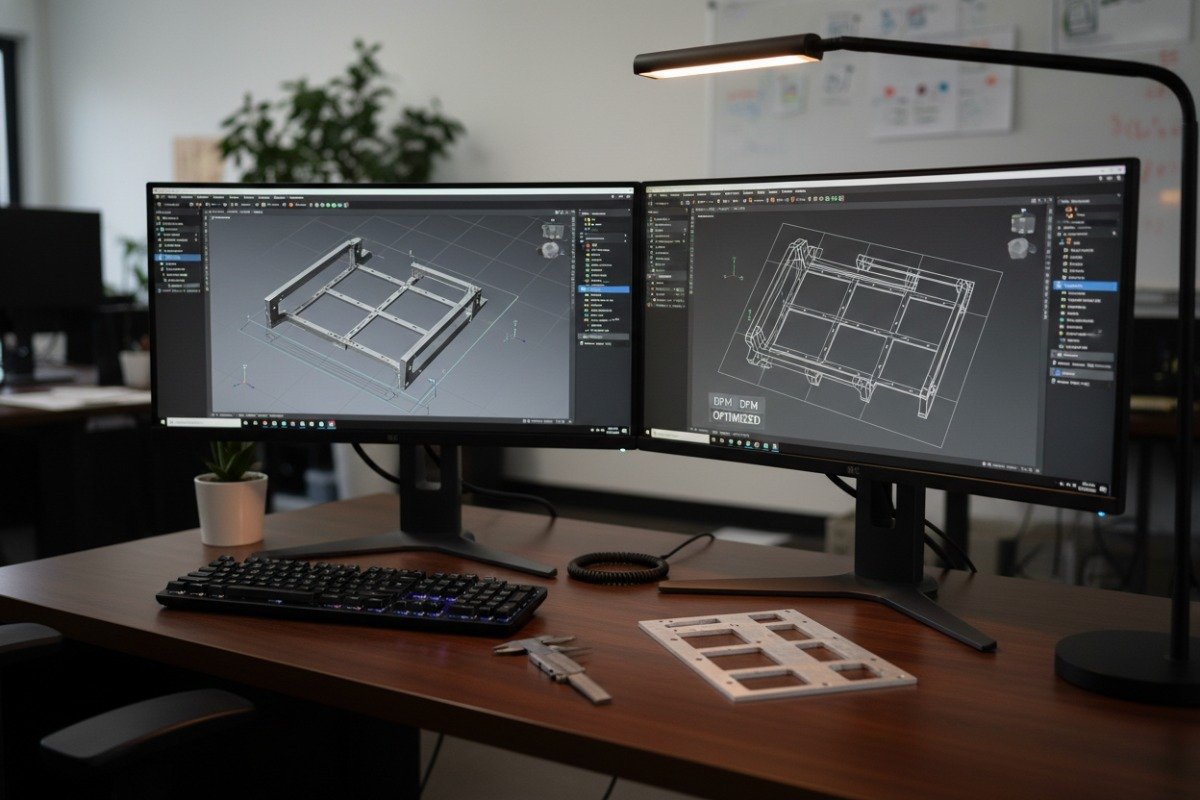
Cost optimization in stamping is not about squeezing your supplier on price. It is about designing smarter. The biggest cost drivers in custom stamping are tooling complexity, material waste, secondary operations, and tolerance requirements. Let us look at each one.
Herstellbarkeitsunterstützung (DFM)
DFM is a collaborative review between your engineering team and the manufacturer's tooling engineers. Herstellbarkeitsunterstützung (DFM) 10 The goal is to identify design features that are difficult or expensive to stamp — and find alternatives that achieve the same function at lower cost.
For example, a sharp internal corner might require an expensive EDM-cut die insert. A small radius in the same location could allow conventional machining, saving hundreds or thousands of dollars on the tool. These are the kinds of insights that come from experience, and they only happen when the manufacturer is involved early.
Common Cost Drivers and Solutions
| Kostentreiber | Why It Increases Cost | Designoptimierung |
|---|---|---|
| Tight tolerances on all dimensions | Requires slower press speeds, more inspection | Apply tight tolerances only to functional surfaces |
| Non-standard material thickness | Longer lead times, higher material cost | Use standard gauge thicknesses where possible |
| Multiple secondary operations | Additional handling, setup, and labor | Design tapping, coining, or forming in-die |
| Complex geometry with deep draws | Higher tooling cost, more forming stages | Simplify geometry or split into sub-assemblies |
| Small bend radii | Increases cracking risk, requires special tooling | Use minimum bend radius ≥ material thickness |
| Excessive scrap rate | Wasted material per part | Optimize blank layout with nesting software |
In-Die Operations Save Money
One of the most effective cost reduction strategies is consolidating secondary operations into the stamping die itself. If your part needs tapped holes, those can often be tapped in-die during the stamping cycle. The same applies to coining, embossing, and certain forming operations. Each operation you eliminate from the secondary process removes a handling step, a setup, and a potential source of error.
Our engineering team routinely suggests in-die modifications during the quoting phase. On one recent project, we redesigned a progressive die to include in-die tapping for four holes. This eliminated a separate tapping operation, reduced the per-unit cost by 15%, and cut lead time by three days.
Material Selection and Nesting
Material cost is typically 40–60% of the total part cost in stamping. Choosing the right material — and using it efficiently — has a direct impact on your bottom line. Standard thicknesses are stocked by mills and distributors, so they cost less and arrive faster. Non-standard thicknesses require special orders with minimum quantity requirements and longer lead times.
Nesting — the arrangement of blanks on the strip — determines how much material is wasted per part. A well-designed progressive die maximizes material utilization. Even a 5% improvement in nesting efficiency can save thousands of dollars over a production run of 100,000 parts.
What Steps Should I Take to Verify a Manufacturer's Technical Capabilities Before Placing My Order?
Before we onboard any new stamping supplier into our network, our team conducts a structured audit that covers equipment, processes, personnel, and track record. We learned this the hard way — after a supplier who "could do everything" delivered parts that could do nothing.
Before placing an order, request a facility tour or virtual audit, review their equipment list and press capacities, ask for sample parts and dimensional reports from similar projects, verify certifications independently, check references from existing clients, and conduct a trial order to validate quality and delivery performance.

Verification is not about distrust. It is about due diligence. A professional manufacturer welcomes scrutiny because they know it builds confidence. Here is a step-by-step approach we recommend to every client.
Step 1: Request Detailed Information
Start with a formal Request for Information (RFI). Ask the manufacturer to provide their equipment list, certifications, organizational chart, quality manual summary, and a list of industries served. This gives you a baseline understanding of their capabilities without requiring a site visit.
Pay attention to the details. A manufacturer who responds with a well-organized, comprehensive package is likely well-organized in their operations too. A vague or incomplete response is a signal.
Step 2: Conduct a Facility Audit
If possible, visit the facility in person. If geography makes that impractical, request a virtual tour via video call. During the audit — whether physical or virtual — focus on these areas:
- Press room: What types and tonnages of presses do they operate? Are the machines well-maintained?
- Tool room: Do they have in-house die-making capability? What CNC and EDM equipment is available?
- Quality lab: What inspection equipment do they have? CMMs, optical comparators, surface testers?
- Materiallagerung: Is raw material stored properly, labeled, and traceable?
- Haushaltsführung: A clean, organized shop floor reflects disciplined management.
When our Vietnam team audits a potential supplier, we use a standardized 120-point checklist that covers equipment condition, process documentation, operator training records, and environmental controls. This level of rigor is what separates a professional sourcing partner from a casual buyer.
Step 3: Review Sample Parts and Reports
Ask the manufacturer to provide sample parts from a project similar to yours — along with the dimensional inspection report. Compare the report to the drawing. Look for:
- Are all critical dimensions measured?
- Are the results within tolerance?
- Is the measurement method appropriate for each feature?
- Is the report format professional and traceable?
Step 4: Verify Certifications Independently
Do not just accept a PDF of an ISO certificate. Check the certificate number against the issuing body's online database. Verify the scope of certification — some manufacturers hold ISO 9001 for only part of their operations. Make sure the certification covers stamping, not just assembly or warehousing.
Step 5: Check References and Conduct a Trial Order
Ask for two or three client references, ideally in your industry. Call them. Ask about quality, communication, on-time delivery, and how the manufacturer handles problems. Then place a small trial order. This is the most reliable test of all. A trial order reveals the manufacturer's true capabilities — their communication speed, their attention to detail, their packaging quality, and their ability to meet a deadline.
Capability Verification Checklist
| Verifizierungsschritt | What You Learn | How to Do It |
|---|---|---|
| Equipment list review | Press types, tonnages, automation level | Request formal equipment inventory |
| Facility audit | Housekeeping, organization, process discipline | On-site visit or virtual tour |
| Sample part review | Dimensional accuracy, surface finish quality | Request samples + inspection reports |
| Certification verification | Legitimacy and scope of quality certifications | Check issuing body's online database |
| Client references | Real-world performance on quality and delivery | Phone calls with 2–3 existing clients |
| Trial order | End-to-end capability validation | Place a small production order |
Do Not Skip the Trial Order
We cannot stress this enough. A trial order is the single most important step in supplier verification. It tests every link in the chain — from order acknowledgment to final delivery. Our team manages trial orders for clients as part of our sourcing service, and the insights we gain from a single trial run are worth more than a dozen emails and presentations.
Fazit
Sourcing custom sheet metal stamping reliably comes down to thorough evaluation, early collaboration, and ongoing verification. Choose a partner — not just a supplier — and invest the time upfront to protect your quality, cost, and delivery performance.
Footnotes
1. Wikipedia provides a comprehensive overview of metal stamping processes and applications. ↩︎
2. Replaced with an authoritative page from BSI, a leading certification body, detailing IATF 16949. ↩︎
3. Explains the definition, process, and importance of First Article Inspections in manufacturing. ↩︎
4. NIST provides a technical discussion on the use and accuracy of Coordinate Measuring Machines. ↩︎
5. Replaced with the official AS9100 standard page from SAE International, a highly authoritative source for aerospace standards. ↩︎
6. Official ISO page detailing the ISO 9001 standard for quality management systems. ↩︎
7. Replaced with a general, authoritative definition from Wikipedia for ‘supply chain network’. ↩︎
8. Official AIAG page for the Production Part Approval Process (PPAP) standard. ↩︎
9. ASQ offers a detailed definition and explanation of statistical process control. ↩︎
10. Wikipedia provides a clear definition and overview of Design for Manufacturability. ↩︎

 English
 Español de México
 Deutsch
 Français
 Русский
 العربية