
Every year, our team reviews dozens of Spritzguss 1 suppliers across Asia for our U.S. clients. The wrong choice costs more than money — it costs time, trust, and market share.
Choosing the best plastic injection molding manufacturer starts with defining your project requirements — production volume, part complexity, material needs, and budget. Then shortlist candidates based on technical expertise, certifications, quality systems, equipment capacity, and proven communication reliability.
The global injection molding market hit $280 billion in 2025 and is projected to grow at 5.2% CAGR through 2030. Automotive accounts for 35% of that share, followed closely by medical devices requiring precision tolerances under 0.1mm. With nearly 600 North American molders and thousands more across Asia, the options are overwhelming Design for Manufacturability 2. But not all manufacturers are equal. Defect rates average 2–5% industry-wide, yet top performers push that below 1%. On-time delivery benchmarks at 95%+ separate leaders from the rest. This guide breaks down exactly what to look for — step by step — so you can make a confident, informed decision.
What Specific Certifications and Quality Standards Should I Look for in a Potential Molding Partner?
When we audit factories in Vietnam and across Southeast Asia, certifications are the first documents we request. But a certificate on the wall does not always mean quality on the floor.
Look for ISO 9001 as a baseline quality management certification. For medical parts, require ISO 13485. For aerospace, demand AS9100. But go beyond badges — audit their actual inspection protocols, defect tracking systems, variability controls, and on-time delivery records to verify real-world performance.
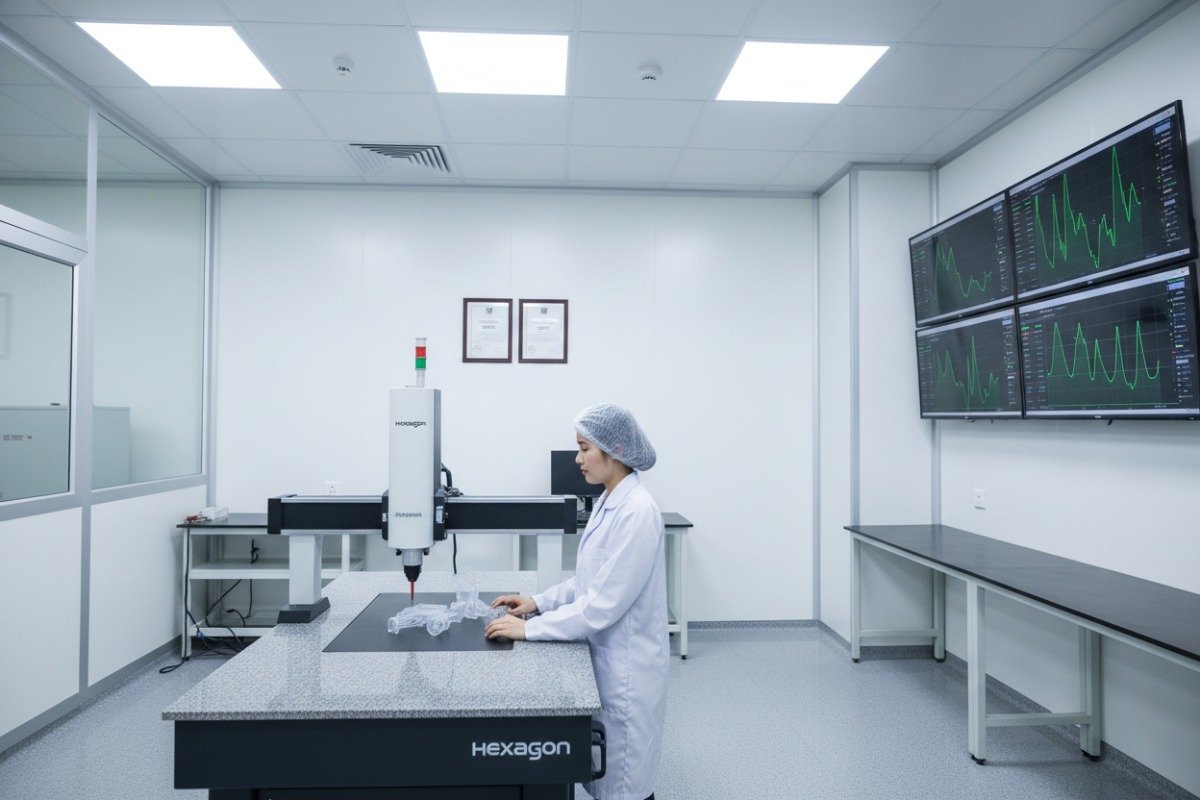
Warum Zertifizierungen allein nicht ausreichen
Critics of certifications make a fair point. A certificate proves a system exists. It does not prove the system works every day. We have walked into ISO 9001 3-certified factories where operators skipped inspection steps routinely. That is why our approach combines document review with hands-on verification.
When you visit a potential partner — or when your sourcing agent visits on your behalf — ask to see their corrective action logs. Ask how they handle a defective batch. Ask for their scrap rate data from the last six months. These numbers tell you more than any plaque on the wall.
Key Certifications by Industry
| Branche | Erforderliche Zertifizierung | Was es abdeckt |
|---|---|---|
| Allgemeine Fertigung | ISO 9001 | Quality management systems, process consistency |
| Medizinprodukte | ISO 13485 4 | Design controls, traceability, risk management |
| Luft- und Raumfahrt | AS9100 5 | Supply chain reliability, configuration management |
| Automobilindustrie | IATF 16949 6 | PPAP, FMEA, SPC, defect prevention |
| Umwelt | ISO 14001 7 | Waste reduction, sustainable operations |
Dig Into the Quality Details
Beyond certifications, here is what separates a reliable partner from a risky one:
- Inspection protocols: Do they use CMMs (coordinate measuring machines), laser scanners, or just calipers? Advanced inspection tech catches issues that manual checks miss.
- Defect handling: Ask for their NCR (non-conformance report) process. How fast do they respond? Do they perform root cause analysis or just rework and ship?
- On-time delivery rate: Industry leaders hit 95%+ consistently. Ask for documented proof, not just verbal claims.
- Sample turnaround time: A good manufacturer provides first article samples within a predictable window. Delays here signal deeper capacity or process issues.
- Variability controls: Statistische Prozesskontrolle 8 (SPC) charts should be active on the production floor, not buried in a filing cabinet.
One thing we always tell our clients: request a pilot run before committing to full production. A pilot run of 500–1,000 parts reveals more about a manufacturer's true quality capability than any certification audit. It tests their process stability, their material handling, and their attention to your specific drawing requirements.
Sustainable molding is also gaining traction. The market for recycled resins grew 25% in 2025. If your company has ESG goals, look for manufacturers investing in energy-efficient processes, recycled material usage, and waste reduction. ISO 14001 certification is a good indicator here, but again — verify with data.
How Do I Determine if a Manufacturer Has the Right Equipment and Capacity for My Production Volume?
Our engineers spend significant time matching client volume requirements to the right factory. We have seen projects fail because a small shop took on a million-piece order they could not handle — and because a massive factory ignored a 5,000-piece prototype run.
Evaluate a manufacturer's machine tonnage range, total press count, automation level, and scalability. High-volume projects need larger tonnage machines and multiple presses running simultaneously. Low-volume or prototype work requires flexible tooling — like aluminum molds — and willingness to accommodate design changes across production scales.
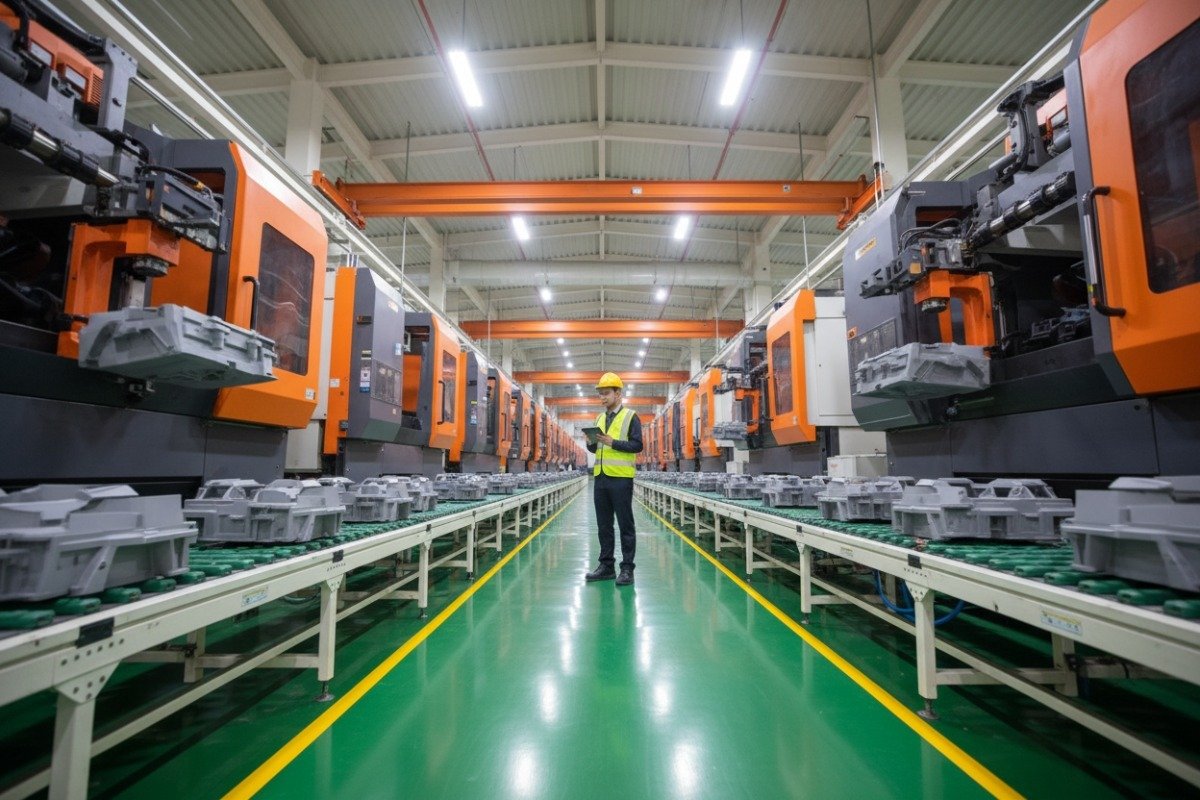
Match Your Volume to Their Capability
Production volume alignment is one of the most overlooked factors in supplier selection. A manufacturer optimized for runs of 500,000+ parts per year will not give your 2,000-piece order the attention it deserves. Conversely, a small shop with five presses cannot reliably deliver 2 million parts on schedule.
Here is a simple framework we use when evaluating capacity fit:
| Produktionsvolumen | Ideal Machine Setup | Werkzeugtyp | Typische Vorlaufzeit |
|---|---|---|---|
| Prototype (< 1,000 parts) | Small tonnage, 1–2 presses | Aluminum or 3D-printed soft tooling | 1–3 Wochen |
| Low Volume (1,000–50,000) | Mid tonnage, 3–10 presses | Aluminum or P20 steel | 3–6 Wochen |
| High Volume (50,000–1M+) | Large tonnage, 10+ presses | Hardened steel (H13, S136) | 6–12 weeks for tooling, then continuous |
Equipment You Should Ask About
When you tour a facility or request an equipment list, look for:
- Machine tonnage range: Small parts (bottle caps, connectors) need 50–200 tons. Large parts (automotive panels, housings) need 500–3,000+ tons. Make sure their range covers your part size.
- Press count and utilization rate: A factory with 20 presses running at 90% utilization has little room for your urgent order. Ask about current capacity availability.
- Automation level: Robotic part removal, automated packaging, and conveyor systems reduce cycle times and human error. Factories investing in Industrie 4.0-Technologien 9 — IoT sensors for real-time monitoring, predictive maintenance — deliver more consistent results.
- Engineering tools: CAD software like Creo or Autodesk Moldflow for mold flow analysis helps optimize gate placement, cooling channels, and fill patterns before cutting steel. This reduces trial-and-error and gets you right-first-time results.
Scalability Matters
Your business will grow. Or your order volumes will fluctuate seasonally. The best manufacturers can scale up and down without major disruptions. Ask them directly: "If my order doubles next quarter, can you handle it? What is your plan?"
Hybrid models — manufacturers capable of both low-volume prototyping and high-volume production — are increasingly the best practice. Pure specialization has its place, but flexibility wins in a dynamic market. Post-pandemic data from 2025 shows 15–20% growth in North American injection molding capacity due to reshoring. But labor shortages and resin price volatility (up 10% year-over-year) still challenge smaller firms. A manufacturer with strong automation offsets these risks.
We also recommend asking about their tooling maintenance schedule. A hardened steel mold can last 500,000+ shots — but only with proper maintenance. If they cannot show you a preventive maintenance log, that is a red flag.
What Are the Most Important Questions I Should Ask During My Initial Factory Audit or Consultation?
Over the years, our team has conducted hundreds of factory audits across China, Vietnam, and other Asian manufacturing hubs. The questions you ask in the first visit often determine whether a partnership succeeds or fails.
During your initial audit, ask about their defect rate history, corrective action process, tooling ownership policy, resin sourcing strategy, engineering support capabilities, and reference clients. Also request to see active production lines, not just showrooms, to verify real working conditions and process discipline.

The Questions That Actually Matter
Most buyers ask about price and lead time. Those matter, of course. But they are surface-level. The questions below dig deeper and reveal whether a manufacturer can truly deliver.
1. "Can I see your NCR log from the last quarter?"
Non-conformance reports show how often things go wrong and how the factory responds. A factory with zero NCRs is either lying or not tracking issues. A healthy factory has NCRs — and clear corrective actions tied to each one.
2. "Who owns the tooling?"
This is critical. Some manufacturers retain mold ownership, locking you into their facility. Others transfer ownership to you. Get this in writing before you pay for tooling.
3. "What is your on-time delivery rate for the past 12 months?"
Ask for data, not promises. Industry leaders maintain 95%+ on-time delivery. If they cannot provide this number, that tells you something.
4. "Walk me through your incoming material inspection process."
Resin quality directly affects part quality. Commodity PP costs about $1.50/lb, while engineering-grade PEEK runs $50+/lb. Regardless of cost, incoming material should be tested for moisture content, melt flow index, and contamination.
5. "Do you offer DFM (Design for Manufacturability) analysis?"
A manufacturer that reviews your design before cutting a mold saves you money and time. DFM analysis catches issues like insufficient draft angles, undercuts, and wall thickness inconsistencies early.
Warnsignale, auf die Sie achten sollten
| Warnsignal | Was es signalisiert |
|---|---|
| Evasive or vague pricing quotes | Hidden costs, potential for scope creep |
| No client references provided | Lack of proven track record or unhappy past clients |
| Weak or no IP protection policy | Risk of design theft or unauthorized reproduction |
| No documented quality procedures on the floor | Certifications are for show, not for practice |
| Reluctance to allow floor access during audit | Something to hide — messy conditions, child labor, or unsafe practices |
| No engineering staff available for discussion | Limited technical capability for complex projects |
Value-Added Services Worth Asking About
Elite injection molding partners offer more than just pressing plastic. Ask about:
- Insert molding: Combining metal inserts with plastic in a single molding cycle.
- In-mold labeling and decoration: Reduces secondary operations.
- Sonic welding and assembly: Keeps your supply chain shorter.
- Full program management: A dedicated engineer or project manager assigned to your account, from concept through production.
- Prototyping via 3D printing or soft tooling: Reduces risk and speeds time-to-market before committing to hardened steel molds.
These services streamline your supply chain, reduce the number of vendors you manage, and often cut total cost of ownership 10. When we evaluate suppliers for our clients, we always calculate TCO — not just unit price. Tooling life, scrap rates, rework costs, and logistics all factor in. A supplier quoting 10% less per part but delivering 5% defect rates and chronic delays will cost you far more in the long run.
We once helped a client switch from a low-cost overseas molder that had a 30% defect spike on a critical automotive component. The replacement supplier charged 20% more per unit but delivered with less than 1% defects and cut time-to-market by 20%. The math was clear.
How Can I Evaluate the Long-Term Reliability and Communication Style of a Molding Supplier?
In our experience managing supply chains between Asia and the U.S., communication breakdowns cause more project failures than technical shortcomings. A supplier who makes great parts but goes silent for two weeks when problems arise is not a reliable partner.
Evaluate long-term reliability by checking reference clients, reviewing on-time delivery history, testing responsiveness during the quoting phase, and assessing whether they assign dedicated project managers. Strong suppliers communicate proactively, flag issues early, and provide regular production status updates without being chased.

Communication Is a Leading Indicator
Here is a pattern we have seen repeatedly: how a supplier communicates during the quoting and sampling phase is exactly how they will communicate during production. If they take five days to respond to an RFQ email, expect the same delays when you need an urgent quality update.
Test their responsiveness early. Send a technical question about your drawing. See how fast and how thoroughly they respond. Do they ask clarifying questions? Do they catch potential issues in your design? Or do they just say "yes, we can do it" without any detail?
What Reliable Suppliers Do Differently
| Behavior | Reliable Supplier | Unreliable Supplier |
|---|---|---|
| Response time to emails | Innerhalb von 24 Stunden | 3–7 days or inconsistent |
| Problem notification | Proactive — flags issues before they escalate | Reactive — you discover problems at delivery |
| Project updates | Regular status reports (weekly or per milestone) | Silent unless you ask |
| Engineering input | Reviews drawings, suggests DFM improvements | Accepts everything without question |
| Dedicated contact | Assigns a named project manager | Rotates contacts or uses generic email |
| Payment terms flexibility | Offers open account (Net 60–90) for established clients | Demands 100% upfront or rigid T/T terms |
The Reference Check
Always ask for 3–5 reference clients. Then actually call them. Ask these specific questions:
- "Has this supplier ever missed a delivery date? How did they handle it?"
- "Have you experienced quality issues? How were they resolved?"
- "How would you describe their communication style?"
- "Would you use them again for a new project?"
A supplier who cannot provide references — or whose references give lukewarm answers — is a risk.
Long-Term Partnership Indicators
The best supplier relationships are not transactional. They are partnerships. Look for these signs:
- Investment in your success: Do they suggest cost-saving design changes? Do they proactively recommend better materials? Our team in Vietnam regularly flags opportunities for clients to reduce part weight or simplify tooling, saving thousands of dollars.
- Willingness to offer credit terms: Suppliers confident in the relationship will offer Net 60 or Net 90 payment terms. This alleviates your cash flow pressure and signals their financial stability.
- Continuous improvement mindset: Do they track KPIs and share them with you? Do they invest in new equipment and training? Factories adopting Industry 4.0 — IoT sensors, AI-driven process optimization, predictive maintenance — are positioning themselves for long-term competitiveness.
- IP-Schutz: Especially when sourcing from Asia, verify their data security protocols. Do they have NDA processes? Do they restrict access to your mold designs? Weak IP policies are a dealbreaker for many U.S. buyers.
Onshoring trends favor U.S. and North American manufacturers for shorter lead times (2–4 weeks vs. 8–12 weeks overseas) and stronger IP protection. But global options in Asia still offer 20–30% cost savings for commodity parts. The key is matching your risk tolerance to the right geography and the right partner.
We have seen clients burned by choosing the cheapest option overseas — delays, quality inconsistencies, and in one case, a supplier who replicated their proprietary design for a competitor. On the other hand, we have helped clients build decade-long partnerships with Asian suppliers who deliver premium quality, on time, with full transparency. The difference always comes down to the vetting process upfront.
Fazit
Choosing the right plastic injection molding manufacturer is a decision that impacts your quality, cost, timeline, and reputation. Vet thoroughly, audit honestly, and prioritize communication alongside capability.
Footnotes
1. Explains the manufacturing process of injection molding and its applications. ↩︎
2. Explains DFM as designing products to reduce manufacturing cost and ease production. ↩︎
3. Defines ISO 9001 as an international standard for quality management systems. ↩︎
4. Replaced with a working and authoritative BSI page on ISO 13485. ↩︎
5. Details AS9100 as the quality management system standard for the aerospace industry. ↩︎
6. Describes IATF 16949 as the quality management system standard for the automotive sector. ↩︎
7. Explains ISO 14001 as the international standard for environmental management systems. ↩︎
8. Defines SPC as applying statistical methods to monitor and control production processes. ↩︎
9. Replaced with a working and authoritative IBM page explaining Industry 4.0 technologies. ↩︎
10. Defines TCO as a financial estimate of direct and indirect costs over a product’s lifecycle. ↩︎

 English
 Español de México
 Deutsch
 Français
 Русский
 العربية