
Choosing between domestic vs overseas stamping parts suppliers keeps purchasing managers awake. I have watched a “cheap” quote destroy a launch schedule after our Vietnam team audited the supplier behind it.
Domestic vs overseas stamping parts suppliers trade off differently: domestic suppliers win on lead time, communication, quality oversight, and supply-chain resilience, while overseas suppliers win on unit price and high-volume capacity. The right choice depends on total landed cost, quality risk, and program stability—not the quoted part price alone.
The quote price is only one line item. Freight, tariffs, rework, inventory, and delays all change the math. Let me walk you through each factor, based on what we see managing stamping projects across Asia every week.
How Do Domestic and Overseas Stamping Suppliers Compare on Cost and Total Landed Price?
A buyer once sent me two quotes for a simple Z-fold mounting clip: a U.S. quote and an Asian quote 40% lower. He asked which was cheaper. My honest answer was, "I don't know yet."
Overseas stamping suppliers often quote 30–50% lower unit prices, but freight, tariffs, customs fees, insurance, safety stock, and rework can add 20–25% or more to total cost. Domestic suppliers cost more per part yet frequently land closer than the initial quotes suggest.

Unit price is where every comparison starts. It should never be where the comparison ends. In our sourcing work for U.S. clients, we build a full landed-cost model 1 before recommending any stamping supplier. The gap between quote price and true cost surprises buyers almost every time.
What Goes Into Total Landed Cost
Here is a simple breakdown of the cost items we track on every stamping program:
| Cost Item | Domestic Supplier | Overseas Supplier |
|---|---|---|
| Unit price | Higher (labor and overhead) | Often 30–50% lower |
| Ocean/air freight | Minimal | Significant and volatile |
| Tariffs and duties | None | Can be substantial, policy-dependent |
| Customs brokerage | Not needed | Required, adds fees and delay risk |
| Safety stock / inventory | Low, short replenishment | High, to cover long transit |
| Rework and quality escapes | Caught early, fixed fast | Often found late, costly to resolve |
| Currency conversion | None | Exchange-rate exposure |
A few points deserve emphasis. First, freight is not stable. Ocean rates swing hard, and one spike can erase a year of unit-price savings. Second, tariffs shift with trade policy 2, which is exactly why many of our U.S. clients now ask us to source from Vietnam, Taiwan, and India instead of relying on a single country. Third, inventory carrying cost is real money. If you must hold 90 days of stamped brackets to cover transit risk, you are financing that steel with your own cash.
One more factor buyers overlook: tooling. Some offshore shops quote lower die costs, but tooling ownership disputes 3 are more common overseas. We always lock tooling rights into the contract before the first strip of steel is fed into a press. That single clause has saved several clients from being held hostage over their own dies.
The honest conclusion? For stable, high-volume commodity stampings, overseas economics can still win convincingly. For low-volume, high-mix, or frequently revised parts, the landed-cost gap often shrinks to nothing.
Can Overseas Stamping Suppliers Match Domestic Quality and Delivery Reliability?
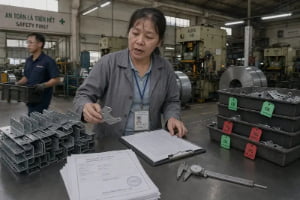
During a supplier audit in Vietnam last year, our team rejected a stamping shop with beautiful sample parts. Their process controls were the problem—no first-article discipline, no die maintenance records 4. Samples lie; systems don't.
Overseas stamping suppliers can match domestic quality, but only with disciplined oversight: supplier audits, PPAP, in-process controls, and final inspection. Without local eyes on the process, quality escapes are found late, and lead times of 90–180 days versus 2–6 weeks domestically amplify every mistake.

Quality is not a nationality. I have seen excellent presses in Asia and sloppy ones in the West. What changes with distance is your ability to catch problems early. That is the honest core of this debate.
Why Distance Multiplies Quality Risk
Think about a stamped bracket with a slightly oversized oval slot. In a domestic shop, an engineer drives over, checks the die, and the issue dies the same week. In an offshore shop with no oversight, that bracket ships. It sits on the ocean for five weeks. It clears customs. Then your customer's assembly line finds the problem. Now you have a container of scrap, a line-down claim, and a 90-day wait for replacements.
This is why our model puts a local team between the buyer and the factory. Our Vietnam office handles supplier audits, PPAP submissions 5, process control checks, and final inspection before anything gets loaded. We aim for "right first time" because with ocean transit, there is no affordable second time.
Delivery Reliability Compared
| Factor | Domestic | Overseas (Unmanaged) | Overseas (With Local QC Partner) |
|---|---|---|---|
| Typical lead time | 2–6 weeks | 90–180 days | 60–120 days, more predictable |
| Defect detection | At the source, fast | Often at receiving, too late | At final inspection, before shipping |
| Root-cause resolution | Days | Weeks to months | Days, via on-site engineers |
| Delivery variability | Low | High (customs, port congestion) | Moderate, actively managed |
The pattern is clear. Overseas quality and delivery are manageable, but they are not automatic. Buyers who treat an offshore stamping supplier like a vending machine—send drawing, receive parts—get burned. Buyers who invest in audits, PPAP discipline, and pre-shipment inspection can get near-domestic quality at overseas prices. The cost of that oversight must be counted in the landed cost, but it is far cheaper than a rejected container.
What Communication and Project Management Challenges Should I Expect When Sourcing Stamping Parts Overseas?
Early in my career, a single ambiguous tolerance callout on a flange bend cost a client three weeks. The factory read the drawing one way. The engineer meant another. Nobody asked. Everybody paid.
Expect time-zone gaps that slow answers by a full day, language barriers that blur tolerance and material callouts, and slower engineering-change cycles. Small drawing ambiguities become expensive after production starts, so overseas stamping projects need structured project management, written confirmations, and bilingual technical staff.

Communication problems rarely look dramatic. They look like a question answered a day late, a note on a drawing skipped, a bend radius assumed instead of confirmed. Then they compound.
Where Overseas Communication Breaks Down
In our experience running custom-parts programs between U.S. engineers and Asian factories, friction concentrates in four spots:
- Drawing interpretation. Datum schemes, GD&T symbols 6, and material grade equivalents get misread. A U.S. steel spec may have several "close" Asian equivalents, and the wrong pick changes formability and finish.
- Time-zone lag. A question asked Monday morning in Ohio gets answered Tuesday morning at best. A five-question clarification loop can burn a full week.
- Engineering changes. Mid-program revisions—say, moving a punched hole or tightening a flatness spec—travel slowly through language and hierarchy. Domestic shops turn these in days; unmanaged offshore shops can take weeks.
- Silent assumptions. Some factories will not flag a problem they think they can "work around." You discover the workaround at incoming inspection.
How We Bridge the Gap
Our answer is a bilingual technical team sitting in the same time zone as the factory. Our engineers in Vietnam and China review every drawing before quoting, flag ambiguities, and issue a written specification confirmation the factory signs. During production, we hold the factory to a milestone plan: material verification, first article 7, in-process checks, final inspection. The U.S. buyer emails once, in English, and gets consolidated answers—usually within one business day, because someone on our side is awake when the factory is running.
Concise, proactive email updates matter more than buyers admit. Conservative purchasing managers do not want daily calls. They want to know that milestones are on track, and to hear about problems early, with a proposed fix attached. That is a management discipline, not a language skill.
How Do Payment Terms and Cash Flow Differ Between Domestic and Overseas Stamping Suppliers?
A U.S. purchasing manager once told me his real constraint wasn't price at all. It was cash. His domestic supplier offered net 60; his offshore quotes demanded 30% deposits. That gap shaped his whole sourcing strategy.
Domestic stamping suppliers commonly extend net 30–60 credit terms with no deposit. Overseas suppliers typically require 30–50% deposits with balance before shipment, tying up cash for months during production and transit. Trading partners offering open-account terms can close this gap for importers.

Cash flow is the quiet factor in the domestic-versus-overseas debate. It rarely appears in a cost comparison spreadsheet, yet it can matter as much as unit price for a growing importer.
The Cash Cycle, Side by Side
| Stage | Domestic Supplier | Direct Overseas Supplier | Through a Trading Partner with Credit Terms |
|---|---|---|---|
| Order placement | No deposit | 30–50% deposit upfront | Often no deposit |
| Production (4–8 weeks) | No cash out | Deposit locked up | No cash out |
| Pre-shipment | No payment yet | Balance due before loading | No payment yet |
| Transit (4–6 weeks ocean) | N/A | Full payment already made | Goods financed by partner |
| After receipt | Pay net 30–60 | Cash already gone | Pay on 60–90 day terms |
Look at the middle column. With direct offshore sourcing, you may pay 100% of the invoice six to ten weeks before the parts reach your dock—and months before you invoice your own customer. On a large stamping program, that is serious working capital sitting on the water.
Domestic suppliers flip that equation. You receive parts, inspect them, put them into production, and often collect from your customer before your supplier invoice is due.
This cash-flow gap is one reason our business model includes open-account terms for qualified clients. We pay the Asian factories on their terms, carry the financing through production and transit, and let U.S. buyers pay on 60–90 day terms after shipment. The buyer gets overseas pricing with something close to domestic payment behavior. There is also a risk dimension: a deposit paid to an unvetted offshore factory is leverage lost. If quality disputes arise, the party holding your money holds the cards. Credit terms, backed by pre-shipment inspection, restore that leverage to the buyer.
Conclusion
The cheapest quote is rarely the cheapest supplier. Delays, defects, and locked-up cash punish price-only decisions. Weigh landed cost, quality oversight, communication, and payment terms—then choose the model that fits your parts, not just your budget.
Footnotes
1. World Bank trade resources support the total landed cost analysis framework described. ↩︎
2. Authoritative source on tariff policy shifts that


 English
 Español de México
 Deutsch
 Français
 Русский
 العربية
Leave a Comment
Your email address will not be published. Required fields are marked *