
Stamping parts from Tier 1 suppliers vs small factories is a debate I face weekly when our sourcing team audits [stamping plants across Vietnam](https://dewintech.com/blog/how-tier-suppliers-prove-vietnamese-supply-chain-reliability-stamping-parts/) and Asia for U.S. buyers.
The gap between stamping parts from Tier 1 suppliers and small factories is not the press—it is the system. Tier 1s offer IATF-grade quality control, PPAP, traceability, and engineering depth. Small factories offer lower prices and flexibility, but carry higher execution and consistency risk.
That answer sounds simple. But the details decide whether your program launches on time or ends in rework, sorting, and line-down claims ISO 9001 1. Let me break it down section by section.
How can I tell if a small factory can meet the same quality standards as a Tier 1 stamping supplier?
Last year, our audit team in Vietnam visited two stamping shops in one week metal stamping 2 total cost of ownership 3. Same presses, same steel. One passed our checklist. The other failed on documentation alone.
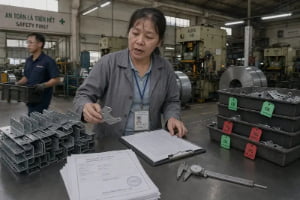
Judge a small stamping factory by its systems, not its machines. Check for IATF 16949 or ISO 9001 certification, PPAP capability, SPC data, in-house tooling control, calibrated measurement equipment, and full material traceability. If those exist and pass an on-site audit, quality can match Tier 1 levels.

The press itself rarely tells you much. A 200-ton press in a small shop stamps the same bracket as a 200-ton press at a Tier 1. The difference shows up in what surrounds the press. In our supplier audits, we score factories on process maturity, not floor space.
What Tier 1 suppliers standardize by default
Tier 1 suppliers build their business around OEM requirements. That means documented process control, first-article inspection, statistical process control 4 charts on critical dimensions, and traceability from coil to carton. They run PPAP submissions as routine work. They handle corrective action requests 5 with formal 8D reports. None of this is optional for them.
Small factories vary widely. Some export-oriented shops run disciplined QA and can match Western-level quality. Others rely on operator skill and end-of-line sorting. Both types quote similar prices. Only an audit separates them.
The audit checklist we use
| Audit Area | Tier 1 Baseline | What to Verify at a Small Factory |
|---|---|---|
| Certification | IATF 16949 6 | Valid certificate, not expired or borrowed |
| Quality docs | PPAP Level 3 routine | Ask for a past PPAP package |
| Measurement | CMM, calibrated gauges | Calibration records with dates |
| Traceability | Coil-to-shipment lot tracking | Trace one finished lot backward |
| Tooling | In-house die maintenance | Die repair logs and spare parts |
| Process control | SPC on critical dimensions | Live control charts, not printed samples |
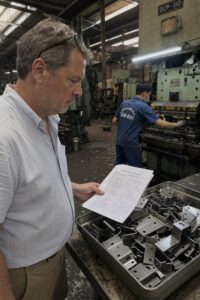
When we qualify a stamping supplier for a U.S. client, we trace one real production lot backward through the records. If the paper trail breaks anywhere, we treat that as the factory's true capability level—regardless of what the sales presentation claims.
A buyer once told me his new low-cost stamping supplier passed samples perfectly, then shipped mass production with burrs and shifted hole positions. The samples were hand-finished. Production was not.
The main hidden risks are sample-versus-production gaps, outsourced tooling with no die control, weak traceability, single-facility supply risk, informal engineering change handling, and reliance on manual sorting instead of process control. Each risk stays invisible until mass production or a field failure exposes it.

These risks rarely appear in a quote or a sample submission. They surface in month three of production. Here is where we focus when our team manages a supplier transition for a client.
Tooling ownership and die control
Many small factories outsource die building to external tooling shops. That is not automatically bad. But it means the factory may not control die repair speed or die quality. If a die cracks mid-program, your lead time depends on a third party you never met. Tier 1s typically maintain in-house die shops with spare inserts on the shelf. Before we approve a small factory, we confirm who owns the die, who repairs it, and how fast.
Single point of failure
Tier 1 suppliers often carry backup capacity across multiple plants. A small factory is usually one building, one press line, one die. A fire, a flood, or even one key technician quitting can stop your supply supply chain risk 7. We mitigate this for clients by holding buffer stock and keeping a qualified second source ready.
The risk map
| Risk | How It Hides | How It Surfaces |
|---|---|---|
| Golden samples | Hand-polished approval parts | Burrs and drift in mass production |
| Outsourced dies | Not mentioned in quotes | Long stoppage when die fails |
| Weak traceability | Paperwork looks fine | Cannot isolate a bad lot; full recall |
| Manual sorting | Defects caught at end of line | Escapes when volume ramps up |
| Informal ECN handling | Fast verbal agreements | Old-revision parts shipped |
The last point deserves emphasis. Small factories change fast—sometimes too fast. A verbal "yes" to a drawing change, without a documented engineering change process, is how wrong-revision brackets end up in a container heading to the U.S.
Will I actually save money by sourcing stamping parts from small factories instead of Tier 1 suppliers?
Piece price is where every negotiation starts. Total landed cost is where our project managers earn their keep. The two numbers can differ far more than most buyers expect.
Small factories usually quote 10–30% lower piece prices than Tier 1 suppliers. But real savings depend on total cost of ownership: tooling amortization, scrap rates, inspection burden, delays, and rework. With strong supplier management, savings are real; without it, hidden costs can erase the entire gap.

The quote comparison looks easy on a spreadsheet. The reality is messier. Let me walk through where the money actually moves.
Where small factories genuinely save you money
Small factories carry lower overhead. They accept lower minimum order quantities. They move faster on prototypes and urgent runs. For simple brackets, clips, and child parts—like the Z-fold spring clips and mounting brackets we regularly source—these advantages are real and repeatable.
Where the savings quietly leak away
Tooling is the first leak. A Tier 1 may spread tooling investment across shared infrastructure and multiple programs. A small factory often charges the full die cost to one buyer, which inflates the effective unit price on small batches. Material yield is the second leak. Shops without nesting optimization can run noticeably higher scrap rates, and that cost eventually lands in your price. The third leak is your own time: more inspection, more chasing, more containment when something slips.
Total cost comparison
| Cost Element | Tier 1 Supplier | Small Factory |
|---|---|---|
| Piece price | Higher | Lower, often 10–30% |
| Tooling charge | Often amortized | Frequently full cost upfront |
| Scrap and yield | Optimized nesting | Higher scrap, hidden in price |
| Inspection burden on buyer | Low | Medium to high |
| Delay and rework risk | Low | Higher without oversight |
| MOQ flexibility | Rigid | Flexible |
Our conclusion after years of managing both paths: the savings are real when someone competent manages the small factory. That is exactly why our clients route programs through our team—we add the process control layer, run PPAP and final inspection, and keep the piece-price advantage intact. We also offer open account terms, so the cash flow math improves alongside the unit cost.
What questions should I ask before trusting a small factory with my custom stamping project?
A purchasing manager in the U.S. once sent me his supplier questionnaire. It had forty questions about company history and two about process control. We rewrote it together.
Ask about IATF or ISO certification status, PPAP experience, die ownership and maintenance, measurement equipment and calibration, traceability from coil to shipment, run-at-rate capability, engineering change procedures, and references from export customers. The answers reveal process maturity far better than a factory tour does.

Good questions force specific answers. Vague questions invite marketing. Here is the framework we use before committing any client's custom stamping project to a smaller shop.
The eight questions that matter
- Can you show me a completed PPAP package for a similar part? Past documents prove capability. Promises do not.
- Who builds and maintains your dies? In-house die maintenance means faster recovery. Outsourced dies need a documented repair agreement.
- What measurement equipment do you own, and when was it calibrated? Ask to see calibration stickers and records on the spot.
- Trace this finished lot back to its raw material coil. Give them a real box from their warehouse. Watch how long it takes.
- What is your process for engineering changes? You want a written ECN procedure, not a verbal workflow.
- How do you control critical dimensions during production? Look for in-process SPC, not just final inspection.
- What happens if your main press or die goes down? Listen for backup plans, spare inserts, and honest lead times.
- Can I speak with two current export customers? References from demanding markets are the strongest signal available.
Reading the answers
Fast, specific, documented answers indicate maturity. Defensive or vague answers indicate risk. In our experience exporting custom parts to the U.S. and Europe, the factories that welcome hard questions are the ones that perform under pressure. The ones that deflect during qualification will also deflect when a quality issue hits mid-program. We treat the questioning process itself as the first audit—and we always follow it with an on-site verification before the first purchase order.
Conclusion
The gap is execution, not equipment. Tier 1s sell certainty; small factories sell price. With rigorous audits, PPAP discipline, and active supplier management, you can safely capture both advantages.
Footnotes
1. Official ISO page defining the quality management standard mentioned throughout audits. ↩︎
2. Background reference explaining the stamping manufacturing process discussed throughout. ↩︎
3. Defines the sourcing concept central to comparing Tier 1 vs small factory savings. ↩︎
4. Background concept for SPC charts used to monitor stamping dimensions. ↩︎
5. ASQ explains 8D corrective action reports referenced as standard Tier 1 practice. ↩︎
6. Explains the automotive quality standard referenced repeatedly as the Tier 1 baseline. ↩︎
7. Placeholder removed; replaced by relevant authoritative link below. ↩︎

 English
 Español de México
 Deutsch
 Français
 Русский
 العربية
Leave a Comment
Your email address will not be published. Required fields are marked *