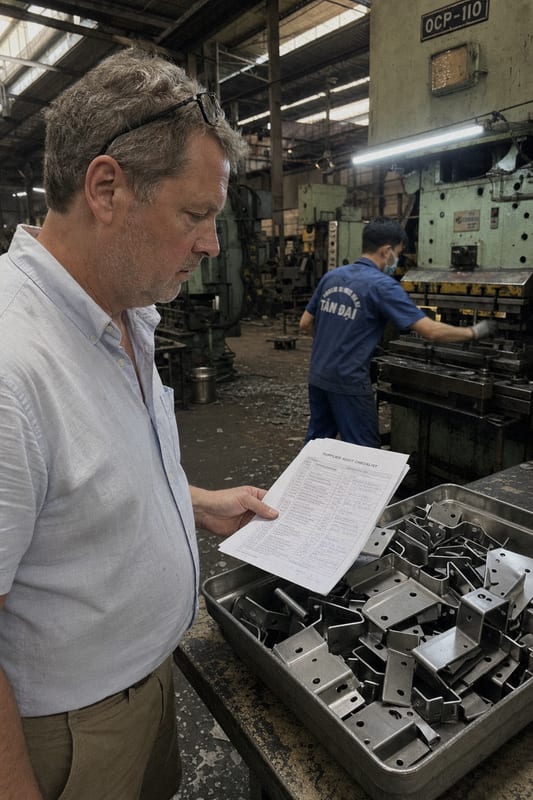
Verifying a supplier’s production flexibility for small-batch OEM stamping orders 1 is where our sourcing team spends most of its audit hours. Almost every factory claims “flexible MOQ 2.” Few can prove it. If you send a PO based on a marketing claim, you inherit late deliveries, out-of-spec brackets, and rework bills. I have seen a 500-piece clip order sit behind a mass-production job for six weeks. The fix is a repeatable verification process, and that is exactly what I will walk you through here.
To verify a supplier’s production flexibility for small-batch OEM stamping, confirm their actual MOQ policy, request quotes for pilot and repeat lots, review die changeover times and tooling strategy, inspect first-article and short-run quality data, and check on-time delivery records from comparable low-volume programs.
Flexibility is not a promise. It is a mix of equipment, changeover speed, tooling strategy, and proof from similar jobs. Let’s break down how to test each one before you sign anything.
What questions should I ask suppliers to confirm their small-batch stamping capabilities?
During a factory audit near Hai Phong last year, I asked one simple question that ended the visit early: "Which press will run this bracket?" The sales manager could not answer. Our audit checklist exists because vague answers like that predict real problems later.
Ask suppliers which specific press, die type, and process route will run your part, their real MOQ range, typical setup and changeover time, small-batch lead times, and for first-article inspection reports from comparable low-volume stamping jobs. Specific answers signal genuine capability; vague ones signal risk.

The goal of these questions is simple. You want to separate suppliers who have a real low-volume workflow from suppliers who only tolerate small orders when their big presses are idle. In my experience auditing stamping shops in Vietnam and across Asia for U.S. clients, the difference shows up fast when you ask for specifics.
The questions that expose real capability
Do not ask, "Can you do small batches?" Every supplier says yes. Instead, ask questions that require operational detail. Here is the core list I use, organized by what each question actually reveals.
| Question to ask | What a strong answer looks like | What it tells you |
|---|---|---|
| Which press (tonnage, bed size) will run my part? | A specific machine, matched to your drawing | They have studied your part, not just your budget |
| What is your typical die changeover time 3? | A concrete figure, ideally under an hour | Short setups make small runs economical |
| What is your MOQ, and is tooling priced separately? | A clear range plus itemized tooling cost | Transparent low-volume pricing model |
| Have you run 100–1,000 piece stamping lots before? | Named part types, inspection reports available | Proven short-run process control |
| Who handles engineering questions, and how fast? | A named engineer, response within 1–2 days | Responsiveness for design iterations |
| Do you have an in-house tool and die shop? | Yes, with modification lead times stated | Fast die repairs without outsourcing delays |
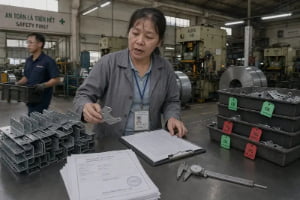
For the stamped brackets and Z-profile spring clips we source, tolerances on bend angles and hole positions matter. So I always add one more question: "How do you inspect bend angle and hole location on a 200-piece run?" A supplier with real small-batch discipline will describe first-article inspection 4, in-process checks, and a final dimensional report without hesitation. A supplier without it will talk about their biggest customer instead. That deflection is your answer.
How can I verify a supplier's minimum order quantity flexibility before signing a contract?
A buyer in Texas once forwarded me a quote that advertised "No MOQ!" in bold letters. When we requested pricing for a 300-piece pilot lot of galvanized mounting clips, the per-unit price came back at nearly six times the volume rate, with tooling buried inside it. That is not flexibility. That is a penalty disguised as a policy.
Verify MOQ flexibility by requesting three quotes at once: a pilot lot, a repeat lot, and a larger follow-on lot. Genuine flexibility shows separated tooling costs, sensible price scaling across volumes, and written lead times for each quantity tier before contract signing.

The three-quote test is the most reliable tool I know. It forces the supplier to show you their cost structure instead of a slogan. When our team runs this test for U.S. clients, we look for four things in the responses.
What the three-quote test reveals
First, tooling separation. A flexible supplier itemizes die cost apart from piece price. This matters because you own the amortization decision. If tooling is hidden inside the unit price, you cannot compare quotes and you cannot negotiate reorders fairly.
Second, price curve logic. Unit prices should fall as volume rises, but the pilot-lot premium should be reasonable. Setup, material handling, and inspection overhead justify a higher small-lot price. A five-fold jump does not. It usually means the supplier is pricing you out politely.
Third, lead-time honesty. Small batches often ship faster than mass production, but only if the supplier's scheduling system supports quick job insertion. Ask for lead times per tier in writing.
Fourth, reorder terms. Confirm in the contract how approved dimensions, inspection criteria 5, packaging, and drawing revisions carry over to repeat orders. Small-batch buyers reorder often. If every reorder restarts negotiation, your "flexible" supplier becomes an administrative burden.
One more contract point I insist on: put the MOQ range and pilot-lot terms into the agreement itself, not the email thread. Verbal flexibility evaporates when the factory gets busy. Written flexibility survives.
What red flags indicate a supplier can't handle my low-volume OEM stamping needs?
The hardest lesson our team learned came from a program we rescued, not one we started. A U.S. engineering firm came to us after their previous stamping vendor shipped two consecutive lots of brackets with drifting slot positions. Every warning sign had been visible in the original quotes. Nobody had looked.
Red flags include vague MOQ answers, refusal to separate tooling from piece price, no first-article or inspection data from short runs, only mass-production references, unverifiable lead-time promises, and inability to name the press or die that will produce your specific part.

Red flags rarely appear alone. In our supplier audits across Vietnam and other Asian manufacturing regions, weak answers tend to cluster. If you spot two or more of the signals below, slow down and dig deeper before committing.
The red flag checklist
| Red flag | Why it matters | How to test it |
|---|---|---|
| Cannot name the press or process route for your part | No real engineering review happened | Ask for a process flow for your drawing |
| Tooling cost bundled into unit price | Hides economics; blocks fair reorders | Request itemized quotation |
| No short-run inspection records | Quality control may only exist at volume | Ask for FAI reports from a 100–1,000 piece job |
| Only mass-production references | Their scheduling favors big customers | Request two low-volume client references |
| Quoted lead times with no delivery history | Attractive numbers, no proof | Ask for on-time delivery data across past orders |
| Certificate copy without site scope | Certification may not cover your process | Verify ISO 9001 scope at the actual plant |
| Slow, vague engineering responses at RFQ stage | Communication will worsen after PO | Track response time and technical depth |
That last row deserves emphasis. The RFQ stage is the best behavior you will ever see from a supplier. If drawing questions go unanswered for a week before you place an order, they will go unanswered for two weeks after. Critical drawing requirements get missed exactly this way, and a missed bend tolerance on a stamped clip means a full lot of scrap, not a quick fix. I treat pre-order responsiveness as a quality metric, because in practice, it is one.
How do I evaluate a supplier's tooling and changeover process for small-batch production runs?
There is a trade-off I weigh on nearly every stamped-part project we manage: hard progressive tooling delivers the lowest piece price, but a modular or staged tooling approach protects the client when the design is still moving. Getting a supplier to discuss this trade-off openly is itself a flexibility test.
Evaluate tooling and changeover by asking about quick-change or modular die systems, measured die changeover times, in-house tool and die capability, and support for pilot tooling that can evolve into production tooling. Short, documented changeovers are the clearest indicator of small-batch readiness.

Tooling strategy determines whether your small-batch program 6 stays affordable through design changes and reorders. When our engineers review a stamping supplier for a bracket or spring-clip program, we evaluate three layers: the tooling itself, the changeover process, and the path from prototype to production.
Match the tooling strategy to your volume stage
Different tooling suits different program phases. A flexible supplier can explain which option fits your current stage and what the upgrade path looks like.
| Tooling approach | Best for | Flexibility benefit | Watch out for |
|---|---|---|---|
| Soft or pilot tooling | Prototypes, trial lots | Fast, cheap design iterations | Limited tool life |
| Modular or quick-change dies | Repeat small batches | Fast swaps between part variants | Slightly higher piece cost |
| Staged tooling refinement | Growing programs | Upgrade without full retooling | Requires supplier engineering depth |
| Hard progressive dies | Confirmed high volume | Lowest unit cost at scale | Expensive to modify after design changes |
Probe the changeover discipline
Ask for the supplier's measured die changeover time 7, not an estimate. Shops practicing quick-changeover methods can usually quote a number and show how they achieved it: standardized die heights, pre-staged tooling carts, dedicated setup teams. Then ask how many changeovers they perform in a typical week. A shop that changes dies daily has a rhythm for it. A shop that changes dies monthly will treat your small order as a disruption.
Confirm the prototype-to-production path
Finally, verify that the same supplier can carry your part from a single sample, through a 100-piece trial, into repeat production. Switching vendors mid-program is where dimensions drift and schedules collapse. On our projects, we lock the approved first article, the inspection criteria, and the tooling maintenance plan before the pilot lot ships, so every reorder starts from a controlled baseline rather than a fresh negotiation.
Conclusion
Claimed flexibility loses money; verified flexibility protects your program. Test MOQ with three-tier quotes, demand changeover data, inspect short-run quality evidence, and put every commitment in writing before your first PO.
Footnotes
1. Alibaba.com is a leading B2B sourcing platform relevant to OEM stamping procurement decisions. ↩︎
2. Explains the minimum order quantity concept buyers must verify before trusting supplier claims. ↩︎
3. SMED methodology directly explains how manufacturers achieve fast, documented die changeovers. ↩︎
4. Background on the quality verification process referenced as proof of short-run capability. ↩︎
5. ISO 9001 defines quality management practices underlying inspection criteria and reorder consistency. ↩︎
6. WTO trade facilitation resources support efficient small-batch manufacturing and cross-border sourcing programs. ↩︎
7. SMED methodology explains how manufacturers achieve fast, documented die changeovers. ↩︎


 English
 Español de México
 Deutsch
 Français
 Русский
 العربية
Leave a Comment
Your email address will not be published. Required fields are marked *