
Trying to [negotiate MOQ with suppliers for small orders of stamping parts](https://dewintech.com/blog/how-negotiate-moq-suppliers-small-batch-stamping-parts-orders/) can feel impossible. Our sourcing team hears this frustration weekly. High minimums stall projects, drain cash, and kill prototypes before launch.
To negotiate MOQ with suppliers for small orders of stamping parts, first ask why the minimum exists, then offer targeted concessions: a higher unit price, upfront payment, a blanket order with scheduled releases, consolidated SKUs, or a material buyout. Frame the order as a trial with credible reorder potential.
MOQ is rarely a fixed wall. It is a business problem with several levers. Below, I walk through each lever, section by section, based on real sourcing projects across Asia.
How can I convince a stamping supplier to lower their standard MOQ for my small order?
Last year, a U.S. client asked our Vietnam office to source 800 pieces of a zinc-plated Z-clip. The supplier's stated MOQ was 5,000. We closed the gap by understanding their cost math first.
Convince a stamping supplier to lower MOQ by uncovering the real cost driver behind it — setup, material minimums, or scheduling — then removing that pain. Explain your first-order risk, show a realistic reorder forecast, and offer a concession that protects the supplier's economics, not just your budget.

Suppliers do not set MOQs to annoy buyers. They set them because small stamping runs carry heavy fixed costs. When I sit in changeover meetings at partner factories in Vietnam, I see it firsthand. A press changeover can eat hours of skilled labor. The die must be mounted, aligned, and trialed. First-article inspection 1 takes the same time whether the run is 500 pieces or 50,000.
Understand the MOQ drivers first
Before you negotiate anything, ask the supplier one simple question: "What drives your MOQ for this part?" The answer changes your whole strategy. Here are the common drivers and what each one means for you.
| MOQ Driver | Why It Exists | Your Best Counter-Move |
|---|---|---|
| Die setup and changeover | Fixed labor hours per run | Offer a setup fee or higher unit price |
| Material purchase minimums | Steel mills sell coil in minimum lots | Buy the full material lot upfront |
| Inspection and QC overhead | First-article checks cost the same at any volume | Accept a simplified inspection plan for the trial |
| Production scheduling | Small jobs disrupt press utilization | Offer flexible delivery timing |
| Packaging minimums | Custom cartons have their own MOQ | Use standard packaging |
Build credibility before asking
A lower MOQ is a favor. Suppliers grant favors to buyers they trust. So show them a forecast, even a rough one. Share your product roadmap. Send a professional purchase order with clear drawing revisions and tolerances. In our experience managing PPAP 2 submissions for U.S. clients, suppliers bend far more for buyers who look organized. A sloppy RFQ signals a one-time order. A clean one signals a program.
Also, timing matters. We have won MOQ concessions simply by placing trial orders during a supplier's slow season, when open press capacity made a small run attractive rather than disruptive.
What negotiation strategies work best when I need custom stamping parts below the supplier's minimum quantity?
A purchasing manager once told me his previous supplier simply replied "MOQ is MOQ" to every request. When our team took over the project, we reframed the conversation around deal structure — and got the run approved in one week.
The best strategies are: propose a pilot run at 30–70% of stated MOQ, structure a blanket order with scheduled releases, consolidate multiple part numbers into one PO, request an itemized cost breakdown to isolate the true constraint, and always offer a concession in exchange.

Negotiation works when both sides gain something. So never ask for a lower MOQ empty-handed. Instead, pick from a menu of deal structures and match one to the supplier's real constraint.
The five deal structures that actually work
- Pilot run with a growth path. Ask for a trial batch, typically 30–70% of the stated MOQ. Frame it as market validation before a larger release. Suppliers accept this because it signals future volume, not a dead-end order.
- Blanket order with scheduled releases. Commit to the full MOQ on paper, but take delivery in smaller shipments over six or twelve months. The supplier gets their production economics. You get manageable cash flow and inventory.
- SKU consolidation. If you need several related brackets or clips, negotiate one combined MOQ across the part family. Shared material and similar setups make this attractive to the factory.
- Material buyout. If coil minimums drive the MOQ, offer to pay for the full material lot upfront while releasing production in stages. The supplier's risk disappears.
- Itemized cost breakdown. Request a split of tooling, setup, material, and labor. Once costs are visible, you can pay for the specific burden — like a one-time setup fee — instead of absorbing it through volume.
Match the strategy to the situation
| Your Situation | Best Strategy | Why It Works |
|---|---|---|
| Testing market demand | Pilot run at partial MOQ | Supplier sees future volume |
| Steady demand, tight cash | Blanket order with releases | Supplier keeps run efficiency |
| Multiple similar parts | SKU consolidation | Setup costs are shared |
| Custom material required | Material buyout | Removes supplier's inventory risk |
| Unclear pricing | Cost breakdown request | Reveals the true lever to negotiate |
One caution from our project files: a trial order does not fix structural cost problems. If your part needs an uncommon alloy or a complex progressive die, someone must still pay for that setup. Be ready to fund it directly.
Should I offer higher unit prices or longer-term commitments to reduce MOQ requirements for stamping parts?
There is a trade-off I weigh on almost every low-volume quote our team prepares: pay more per piece now, or promise more volume later. Neither answer is always right, and picking wrong can cost real money.
Offer a higher unit price when you need speed and have no reliable forecast; offer a longer-term commitment when your demand is credible and documented. Many suppliers accept 10–30% price premiums for small runs, but always compare total program cost, not just batch size.

Both levers work. The question is which one fits your situation, and what each one really costs you.
When a higher unit price makes sense
A price premium is clean and fast. The supplier recovers their setup burden immediately. There is no future obligation to track. This suits prototypes, market tests, and one-off replacement parts. But watch the math. A lower MOQ at a much higher piece price can be worse overall than accepting the full MOQ. I have seen buyers pay a 40% premium for a half-size run when carrying the extra inventory would have cost them less. Always calculate total landed cost 3 per usable part, including storage.
When a long-term commitment makes sense
A volume commitment costs nothing today, but it costs credibility if you miss it. Suppliers remember broken forecasts. In our sourcing work across Vietnam and China, we advise clients to commit only to volumes they can defend with real data — an existing customer contract, historical sales, or a signed program award. A written commitment backed by evidence often unlocks MOQ flexibility that vague promises never will.
Compare the two levers
| Factor | Higher Unit Price | Long-Term Commitment |
|---|---|---|
| Cash impact today | Higher | Lower |
| Risk to supplier | None | Forecast risk |
| Best for | Trials, prototypes | Recurring production |
| Trust required | Low | High |
| Danger | Overpaying vs. full MOQ | Damaged credibility if missed |
There is a third option worth naming: hybrid offers. Pay a modest premium on the pilot run, with written price step-downs tied to future volumes. On several of our OEM co-development projects, this structure got a "no" turned into a "yes" because the supplier saw both immediate protection and future upside. Whatever you agree, put it in the purchase order. Verbal MOQ concessions have a way of evaporating at order confirmation time.
How do I find Asian stamping suppliers who are willing to accommodate small-batch orders without sacrificing quality?
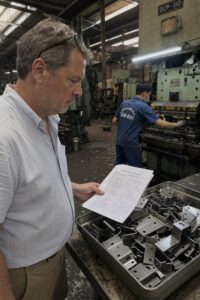
During a supplier audit near Hanoi, I watched a mid-sized job shop run a 600-piece bracket order between two larger jobs — with full first-article inspection. That visit taught me that supplier selection matters more than negotiation skill.
Find small-batch-friendly Asian stamping suppliers by targeting job shops and low-volume specialists rather than high-volume factories, auditing their QC processes before ordering, starting with a paid pilot batch, and using sourcing partners with local teams who can verify capability and inspect on the ground.

Not every factory wants your small order, and that is fine. Your job is to find the ones structured for it. High-volume automotive stampers live on million-piece progressive-die runs 4. A 1,000-piece bracket order disrupts them. Job shops, prototype specialists, and mid-tier factories with mixed press lines see the same order as normal business.
Where to look and what to check
Start on Google and Alibaba 5, but do not stop at the listing. Ask direct questions: What is your typical batch size? How many changeovers do you run per week? Can you share a first-article inspection report from a recent small run? A factory that handles frequent changeovers has the discipline your small order needs.
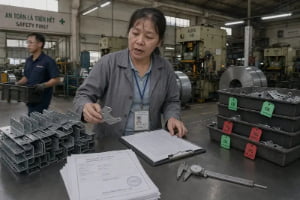
Then verify. Our team runs supplier audits 6 across Vietnam, Taiwan, and India for U.S. clients, and the pattern is consistent: capable small-batch suppliers show organized die storage, documented setup procedures, and calibrated measurement tools on the shop floor. Factories that resist an audit, or cannot produce inspection records, usually fail on quality later — regardless of what they promise on MOQ.
A practical vetting sequence
- Shortlist suppliers who mention prototyping, low-volume, or job-shop stamping.
- Request an itemized quote to confirm they understand small-run economics.
- Order paid samples with a full dimensional report against your drawing.
- Audit the factory, in person or through a local partner.
- Place a pilot batch with defined PPAP or first-article requirements.
- Scale only after the pilot passes final inspection.
One more honest note. For very low volumes — say under a few hundred pieces — stamping economics may never work. Laser cutting plus press-brake bending, or CNC machining 7, can deliver the same bracket geometry with zero die cost. We regularly recommend this route for pilot quantities, then transition clients to hard tooling once volumes justify it. Quality does not have to suffer at low volume, but only if you pick suppliers built for it and hold them to a written inspection standard.
Conclusion
High MOQs can stall your project and strain your cash. But minimums are negotiable when you understand supplier economics. Ask why, offer real concessions, choose the right partners, and document everything.
Footnotes
1. Explains the quality verification process referenced repeatedly for small stamping runs ↩︎
2. Wikipedia reference clarifies the industry-standard approval process mentioned for pilot batches ↩︎
3. Wikipedia background on the cost calculation concept used to compare pricing options ↩︎
4. Defines the die stamping process central to MOQ and setup cost discussion ↩︎
5. Named sourcing platform where buyers start researching small-batch stamping suppliers ↩︎
6. ISO provides standards context for the supplier quality audit process described ↩︎
7. Background on the alternative manufacturing method suggested for very low volumes ↩︎

 English
 Español de México
 Deutsch
 Français
 Русский
 العربية
Leave a Comment
Your email address will not be published. Required fields are marked *