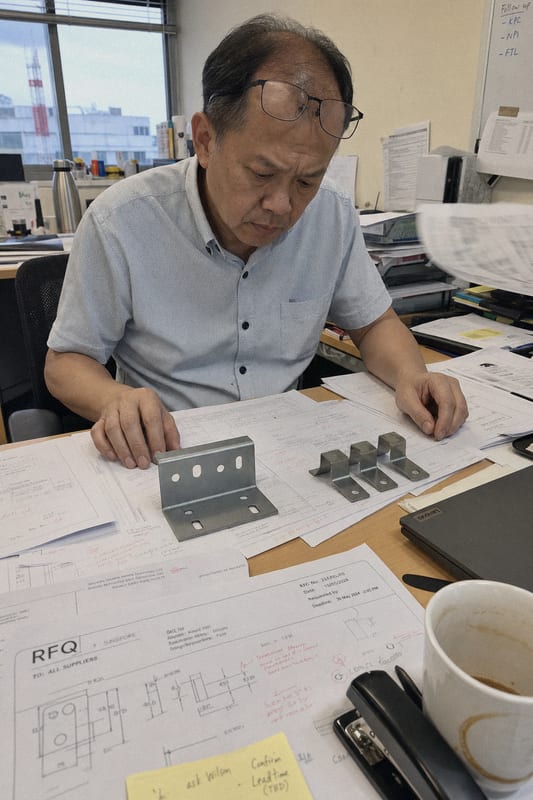
Choosing between a contract manufacturer vs OEM for stamping parts confuses many buyers design for manufacturability 1. I see this weekly when our sourcing team reviews new bracket RFQs from U.S. clients.
A contract manufacturer is better when you already own the stamping part design and need production to your exact drawings. An OEM-style partner is better when you need design input, DFM support, or co-development. The real deciding factors are design ownership, tooling control, and quality responsibility.
The label matters less than the details behind it ISO 9001 2. Let me break down what each model really means for your stamped parts, your tooling money, and your risk.
What's the real difference between a contract manufacturer and an OEM partner for my stamping projects?
Last quarter, a purchasing manager sent our Singapore office an RFQ titled "OEM stamping brackets." His drawings were complete. What he actually needed was contract manufacturing, and that distinction changed his quote.
A contract manufacturer produces stamped parts strictly to your drawings, specs, and tolerances, while you keep the design and IP. An OEM-style partner takes deeper involvement in design, engineering, and product development. The terms overlap in practice, so define responsibilities in the contract, not by the label.

The confusion is understandable. Industries use "OEM" inconsistently. In automotive, the OEM is the vehicle brand at the top of the supply chain original equipment manufacturer 3. A tier-2 stamping shop makes brackets for a tier-1 integrator, who ships assemblies to that OEM. But in general sourcing talk, many buyers say "OEM manufacturer" when they simply mean "a factory that builds to my print." Our team in Vietnam handles both types of projects, so we always ask one question first: who owns the drawing?
The core distinction in plain terms
Here is how the two models compare on the points that matter for stamping projects:
| Factor | Contract Manufacturer | OEM-Style Partner |
|---|---|---|
| Design ownership | Customer owns drawings and revisions | Shared or manufacturer-led design input |
| Engineering role | Execute the print as given | DFM, prototyping, process development |
| IP exposure | Lower, if contracts are clear | Higher, unless carefully managed |
| Best fit | Frozen designs, defined tolerances | Products still in development |
| Typical buyer | Sourcing firms, distributors | Brands building new products |
Why the label misleads people
Private-label and white-label models blur the lines further. Some suppliers advertise "OEM/ODM services" as a catch-all. In my experience exporting custom parts to the United States, the safest approach is to ignore the marketing term. Instead, write down who owns the design, who pays for the dies, who approves revisions, and who carries quality responsibility. Those four answers define your relationship far better than any acronym does.
How do I decide whether I need OEM co-development or straightforward contract manufacturing for my parts?
One trade-off I weigh on every new project is design maturity versus speed. A frozen drawing lets us quote tooling in days. A half-finished concept needs weeks of engineering dialogue first.
Choose contract manufacturing when your geometry, material, tolerances, and finish are already fully defined. Choose OEM co-development when you need DFM feedback, prototyping, material guidance, or compliance engineering. If your product's value lies in the part design itself, keep ownership through contract manufacturing.

The decision comes down to a simple question: is your design frozen or still moving? Everything else flows from that answer.
A quick self-assessment
Run through these questions before you send an RFQ:
- Do you have complete 2D drawings with tolerances, material callouts, and finish specs?
- Have the parts been prototyped and validated in your application?
- Do you know the bend radii, grain direction, and burr requirements?
- Is the design likely to change after tooling kickoff?
- Do you need help meeting a regulatory or customer standard?
If you answered yes to questions one through three and no to four and five, straightforward contract manufacturing fits. If you hesitated, you likely need co-development support. There is no shame in that. Many of the stamped brackets we manage started as rough concepts from engineering design firms. Our project team ran DFM reviews, flagged bend-relief issues, adjusted hole-to-edge distances, and only then released tooling. That early work prevented scrapped dies.
The hybrid reality
Here is what many articles miss: the best modern suppliers offer both. You can get DFM input without surrendering IP ownership. When we co-develop a stamping with a client, our standard practice keeps the drawing package under the client's name, with every revision approved in writing. Development help and design ownership are not mutually exclusive. Insist on both. A supplier who demands IP rights in exchange for basic DFM feedback is signaling a problem, not offering value.
Which option gives me better quality control and fewer non-conforming stamped parts?
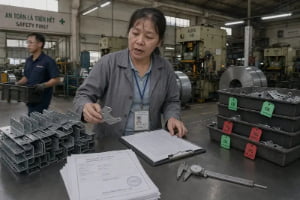
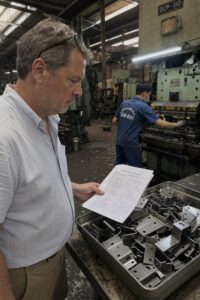
A U.S. client once came to us after a previous supplier shipped three consecutive lots of brackets with oversized slots. The supplier had "read" the drawing but never truly reviewed it. That failure shaped how our QC process works today.
Neither model guarantees better quality by itself. Quality depends on the supplier's certifications, process control, and inspection discipline — not the CM or OEM label. Verify quality system registrations, demand PPAP or first-article reports, and confirm dimensional control, burr limits, and traceability before awarding any stamping program.

Non-conforming stamped parts usually trace back to one of three root causes: a missed drawing requirement, an uncontrolled process, or a skipped inspection. All three are supplier-discipline problems, not business-model problems. That said, the two models do create different quality dynamics worth understanding.
Where each model helps and hurts quality
| Quality Factor | Contract Manufacturing | OEM Co-Development |
|---|---|---|
| Drawing interpretation risk | Higher — supplier only knows the print | Lower — supplier understands design intent |
| Process knowledge | Depends on supplier's stamping depth | Built during development phase |
| Accountability | Clear — conform to print or reject | Can blur if design input was shared |
| Change control | Buyer-driven, formal | Requires tight revision discipline |
| First-article validation | Essential gatekeeping step | Often integrated into development |
What actually prevents non-conforming parts
In our process control work across Vietnam and other Asian facilities, five practices consistently reduce rejects on stamped parts:
- A formal contract review where the supplier confirms every drawing note, not just the dimensions.
- PPAP 5 or first-article inspection with full dimensional reports before production release.
- Defined burr direction and height limits, since stamping always produces a burr side metal stamping 6.
- In-process checks tied to die wear, because punched hole sizes drift as tooling ages.
- Final inspection with documented sampling plans before anything ships.
The critical insight is this: co-development lowers interpretation risk because the supplier understands why each tolerance exists. But contract manufacturing gives cleaner accountability, since conformance to print is black and white. Getting it right the first time requires the discipline layer either way. Ask any candidate supplier to walk you through their last first-article report. Their answer tells you more than their business model does.
Can I get more flexible payment terms and lead times by choosing a contract manufacturer over an OEM?
Payment terms come up in nearly every buyer conversation I have. One purchasing manager told me his previous supplier demanded full payment before shipment on every order, which strangled his cash flow during peak season.
Generally, yes. Contract manufacturers tend to offer more flexible MOQs, faster lead times on frozen designs, and more negotiable payment terms, since they run shared capacity across clients. OEM-style programs often add development cycles and larger upfront tooling commitments. Still, terms are negotiated, not automatic.

Lead time and payment flexibility are where the structural differences between the two models become tangible. Let me unpack both.
Lead time: where the days go
For a stamped bracket with existing drawings, the timeline is mostly tooling and validation:
| Stage | Contract Manufacturing | OEM Co-Development |
|---|---|---|
| Design and DFM | Skipped or minimal | 2–8 weeks |
| Die design and build | 4–8 weeks | 4–8 weeks |
| First-article and approval | 1–2 weeks | 1–3 weeks |
| Production ramp | Fast on shared press lines | Depends on dedicated setup |
Contract manufacturing wins on speed when the design exists, simply because the front end disappears. But note what does not change: die build time. No business model shrinks steel machining. Buyers who need speed should focus on suppliers with in-house die shops and clear approval workflows.
Payment terms as a competitive lever
Payment flexibility varies more by supplier than by model. Many Asian factories still demand deposits plus balance-before-shipment. That structure pushes all cash flow risk onto the buyer. In our own trade business, we offer open account terms 7 to qualified corporate clients precisely because 60–90 day terms are a standard expectation for U.S. purchasing managers. When you evaluate stamping partners, treat payment terms as negotiable and ask early. A supplier confident in their quality is usually more willing to extend credit, because they do not fear rejected shipments becoming payment disputes.
Do not forget the hidden costs
Per-part price comparisons mislead. Build a true total cost picture including NRE fees, secondary operation markups for plating or deburring, freight consolidation, and change-order charges. A cheap unit price with expensive engineering changes can cost more over a program's life than a slightly higher unit price with free revision support.
Conclusion
Neither model wins universally. Contract manufacturing suits buyer-owned stamping designs and IP control; OEM co-development suits products still in engineering. Define design ownership, tooling rights, and quality responsibility in writing — then choose the partner whose model fits your volumes, tolerances, and cash flow.
Footnotes
1. Defines DFM concept discussed extensively as a co-development service. ↩︎
2. Authoritative standard for verifying supplier quality system registrations mentioned in text. ↩︎
3. Background on OEM terminology central to the article’s core distinction. ↩︎
4. WTO reference on IP protections relevant to design ownership risks discussed. ↩︎
5. Explains the industry-standard process referenced for quality validation in stamping. ↩︎
6. Core manufacturing process background for readers unfamiliar with stamping. ↩︎
7. Background on trade finance mechanisms behind payment term flexibility discussed. ↩︎

 English
 Español de México
 Deutsch
 Français
 Русский
 العربية
Leave a Comment
Your email address will not be published. Required fields are marked *